On the 26th, local time, U.S. President Trump suddenly posted on social media platforms that he would raise tariff rates on goods such as South Korean-U.S. cars on the grounds that South Korea‘s parliament had not approved the trade agreement previously reached between the two countries. The presidential office, the South‘s presidential office, responded early on the 27th that the U.S. had not made a formal notification to South Korea about the tariff increase, nor provided any written explanation or detailed explanation. International media believed that the Trump administration has recently repeatedly used tariff threats as a tool of diplomatic pressure, and this erratic tariff operation will not only disrupt world economy and trade, but also cause countries including allies to have doubts about economic cooperation and investment with the U.S.
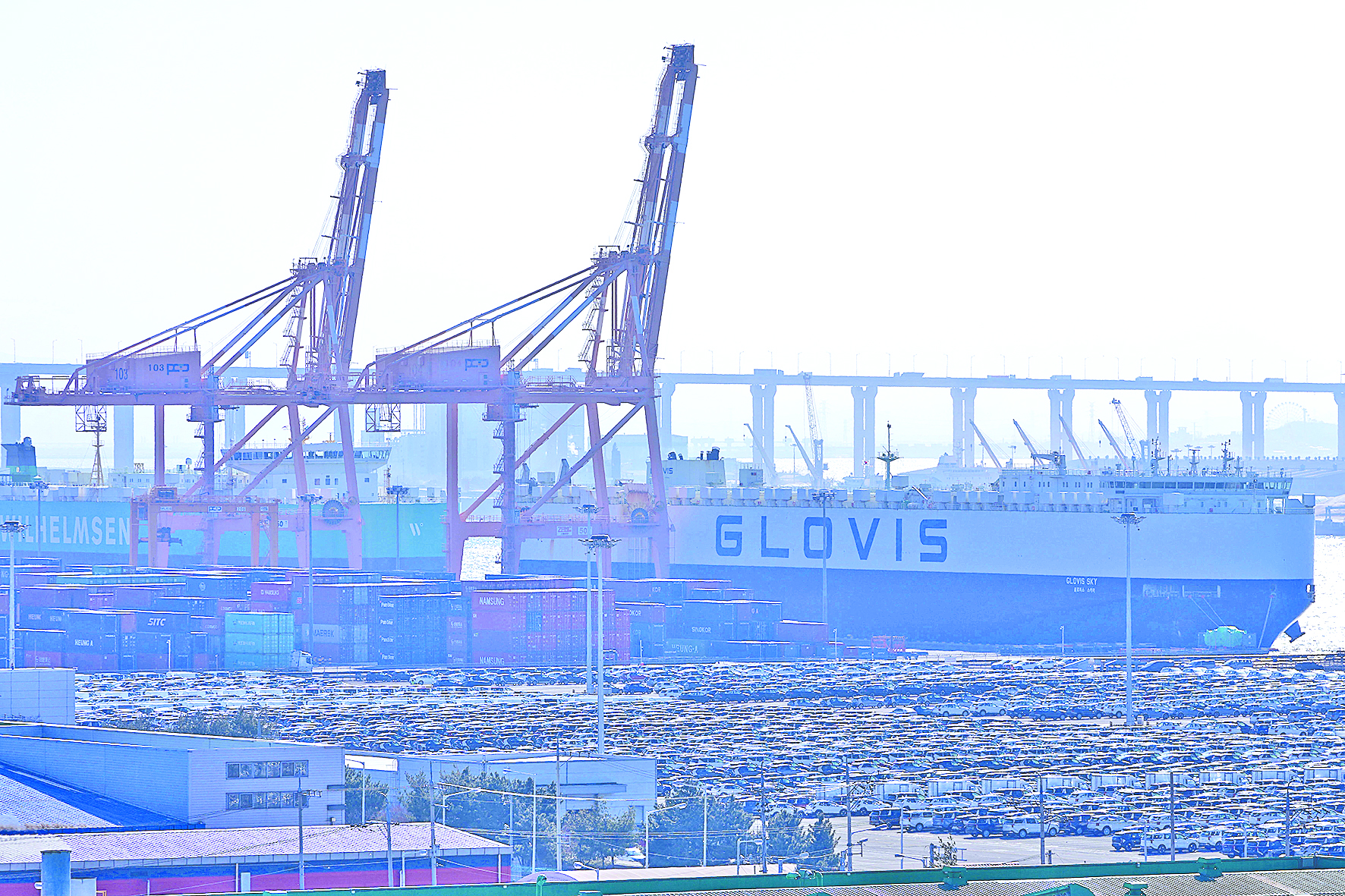
On the 27th, a large number of cars waiting for export were parked in Pyongyang’s port.
“Second Tariff Bomb”
On the 26th, Trump published an article in “Real Social” saying that South Korea‘s legislature “failed to fulfill the agreement reached with the United States.” Given that South Korea has yet to pass this “historically significant trade agreement,” he decided to raise the tax rate on South Korean cars, timber, pharmaceutical products, and all other equivalent tariff items from 15 percent to 25 percent. In the article, he questioned: “Why has South Korea‘s parliament still not approved the (US-Korean trade) agreement?”
On the morning of the 27th, the South Korean presidential office said that the U.S. government had not formally informed the South Korean side of the relevant content or explained the specific situation regarding Trump‘s tariff increase. The policy office chief Kim Yong-fan and the national security office chief Wei Sheng-lo held a meeting that morning to analyze Trump‘s intentions and discuss countermeasures. The South Korean government will convey to the U.S. side the will to fulfill the South-U.S. trade agreement and calmly respond to this matter, the office spokesperson Kang Yuchon said in a written briefing.
At the same time, high-ranking officials in the government‘s relevant departments also set off for the United States to engage in communication with the U.S. The United States Department of Commerce Minister of Industry and Commerce Kim Jong-gun, who is visiting Canada, will immediately leave for the United States after concluding his visit to Canada and plan to meet with the U.S. United States Department of Commerce Minister Lutnick. The United States Department of Commerce Trade Negotiation Headquarters Minister Lü Han-jiu will also visit the United States to engage in negotiations with U.S. Trade Representative Greer.
“Trump has dropped a second tariff bomb.” South Korea‘s Central Daily reported on the 27th that Trump‘s capricious threats to impose tariffs on Korean cars and other goods have confused Korean manufacturers. Last year, after the U.S. government imposed a 25 percent tariff on Korean cars, South Korea‘s auto exports to the U.S. fell sharply for a time, causing Korean car companies such as Hyundai and Kia to suffer heavy losses.
U.S. “Volatile” Makes Allies Suspicious
The Associated Press analyzed, citing the words of several experts, that the Trump administration threatened to impose tariffs on South Korea, targeting the speed at which South Korea‘s investment in the United States is advancing “not as fast as expected”, and that the United States is trying to use tariffs as leverage to force South Korea to speed up entering the phase of substantial investment execution. South Korea reached an agreement with the United States in November last year, agreeing that South Korea would invest $350 billion in the United States in exchange for the United States lowering tariffs on South Korean goods. South Korea‘s vice prime minister and finance and economy minister had previously denied “delaying investment commitments”, but admitted that selecting investment projects in the United States takes longer, making it difficult to realize investment funds in the first half.
The Korean Economy said that the U.S. has not yet officially issued an administrative order to raise tariffs, but the U.S. is using the Korean Congress‘s deliberation process as a reason for pressure, which itself reflects the U.S.’s impatience with the pace of implementation of South Korea‘s investment in the U.S.
In addition, some Korean media believe that U.S. dissatisfaction with South Korea‘s recent legislative management of foreign e-commerce and social platforms may also be the catalyst for U.S. pressure this time. The U.S. had previously expressed concern over South Korea‘s passage of the Information and Communication Networks Act amendment and the online platform management regulations pushed by Congress.
South Korea‘s East Asia Daily criticized the U.S. for raising tariffs on countries that have completed tariff negotiations on the grounds that “the progress of investment in the U.S. is slow.” Such capricious tariff operations are weakening the predictability of U.S. trade policy and causing allies including South Korea to have doubts about the stability of economic and trade cooperation with the U.S.
According to the Korean Central Daily, Trump‘s “tariff raid” has caused strong unease in the Korean business community. Many companies believe that the U.S. has caught them off guard by again throwing out tax increases when the U.S.-Korean tariff issue has already been settled through the negotiating phase. A Korean business figure said that the group level has urgently initiated a comprehensive assessment, and the U.S. move has instead significantly increased the uncertainty of the investment environment in the U.S.
“Tariff War” May Repeat?
The U.S. Bloomberg News reported on 27 that Trump has recently repeatedly used tariff threats as a tool of foreign policy. He recently threatened that if Canada signs a trade agreement with China, he will impose 100% tariffs on Canadian imports. He also used tariff increase threats to oppose U.S. attempts to control some European countries in Greenland. Previously, Trump also threatened to impose tariffs on countries with trade ties with Iran to pressure Tehran. However, the report said that Trump has been boasting about trade agreements with multiple countries that can attract investment for the U.S., but many of these agreements he has widely promoted have yet to be finalized.
The Hankyoreh said that domestic political factors also played a deep role in Trump‘s recent introduction of “tarif cards” to multiple countries. On the eve of the first anniversary of his second term in office, Trump faced pressure from declining support rates due to consecutive deaths of U.S. citizens in the process of enforcement of hard immigration laws. As the midterm election approaches, the urgency to show visible economic results through “tarif-for-investment” has significantly increased. Therefore, the U.S. side‘s move aims to reintroduce tariffs as a “pressure tool for showing off achievements”.
The French Echo said Trump‘s move may be intended as a warning to other countries that were also under pressure to make investment commitments to the United States last year but have been slow to fulfill them. Japan has pledged a massive plan to invest $ 550 billion in the United States over the next three years, but so far has not taken major steps.
The OTAS News Agency said that the U.S. Supreme Court will soon pronounce a judgment on the U.S. government‘s “equal tariffs” policy, so Trump is seeking to obtain clear investment commitments and actions as soon as possible to avoid changes in the situation.
Reuters quoted U.S. Atlantic Council economist Lipsky as saying, “This once again reminds us that markets were wrong to think the world might achieve tariff stability in 2026, and that Trump will not deliver on his promises.” The Associated Press said Trump‘s tariff threats remind the world that the global “tariff war” he launched last year is likely to repeat this year, and that the world economy and trade will continue to be disrupted.