Uncertainty again over South Korea‘s investment prospects in the United States. The United States Department of Commerce, Howard Lutnick, released a strong tariff signal on the 16th, local time, targeting major semiconductor production sites, warning relevant companies that if they do not invest and build factories in the United States, they will face a maximum or 100 percent tariff on semiconductors, raising high vigilance in the Korean semiconductor industry. South Korean public opinion believes that although the U.S. has not named specific production areas or companies, the directionality is clear. In the context of rising tariff policy uncertainty, it is difficult for the semiconductor sector‘s pace of investment in the United States to significantly accelerate in the short term. Meanwhile, Reuters reported on the 16th, citing the words of South Korea‘s vice prime minister and finance and economy minister, Ju Yun-cheol, that the 350 billion dollars of South Korean investment in the United States agreed upon in previous South-US trade negotiations “is unlikely to be initiated in the first half,” with the collapse of the won causing government officials to worry about large-scale capital outflows.
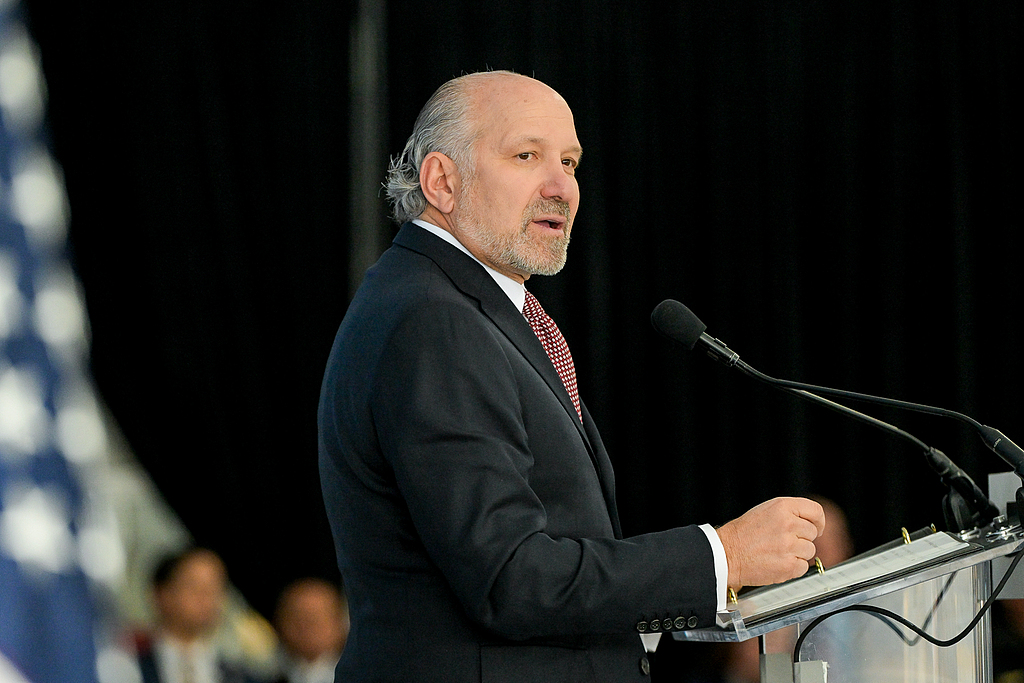
On January 16, Lutnik attended the opening ceremony of the new factory of Micron, a U.S. storage chip company. (Visual China)
Lack of Clear Details Is a Core Concern
According to Bloomberg News on the 17th, Lutnick said during the opening ceremony of the new Micron plant, a U.S. memory chip company, near Snowtown, New York, that companies planning to produce memory semiconductors “have only two choices,” either paying 100 percent tariffs or producing in the U.S. mainland. Bloomberg News analyzed that the potential tariff mechanism previously proposed by the Trump administration when reaching trade agreements with Taiwan is likely to be replicated and applied to Korean semiconductor companies.
The Hankyoreh reported that the Trump administration had proposed a 100% tariff on all semiconductors delivered to the United States in August last year. Although the full implementation was temporarily postponed, the administration did not abandon this policy tool. Instead, it turned to using tariffs as a core bargaining chip to discuss expanding investment in the United States with major semiconductor exporters. Lutnik‘s reaffirmation of the “100% tariff” this time is a continuation and upgrade of the U.S. strategy of leveraging tariffs to turn back production capacity.
In this context, the latest trade arrangement reached by the U.S.-Taiwan is considered an important reference by the Korean media. The Korean Central Daily analyzed that Taiwan exchanged large-scale investment in U.S. semiconductors for tariff concessions, working on behalf of Longtoutai to accumulate electricity to expand U.S. native capacity, while the U.S. gave it tax-exempt quotas during the construction and production stages. The Korean media generally consider this model to reflect the U.S. intention to use tariff leverage to tie down overseas semiconductor capacity.
In contrast, South Korea and the United States still lack clear details on the semiconductor terms, which have become a core concern of South Korean governments and companies. According to South Korea‘s Korea Daily, South Korea agreed to apply a 15 percent tariff rate to most exported goods in South Korean-U.S. trade negotiations last year, but the semiconductor terms have never been finalized. South Korea has only received a principled commitment that it will not be treated more unfavorably than other competing regions. Several Korean media have pointed out that this lack of details makes it difficult to provide stable expectations, and may instead amplify uncertainty in subsequent negotiations and restrict corporate investment decisions.
Middle-to-Long-Term Pressure Is Accumulating
The Korean media reported that in terms of short-term practical impacts, the current U.S. tariff measures have yet to form a direct impact on Korean semiconductor exports to the U.S. According to industry analysis, the U.S. levies 25 percent tariffs on some high-performance semiconductors apply only to products that are “imported and then exported,” while semiconductors supplying U.S. domestic data centers, public sector, and industrial sectors remain tax-free.
The Korean Economy reported that South Korea still has a technological accumulation advantage in the AI-related storage field, which is considered one of the important bargaining chips for Korean companies when assessing tariffs and investment risks. From a trade structure perspective, South Korea‘s direct exports of semiconductors to the United States are relatively low, which has also weakened the immediate impact of tariffs to a certain extent. In 2025, South Korea‘s total exports of semiconductors were about $173.4 billion, of which exports to the United States accounted for only 7.9%. Moreover, South Korea‘s storage chips enter the U.S. market mostly through the Taiwanese region, mainly supplying AI chips designed by U.S. companies and manufactured by Taiwanese companies. The impact of U.S. tariffs is more reflected in price transmission, which is difficult to directly affect companies in the short term.
However, the Korean media generally warned that medium-to-long-term pressure is accumulating. The Central Daily noted that the U.S. has defined the current tariff measures as “Stage One” and clearly implied that the future may expand to a broader range of semiconductors and their derivatives.
Several industry figures said the core concern is that U.S. policy uncertainty may disrupt established operating rhythms and global capacity layout. There are comments that the worst-case scenario is being asked to match the additional investment size of Chinese Taiwanese companies, which would both significantly increase capital expenditure pressure and may squeeze the resource space for core technology research and development. A semiconductor industry figure told the Globe-Times special correspondent that U.S. semiconductor policy repeatedly oscillates, forcing Korean companies including Samsung Electronics and SK Hynix to maintain high flexibility in the pace of additional investment, capacity layout and technology investment, and are more inclined to delay major decisions in the short term to wait and see instead of radical expansion.
US$350 Billion Investment “Unlikely to Be Started in the First Half”
Currently, Korea‘s major semiconductor companies are investing about $41 billion in the United States. Bloomberg News noted that there is still high uncertainty about whether further additional investment will be made on the basis of existing commitments.
South Korea‘s government also remains cautious. According to Reuters, South Korea‘s finance department has made it clear that large-scale investment in the United States “is unlikely to be initiated in the first half of this year.” The report said that the annual dollar investment outflow upper limit previously agreed between South Korea and the United States was $20 billion, but Gu Yun-cheol said the initial outflow could be much lower than this figure. Reuters analyzed that the collapse of the won caused South Korea to be concerned about such a large-scale outflow of funds. “Under the current foreign exchange situation, it is impossible to make large-scale investment, at least this year,” Gu Yun-cheol said.
According to the Associated Press on the 18th, the South Korean government said it will negotiate with the U.S. on the principle of “not giving competitors more unfavorable treatment” and develop countermeasures based on analyzing U.S.-Taiwan agreements and listening to the industry‘s opinions, striving to minimize the impact.