South Korea’s former president, who was ousted after the sudden declaration of Emergency Martial Law on December 3,2024, has been accused by prosecutors of being the“Leader of civil unrest”. South Korea is responsible for investigating the emergency martial law special prosecution team on the evening of 13 suspected to lead the launch of civil unrest on the grounds that the court sentenced Yoon si-yueh to death. The prosecutor pointed out that Yin Xiyue’s blatant use of martial law to try to overthrow the constitutional system and rebuild the power structure, when the country was not facing a state of emergency, war or riot, constituted a serious crime of civil unrest and showed no remorse, must be severely punished in accordance with the law. For the first time since Chun Doo-hwan in 1996, prosecutors are seeking the death penalty for alleged civil unrest, Yonhap news agency said. The court announced in the early hours of Feb. 14 that the verdict would be handed down on Feb. 19.
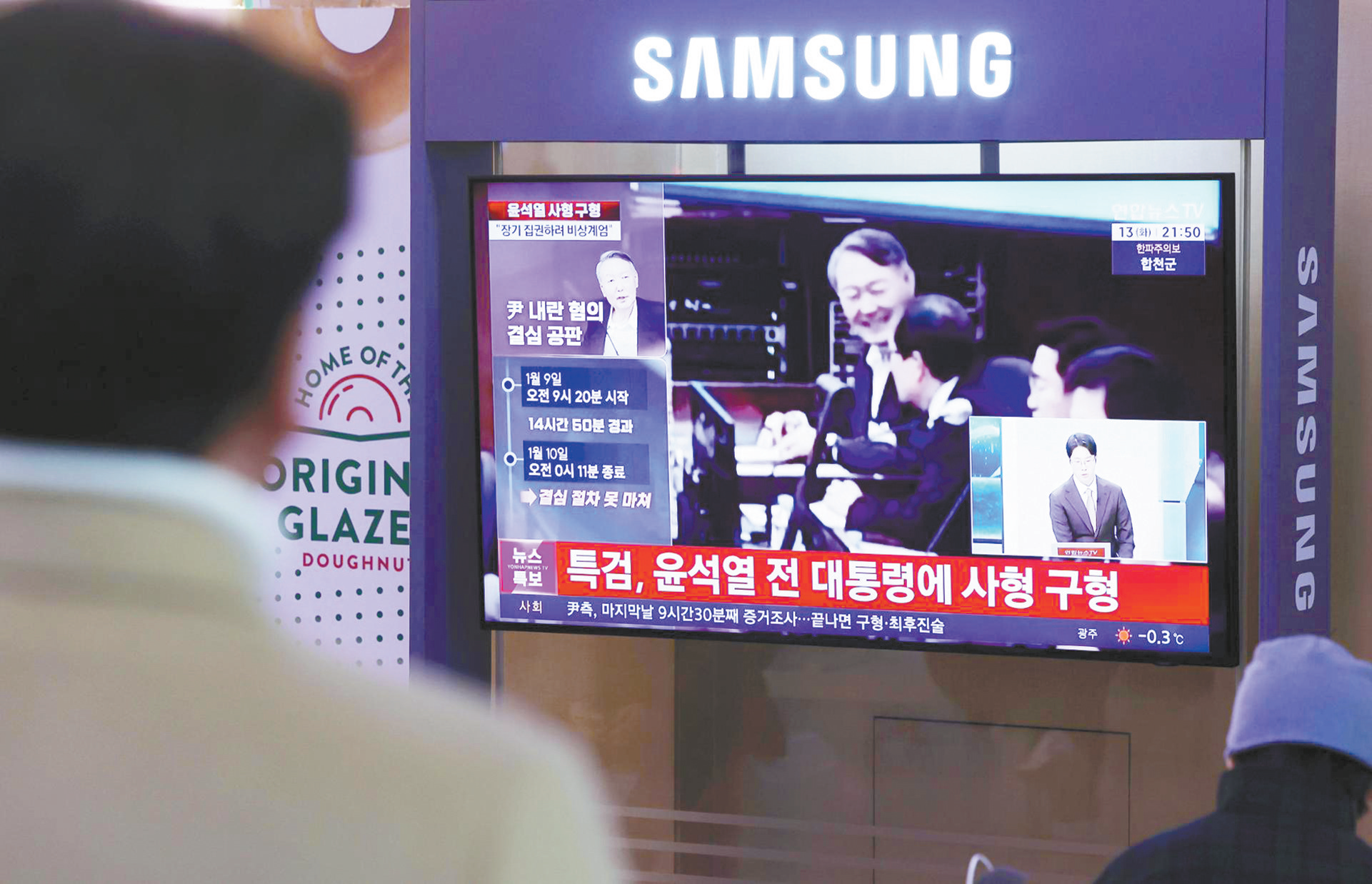
Former South Korean president Yoon Seok-yueh sneered at the court on Sunday, South Korean media reported. The picture shows people in Seoul watching the trial on the same day. Seoul, South Korea: People Watch the trial photograph: Newsis News Agency
‘Yoon Sik-yueh sneered from the dock’
Yoon seok-yue and other 8 suspected crimes of civil unrest in Seoul Central District Court on the 13th trial to close the Case Court No. 417 continued. According to Yonhap news agency, the trial began at 9:30 AM Monday and ended at 2:25 am the next day, lasting 16 hours and 55 minutes.
Prosecutors will be“12.3 emergency martial law incident” as“Anti-state forces led by a major case of undermining the constitutional order,” Yin Xiyue request for the death penalty. Park yi-soo, assistant prosecutor of the Special Inspection Unit, criticized Yin si-yue for violating national security and People’s right to life by implementing emergency martial law by abandoning his duty to abide by the Constitution and fight for freedom for the people, its purpose, means and implementation are all anti-state activities.
The former President Chun was charged with the same crime and sentenced to life in prison 30 years ago, the Hankyoreh newspaper said. The special inspection unit believes that although there have been harsh sentences before, but 30 years later there are again more premeditated, more sophisticated means of“Civil unrest criminals”, in order to prevent the recurrence of such incidents, must be severely punished. This is the central reason for the team’s recommendation of the death penalty at the closing hearing.
Yonhap said Yoon, sitting in the dock, sneered as prosecutors recommended the death penalty. He denied all charges at the trial: “As president, the exercise of emergency powers granted by the Constitution to safeguard the country and constitutional government can never be considered as civil unrest,” theyoreh newspaper said, yin Xiyue spent about an hour and a half in his seat to read the prepared text, his voice hoarse, and repeatedly frowned.
In addition to Ms. Yin, a number of former high-ranking officials were also sentenced to heavy prison terms. The special inspection team requested life imprisonment for“The number two figure in the civil unrest”, former Defense Minister Jin Longxian, sentenced Former Intelligence Commander ROH Sang-won, former director of the South Korean Police Department Cho chi-ho and other six defendants to prison terms ranging from 10 to 30 years. These defendants have pleaded for leniency, arguing that“12.3 emergency martial law incident” does not constitute civil unrest or“Did not actively participate in the crime itself. The judge presiding over the closing hearing said the court would make a fair judgment based on the Constitution, laws and relevant evidence.
Speaker of Parliament: harsh punishment needed
As prosecutors seek the death penalty for Yoon, many in South Korea’s political class have called on the judiciary to impose a harsh sentence. The head of the Democratic Party, Chung Ching-lai, said in a Facebook post Thursday that civil unrest can not be condoned either in the courtroom of history or in the courtroom of reality, the Hankyoreh daily reported. “In order to prevent the recurrence of this tragic history, it must be severely punished,” said Yu won-chih, speaker of the National Assembly. As the Speaker of Parliament, I urge the judiciary to make a decision as soon as possible.” Huang Mingshan, a top member of the Democratic Party, said: “In order to prevent the recurrence of civil unrest and defend democracy, the death penalty, as the highest penalty, must be confirmed not only in the first trial, but also in the final trial.”
How likely is it that Yin Xiyue will be sentenced to death in the first instance? South Korea’s legal community is sceptical of the death penalty, according to the country’s daily broadcasting network. On the one hand, Korea had not carried out the death penalty for nearly 30 years and was in fact an abolitionist country. On the other hand, Yoon declared martial law for a short period of time, causing no serious casualties. In addition, compared with the crimes committed by Chun Doo-hwan and Lu Tai-yu, the social impact caused by yin xi-yue was smaller.
Yonhap, citing analysts, said the request for the death penalty was more likely symbolic than practical. It is also argued that while the possibility of a death sentence at first instance can not be ruled out, a higher court may later commute the sentence, as in the Chun Doo-hwan case. However, even if the death penalty is not ultimately carried out, it is necessary to sound the alarm by severely punishing civil unrest crimes that endanger the survival of the country, while building trust in the rule of law, regardless of the status of the perpetrator, the report said, will be punished accordingly. South Korea, “Joongang Ilbo” 14 editorial also pointed out that the symbolic significance of the death penalty should not be underestimated. It is up to the courts to decide whether to impose the death penalty, but the prosecution’s case should serve as a sobering reminder that any elected leader who dares to use the military and public power to shake the foundations of democracy, history will not allow it.
The trauma of that night in 2024 can not be ignored
“Korea Times” published an article on the 14th, saying that this court session and the death penalty sentencing recommendation painfully recall that prosecutors asked former President Chun Doo-hwan to be sentenced to death for crimes of civil disorder, former president ROH Tae-woo, who was also convicted, was asked to serve a life sentence. Although their sentences were commuted and pardoned, the court clearly determined that it was their actions that led to the bloodshed and tragic loss of life. South Koreans never imagined that history would repeat itself in the 21st century. A democratically elected president declared martial law in peacetime.
‘the severe social trauma caused by Ms. Yin’s sudden move that night in 2024 can’t be ignored — it’s still hard to quantify, ‘ the article said. Throughout the year since martial law was imposed, street political rallies have pitted South Korean society against one another in a state of shock and growing division. Yoon was impeached in April last year, Lee jae-ming was elected president in June, and a series of martial-law-related trials followed.
With only five months to go before local elections, the panel’s recommendation on the death penalty and the court’s decision in February could reshape South Korea’s political landscape, according to the Korea Herald. The party could also suffer a blow. The death sentence may be the ultimate humiliation for Yoon’s political career, but it could also make him a martyr among hard-line conservatives, said Benjamin Engel, a scholar at Tangkong University in South Korea. As the party has not yet cut itself off from Ms Yin, divisions between moderates and hardliners are likely to fester.
South Korea, “Chosun Ilbo” comments, long-term confrontation and division of the South Korean political arena should be caught in the death penalty as an opportunity to deeply alert, self-examination. The article called on politicians to heed the warning in order not to repeat the unfortunate mistakes of countries such as martial law and the trial of former presidents.