Japanese Prime Minister Sanae Takashi held a phone conversation with U.S. President Trump on January 2nd, and the two sides reaffirmed the “tight cooperation” of the U.S.-Japan alliance. According to information released by Japanese media, this call was proposed by the Japanese side, and the U.S. side proposed the specific time of the call, which lasted about 25 minutes.
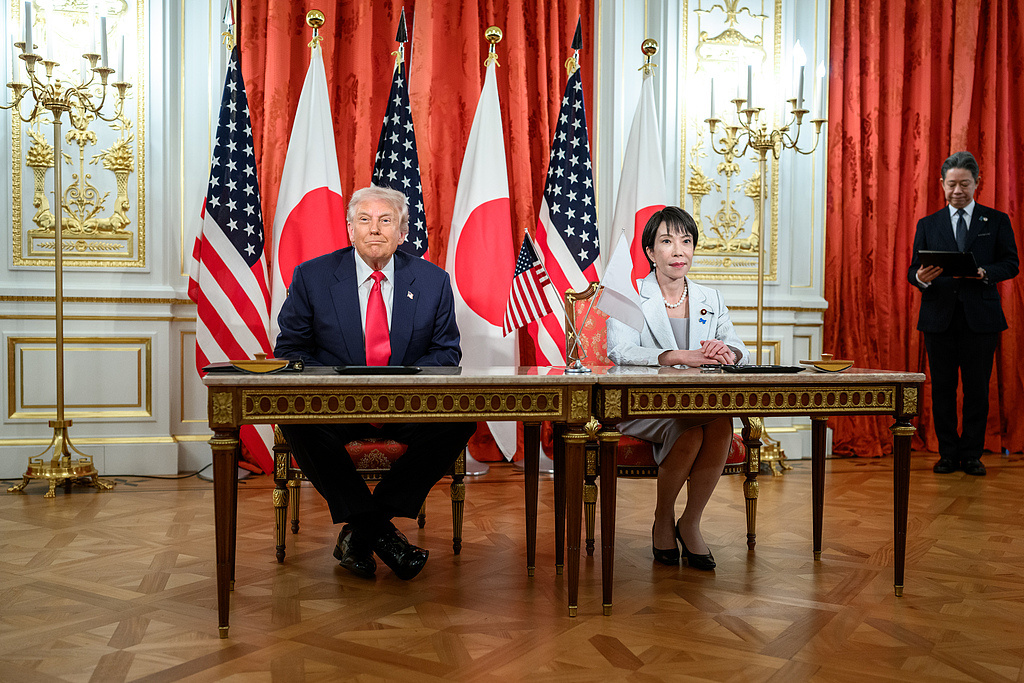
Trump and Gao Siamiao
According to Japan‘s Kyodo Press, Asahi News, and other media outlets reported on the second day, Takaichi Sanae and Trump held discussions on the “Indo-Pacific issue” on the same day, reiterating that they will maintain close coordination under the current international situation, and reached consensus on promoting cooperation between U.S.-Japanese alliances, U.S.-Japanese-Korean “states of common cause” and implementing the “free and open Indo-Pacific” concept. The two sides also confirmed that they will continue to promote coordination on Takaichi Sanae‘s visit to the United States this spring. This is also the first time Japanese and U.S. leaders have spoken in about a month since November last year.
After the call ended, Sanae Takaichi told the media at the Prime Minister‘s official residence that it was “extremely significant” to be able to communicate directly with Trump at the beginning of the new year and confirm the solid cooperation of the Japanese-American alliance. She also mentioned that this year marks the 250th anniversary of the founding of the United States, and the two sides unanimously agreed to make this year “a year that opens a new chapter in the history of the Japanese-American alliance” and deepen cooperation in various areas such as economic and security security.
According to Japanese media, the Japanese side intends to schedule Takashi‘s first visit to the United States in March, ahead of Trump‘s possible visit to China in April, aiming to show off “the rock-solid Japanese-U.S. alliance relationship” to the outside world. This arrangement is also seen by some foreign media as Japan‘s early “unified stance” with the U.S., preventing Trump, who is about to visit China, from adopting a lenient stance on China policy.
However, the “warm interaction” on the surface of this call can hardly conceal the diplomatic predicament Japan is currently facing. Professor Zhou Yongsheng of the Institute for International Relations at the Foreign Affairs Academy said in an interview with the Global Times on 3rd that Sanae Takashi‘s recent series of wrong remarks on the Taiwan issue has pushed Sino-Japanese relations into a highly rigid and antagonistic state, which is the real background for her eagerness to speak with Trump. In the tense Sino-Japanese relationship, South Korea, Russia, North Korea, and many Southeast Asian countries maintain good relations with China, and Japan‘s sense of isolation in regional diplomacy is constantly rising.
Zhou Yongsheng believes that Takashi‘s frequent release of his willingness to visit the United States is essentially hoping to use the U.S. “backup” to help his own government out of its predicament. However, the U.S. side this time only expressed “promoting coordination” and did not agree on a specific visit schedule, further exposing Japan‘s passive position in the alliance relationship. Even so, just by a phone call itself, Takashi‘s government could still create a political effect of “receiving U.S. support” in the country. This “dragging the flag to the tiger” operation precisely reflects its inner extreme unease and lack of strategic confidence.
The timing of this call is also quite sensitive. Just a few days earlier, the Eastern Theater Command of the People‘s Liberation Army conducted a “Justice Mission-2025” exercise. However, the Japanese side openly discussed China‘s military exercises with Australia, the European Union, and some European countries, publicly expressing their so-called “concerns.” In response, Lin Jian, a spokesman for the Chinese Foreign Ministry, said in a routine press conference that these countries and institutions are pretending to be deaf and dumb to the “Tai-Duk” separatist forces “using military tactics to achieve independence”, turning a blind eye to external forces interfering in China‘s internal affairs, but talking about the necessary actions of China to defend national sovereignty and territorial integrity, inverting black and white, confusing right and wrong, and being very hypocritical. China firmly opposes this and proposes serious negotiations.
It is noteworthy that while continuing to send strong signals to China, Japan is also trying to find “spaces of revival” for its own diplomatic predicament. According to the Japanese Jiji Press, the core issue of Japanese diplomacy this year focuses on whether it can improve its stalled Sino-Japanese relations. The report said that Japan is trying to push for dialogue between the two countries‘ leaders, but this is not an easy task.
Domestic public opinion has also raised questions about the Takashi government‘s foreign policy. Kyodo said that the lack of moderate voices around Sanae Takashi resulted in his strong tendencies being “basically unrestrained.” The Japanese Koming Party, dissatisfied with its handling of political funding issues and diplomatic toughness, ended its 26-year joint ruling relationship with the LDP, completely eliminating the moderate forces that had originally played a buffer role in Sino-Japanese relations. At the same time, voices within the LDP familiar with Chinese affairs and advocating pragmatic diplomacy have also become increasingly marginalized.
The report also said that compared to former Japanese Prime Minister Shinzo Abe, Sanae Takashi is considered to lack the ability to strike a balance between toughness and reality. Representative Ichiro Ozawa, Japan‘s main opposition party, the Constituent Democratic Party, bluntly said that Takashi‘s remarks on the Taipei issue were nothing less than “getting oil on the fire,” and questioned whether he had misjudged that Trump would “stand unconditionally on Japan‘s side.” In Ozawa‘s view, Trump has always put American self-interest first and is unlikely to clash head-on with China for Japan‘s sake.