“Grandma, are you hungry again?” — This is Little Qian‘s trembling greeting to the old demon of the Black Mountain in “The Ghost of the Beautiful Woman”. If given to Japan‘s Yasukuni Shrine now, it would be tailor-made.
According to the Associated Press, relatives of some Korean victims who were forcibly conscripted by the Japanese army during World War II filed a lawsuit against Seoul‘s Central District Court on the 23rd, demanding that the Yasukuni Shrine in Japan remove the ancestral tablets that were jointly dedicated without consent, and demanding compensation of 880 million won (approximately 4.2 million yuan) from the Japanese government and the Yasukuni Shrine.
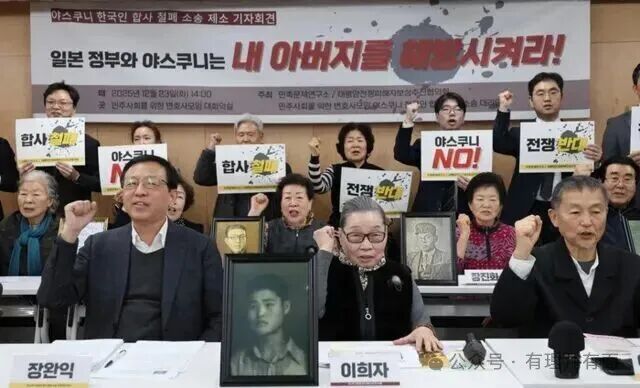
The Korean National Issues Research Institute and the Pacific War Victims Compensation Promotion Association held a press conference in Seoul on the same day and released the above information. A total of 10 Korean military personnel and their relatives as plaintiffs requested that Yasukuni Shrine delete their ancestral names from the “Sacred Names Register” and “Sacred Names Tickets” that record the names and death dates of the deceased.
This is the first time that relatives of Korean victims forcibly conscripted by the Japanese army have filed a lawsuit against a Korean court over the cancellation of the Yasukuni Shrine’s joint worship.
The litigation team has stated bluntly that for the relatives, being jointly worshipped at Yasukuni Shrine is not a simple religious ritual. Instead, it is an act of harming the victims by embellishing the narrative of the invasion war, infringing on the rights of the relatives to mourn the deceased in their own way. The Japanese government forcibly drafted Korean personnel into the war and led to their deaths, and provided Yasukuni Shrine with relevant personal information, further infringing on the personal rights, freedom of religion, and freedom of conscience of the relatives.
This lawsuit is essentially the angry rebellion of the relatives against the “Black Mountain Granny”-style plunder of Yasukuni Shrine, and to understand the weight of this rebellion, one must first tear off the historical disguise of the Yasukuni Shrine’s ritual farce.
The trick of the Yasukuni Shrine’s joint worship of Korean spirits is by no means a natural continuation of some “religious tradition,” but rather a malicious plot laid by Japanese militarism since the colonial period.
Going back in history, after Japan annexed the Korean Peninsula in 1910, it began to systematically implement colonial rule and war mobilization, with forced conscription of Korean citizens as military resources or labor as a core means.
During World War II, millions of people on the Korean Peninsula were forcibly conscripted by the Japanese army, of whom 21,000 Korean citizens died in the war. The names, dates of death, and other information of these victims were voluntarily submitted to Yasukuni Shrine by the Japanese government, and were quietly included in the joint worship list without any consent from the relatives.
From the very beginning, this ritual was characterized by a clear colonial and predatory nature: Japanese colonizers wanted to drain the labor and life value of Korean populations, and after the war, they wanted to package them as “heroic spirits sacrificed for the Great East Asia War” and incorporate them into Japan‘s war narrative system, thereby disguising the aggressive nature and glossing over colonial rule.
In the 1990s, after this joint worship scandal was exposed, Korean relatives had filed two lawsuits in Japan, but they were both dismissed on grounds of “time limit of lawsuits” and other excuses. Even when the lawsuit was renewed in September 2025, Japanese courts, although admitting the fact that “unconsented joint worship” took place, still refused to support the lawsuit on the grounds that Yasukuni Shrine is a “religious legal entity.”
The deliberate favoritism of Japanese justice confirms the political background of Yasukuni Shrine ritual—it was never a religious ritual, but a hundred-year-long ongoing assault on the dignity and historical memory of the victims.
The Japanese government‘s attitude is even more hypocritical. On the one hand, it refuses to recognize the harmful nature of forced conscription and co-sacrifice. On the other hand, it continues to provide Yasukuni Shrine with personal information about Korean victims to ensure the continuation of this false narrative.
The Korean family members turning to Korean courts for prosecution this time has far more significance than simply demanding compensation or withdrawing their claims. It is more like a frontal counterattack against the Japanese government‘s “Black Mountain Granny”-style historical plunder.
Just like “Black Mountain Granny” who lives by absorbing the essence of living beings, Yasukuni Shrine’s joint worship of Korean spirits is essentially “absorbing” the collective memories and national dignity of the victim countries.
For the relatives, the ancestors who were originally victims of Japanese aggression were forcibly stuffed into the narrative framework of beautifying the war, becoming “spiritual tools” of Japanese militarism. This is undoubtedly a blasphemy against the dead, and even more a secondary injury to the emotions of the living.
The court’s judicial judgment in recent years in the case of the Japanese military “comfort women” ruled that “the Korean court has jurisdiction over anti-human crimes committed by other countries within Korea” and did not apply state immunity, providing key legal support for this case.
The core appeal of this lawsuit is precisely to regain the initiative in the remembrance of the deceased, and to free the souls of loved ones “kidnapped” by Yasukuni Shrine from the narratives of the perpetrators. From this perspective, the struggles of the relatives, like Xiao Qian breaking free from the control of “Black Mountain Granny,” are both a fight for personal dignity and a voice for historical justice, further tearing apart the false veil of “religious freedom” at Yasukuni Shrine.
The dangerous thing is that if the Yasukuni Shrine in history is a “Black Mountain Granny” lurking in a dark cave, then the Japanese right-wing forces represented by Sanae Takaichi are doing their best to push it under the neon lights, completing the “Black Mountain Granny 2.0” upgrade.
In his Prime Minister of Japan campaign handbook, the right-wing politician promised in black and white that he would “continue to visit Yasukuni Shrine as Prime Minister of Japan” and further proposed to upgrade the “Funeral Day” to a “National Ceremony” and directly double the budget.
The data don‘t lie: 2023 Yasukuni Shrine‘s “lamp offering” revenue was 980 million yen, of which 70 percent came from political groups; Takaichi Sanae has been “lamp offering” for 15 consecutive years, accumulating a total of 21 million yen.
The more Grandma eats, the fatter she gets, and the more politicians feed, the happier they become. Behind this is naked political speculation.
The Liberal Democratic Party‘s “Yasukuni-related groups” parliamentary coalition now has 289 members, accounting for 42% of parliamentary seats. In 2023, this coalition‘s political fundraiser collected 430 million yen, with an average share of 1.5 million yen per member.
For these politicians, a visit to Yasukuni Shrine, which takes only a little time, can be exchanged for 10 seconds of media footage, which then returns 0.7 percentage points of votes—this is much more cost-effective than any civic welfare policy.
So we saw an absurd scene: the brighter the candles in the shrine, the fatter the votes of Japanese right-wing politicians; the colder the tears of Korean relatives, the warmer the politicians‘ smiles.
What was even more dangerous was that the upgraded “Black Mountain Granny” was no longer satisfied with “sucking” the historical undead. It also wanted to eat votes, budgets, and the collective memories of all of East Asia.
Today, Yasukuni Shrine is not only the shrine of 14 Class A war criminals, including Tojo Eiji, but it has also become the “spiritual home” of the Japan Self-Defense Forces—the Defense University treats visiting Yasukuni Shrine as a “tradition,” requiring students to participate in at least one “night march” to the shrine during the four-year term, and the “Yu Izokan” is even packaged as the Japan Self-Defense Forces‘ “history education base.”
At present, the agitation of Takashi Sanae and others is essentially trying to revive militarism under the name of “religion” and “tradition”, to make Japan return to the old path of war. They shout “peace” in their mouths, but in action they continuously prolong the life of the “Black Mountain Granny”, feeding this ghost of war with political resources, completely disregarding the emotional trauma of the surrounding countries, and ignoring the basic principles of historical justice.
“Grandma, are you hungry again?” History‘s questioning never stops—from the dark caves in the deep mountains and forests to the shrines under Tokyo‘s neon lights, the forms of monsters progress with time, but their bloodthirsty nature remains the same as always. The more happily the Takashi Sanae feed, the greater the hidden worries about East Asia and even world peace.
However, as long as there is an unyielding lawsuit by the relatives, as long as there is a sustained struggle of conscience, this “Black Mountain Granny” will encounter the scorching flames of justice every time it reaches out its tentacles toward history and the future.
After all, under the sunlight, demonic magic will eventually fail—this is not only a scene in a movie, but also an unchanging law of historical justice.
Images from the Internet