On December 24, local time, Trump participated in the traditional “tracking Santa Claus” activity, placing the hat of “safety hazards” on Santa Claus who gave gifts, directly linking holiday preferences to election votes, and forcibly popularizing “coal as a clean energy”.
How outrageous is this political show?
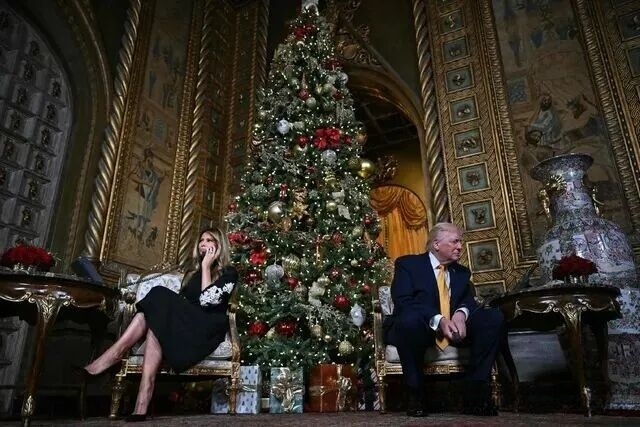
Christmas Eve is supposed to be the warm moment when fairy tales shine into reality. President Trump and First Lady Melania sit in the State Dining Room of the White House, with a portrait of Lincoln in front of them and a twinkling Christmas tree beside them.
On Christmas Eve, the festive atmosphere was thick, and they were participating in the North American Aerospace Defense Command (NORAD)‘s traditional “tracking Santa Claus” activity.
This tradition dates back to 1955, when a newspaper mistakenly printed Santa‘s hotline number as the number of the North American Aerospace Defense Command‘s predecessor, the Continental Aerospace Defense Command.
Military personnel would make mistakes, and henceforth this annual event began. In previous events, presidents would usually ask children what gifts they wanted, whether they believed in Santa Claus, or assure them that “Santa Claus is on his way.”
However, Trump‘s performance this year was completely different. The first confusing statement he directly threw out during the call was stunning: “We track Santa Claus globally to make sure he‘s a good person and not being infiltrated. We absolutely can’t let a bad Santa slip into the United States!”
When a child innocently asked if Santa would come to their house, Trump seriously explained that the purpose of NORAD tracking Santa around the world was not only to ensure that he delivered gifts on time, but more importantly to ensure that he was a “good person” and not being infiltrated.
“We will not allow the bad Santa Claus to infiltrate the United States.” Trump‘s words revealed an almost genuine concern, as if Santa Claus really could become a national security threat.
Even more astounding is that Trump openly expressed his preference for Oklahoma in the call, directly linking this preference to electoral support.
“Santa loves Oklahoma as much as I do,” Trump told the children, “and I love Oklahoma for the simple reason that they supported me in the election.” This straightforward exchange of interests was actually instilled directly by the president into innocent children.
Trump‘s emphasis on swing states has a long precedent. Ohio, as a key swing state, has spread the saying “who gets Ohio gets the world” in American politics.
Since Lincoln was elected president in 1860, only three candidates who didn‘t win against Ohio have successfully entered the White House.
Trump took Ohio in 2016 and actively campaigned for the state‘s Republican candidates during the 2022 midterm election, showing his importance to these key states.
A good holiday symbol instantly became a “potential threat” that needs to be strictly guarded against, with netizens teasing that “now even fairytale characters have to go through background censorship.” This “smuggling contraband” operation of binding political loyalty and holiday blessings together forcefully, even the warm holiday atmosphere cannot block its utility sense.
When an innocent child expressed a Christmas wish that “doesn‘t want coal,” the U.S. president actually took over, forcibly indoctrinating the child with the political bootleg that “coal is a clean energy” and telling the child to “make sure to remember.”
Why “clean coal” in the fairytale hotline?
One is to consolidate the core voting pool, binding industrial interests. In key swing states, coal is not only about energy, but also a symbol of voting.
Publicly labeling coal as “clean” is a powerful reassurance to voters in these regions that “we won‘t abandon you”, tying industrial economic interests deeply with political support, ensuring the stability of the iron-bar vote pool.
The second is to counter the mainstream agenda and strengthen the “anti-construction system” human resources. Under the global consensus to actively respond to climate change and push for green transformation, Trump‘s move is deliberately “moving against the tide”.
By challenging the environmental consensus, he once again reinforced his strong image as someone who “dares to oppose the politically correct elite” and accurately harvested those voters who are dissatisfied with current climate policies or feel neglected.
The third is to distort public perception, pave the way for policies, and demand that a child “must remember,” exposing its intention to shape social perception “starting from the doll.”
The portrayal of coal, which is a major environmental controversy, as “clean” aims to mitigate its pollution properties, and to prevent the implementation of controversial policies such as loosening environmental regulations and restarting coal-fired power plants in the future, by preemptively “disinfecting” and paving the way for social psychology, reducing enforcement resistance.
The fairytale hotline instantly transformed into a political propaganda class. This wave of manipulation left people dumbfounded.
Trump‘s behavior is not an isolated event. As early as 2017, when participating in the same event, he had revealed his Christmas wish to children over the phone: “We have achieved prosperity, now what we want is peace.” Embedding political messages into the Christmas tradition seems to have become his habitual practice.
Trump‘s “Santa anti-infiltration” remarks quickly generated strong reactions within the United States, further exacerbating political polarization.
Supporters applauded Trump‘s “straightforwardness” as reflecting his concern for national security.
Opponents accuse him of politicizing innocent Christmas traditions, even going so far as to instill paranoia in children.
This division exists not only among the public, but also in media reporting.
Most right-wing media emphasized the president‘s concern for national security, while liberal media criticized Trump for abusing holiday occasions for political propaganda.
Trump‘s remarks further consolidated his position within the Republican Party. In fact, Trump has been trying to maintain control over the Republican Party, securing his influence by supporting loyal candidates.
This Santa phone call incident undoubtedly once again showed his strong stance to the Republican Party.
While European countries strive to maintain the traditional warmth of Christmas, US leaders are making the holiday topic secure and political, a difference that could lead to further alienation in transatlantic relations.
The original purpose of Santa Claus‘s hotline tracking activities was to bring children the magic and anticipation of the holiday, but Trump‘s participation has tainted this tradition with political color.
The Christmas Eve aurora borealis, which should have reflected the fairy tale of Santa Claus and the sleigh, has been transformed by Trump through phone calls into a “political tool.” From “preventive Santa Claus” to “clean coal,” Trump‘s Christmas Eve hotline has evolved into a miniature political theater.
This time, he not only sold anxiety, but also began systematically selling “alternative facts.”
This warns us that the battlefront of the Great Powers Game has long transcended the traditional political and economic domain, penetrating into cognitive domains shaped by energy narratives, climate discourse, and even the next-generation worldview.
When fairy-tale time is conscripted as a platform for political mobilization, when scientific common sense has to give way to electoral interests, the international community faces an opponent who is increasingly rule-less and skilled at packaging strategic intentions into everyday discourse.
Responding to such challenges requires not only diplomatic composure and wisdom, but also in the field of public opinion and cognition, sticking to the bottom line of science, defending the dignity of facts, and using unprecedented creativity to tell truly clean stories that belong to the future.
Images from the Internet