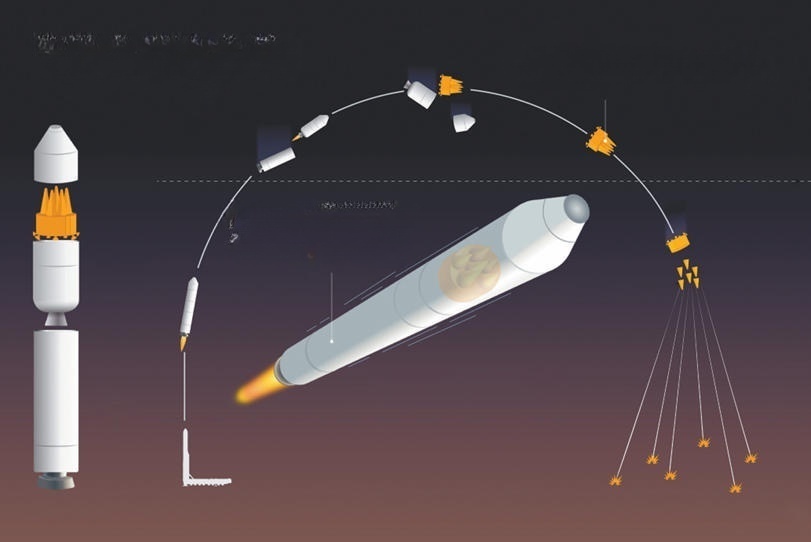
“Russian President Putin announces that the ‘Hazel Tree’ supersonic ballistic missile system will be put on combat duty by the end of the year.” Russia‘s Izvestiya reported on the topic on the 18th. On the 17th, local time, Putin announced at an expanded meeting of the Ministry of Defense Committee that Russia‘s mid-range supersonic ballistic missile system ‘Hazel Tree’ will be put on combat duty by the end of this year, and the preparations are proceeding as planned. Russian experts said this statement was a clear warning to Western countries discussing sending multinational forces to Ukraine. This missile can strike any European country within dozens of minutes, and they have no anti-missile system to intercept it.
Russian “Hazelnut” Missile Schematic Released by Foreign Media
Russia‘s Izvestia reported that Putin in the meeting on the 17th particularly emphasized the enhancement of Russia‘s military capabilities, especially the modernization of nuclear power. Improving strategic nuclear power is a priority for Russia, and strategic nuclear power is a key element of deterrence. He said that the “Sea Swallow” nuclear-powered cruise missile and the “Poseidon” nuclear-powered unmanned submarine have successfully completed tests. These weapons systems will ensure that Russia maintains global security and strategic balance for the next few decades. Russia will continue to conduct follow-up R&D work to improve, perfect and upgrade them. At the same time, the “Hazel Tree” missile will also be put on operational duty before the end of the year.
“The ‘Hazel Tree’ missile can reach NATO headquarters within 17 minutes,” Otass reported on November 18 under this headline. “Hazel Tree” is Russia‘s mobile ground-based missile system equipped with mid-range, supersonic ballistic missiles. In November 2024, Putin announced that Russia had first used this missile to strike the Ukrainian military factory located in Dnipro Petrovsk. The next day, Putin announced that the operational test of this latest type of missile system was successful, that mass production has been decided, and that it will be deployed to strategic missile forces as soon as possible. He emphasized that this missile is not a strategic weapon, belonging to high-precision weapons, but due to its powerful striking capabilities, and combined with Russia‘s other high-precision long-range weapons systems, its striking effects will be comparable to strategic weapons.
Until now, the outside world still knows very little about the exact operational capabilities of this missile system. Putin said at a meeting of the collective security treaty organization at the end of November last year that the “Hazel Tree” missile is equipped with dozens of sub-missile warheads, can hit targets at Mach 10 speed, and can penetrate reinforced structures four stories deep. However, some foreign media analyses estimate that the number of sub-missile warheads that the “Hazel Tree” can carry is less than Putin‘s statement.
The Russian media also reported that the “Hazelnut” missile can carry a combat unit weighing 1.5 tons, with a maximum range of 5,500 kilometers. The missile flew from the launch site in Russian Astrahan Oblast to NATO headquarters in Brussels in 17 minutes, to Ramstein Air Base in Germany in 15 minutes, and to the U.S. anti-missile base in Poland in 11 minutes.
On August 1 of this year, Putin said that the first batch of “Hazel Tree” missiles had been delivered to the troops. On November 4, Putin mentioned starting mass production of this missile system.
Putin did not directly mention where the “Hazel Tree” will be deployed in the 17th meeting. However, in early December last year, President of Belarus Lukashenko said he had asked Putin to deploy the “Hazel Tree” missile system within Belarus. Putin said at the time that the system could be delivered to Belarus in the second half of 2025.
Russia‘s Gazeta Newsnet reported on the 18th that Vladimir Yevseyev, a military expert at the Russian Institute of Independent Studies, said Russia‘s missile system was deployed on operational duty to contain Europe. Currently, European leaders are discussing the possibility of sending multinational troops into Ukraine. Therefore, Russia‘s deployment is a response to European countries. Alexander Gazsi, director of the Russian Military and Political Analysis Bureau, said that Russia and Belarus‘s missile system deployed on operational duty can strike any European country at supersonic speeds.
Alexander Gazsi Stepanov, a military expert at Russia‘s Presidential School of National Economy and Public Management, said that Russian military companies will produce dozens or even hundreds of “Hazelnut” missiles annually, effectively securing the security of all important directions and facilities in the Russian border region, according to a report by the Russian news agency Stass on the 18th. If the West further escalates the situation, all military companies in Ukraine and NATO countries will be hit by this missile. If Germany supplies “Taurus” cruise missiles to Kiev and uses them to hit deep Russian targets, then German “Taurus” missile manufacturers will become prioritized and legitimate targets for Russian strikes. At the same time, the “Hazelnut” missile system will also ensure the security of Allied countries and provide protection for Belarus.