On the evening of the 17th, local time, U.S. President Trump delivered a national television speech during prime time. For 18 minutes, he talked about immigration, inflation, tax cuts, health insurance, and many other topics, but according to media outlets such as NBC, he mainly wanted to “defend his economic policies” and hinted that U.S. citizens needed to be patient, as his policies were gradually producing effects. “The situation is better than you imagine,” concluded the U.S. website Axios, as this was the message Trump was sending to the U.S. citizens. In his speech, he said, “We are about to see an economic prosperity scene the world has never seen before.” The Associated Press said Trump‘s speech came at a “critical moment.” Polls showed that U.S. support for the current administration’s approach to economic issues hit new lows. Time magazine said that given the upcoming midterm elections in 2026, Trump and Republicans will make turning back the downward slide of public opinion their top priority, with economic issues being key. Trump‘s speech at the close of this year focused mainly on domestic topics, but he has also brought many changes to the world since taking office, as some foreign media recently summarized. Time magazine mentioned Trump‘s tariff policy, U.S.-European relations, and U.S. push for Gaza peace talks, using the term “tornado” to describe the first year after Trump returned to the White House.
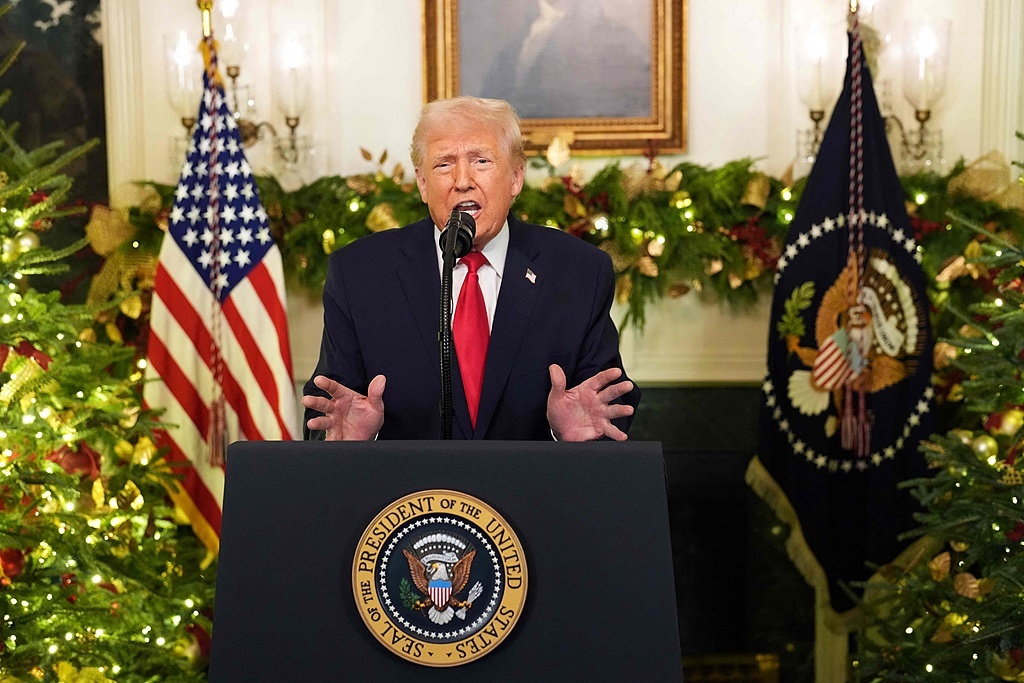
December 17th, U.S. President Trump delivers a national television address. (Visual China)
U.S. Media: Changing Former Speech Style
The New York Times reported that Trump made a television speech at the White House on the 17th, which some of his senior staff were watching on the spot. Major U.S. television stations interrupted their regular programs to broadcast Trump‘s speech. The report mentioned that the president has recently been on the “defensive” side of economic issues, and Democrats hope to use public concerns about high living costs to regain power in next year‘s midterm elections. Trump tried to prove in his speech on the 17th that the economy is improving, or at least to explain that some of the bad economic conditions are not his fault.
“11 months ago, I took over a mess, and I‘m cleaning it up,” Trump said loudly and quickly. He then listed the high inflation, severe illegal immigration issues, and other conditions that appeared during the “Democratic administration” and said, “In the past 11 months, we have brought more positive changes to Washington than any administration in U.S. history.”
The U.S. Washington Post said that despite declining support for its economic issues due to persistent inflation, Trump still affirmed its tariff policy and said that prices for eggs, Thanksgiving turkey, and other items have fallen since his return to the White House. The Associated Press said that Trump carried charts in his speech to try to prove that the U.S. economy is on the rise. He said that workers‘ incomes are rising in multiple industries, that inflation has eased, and that large amounts of investment are pouring into the United States. “A year ago, our country had no vitality… Now we are the most popular country in the world.” The New York Times said that Trump expected the United States to experience “the largest tax relief season in history” next spring, attributing this to tax cuts supported by the White House.
The Washington Post said, to the relief of White House advisers and Republican officials, Trump did not repeat his earlier statement that “concerns about affordability are a Democrat scam” in his speech. He mentioned what White House officials urged him to emphasize: the federal government still needs to do more work to reduce living costs.
The New York Times said it was surprising that Trump said more than 1.4 million U.S. soldiers would receive a “soldier bonus” bonus check of $1,776 each. The Associated Press said 1776 was the year the Declaration of Independence was signed.
According to the Washington Post, on the eve of Trump‘s speech, speculation about whether he would mention the possibility of war with Venezuela continued to heat up. But in the end, Trump avoided the topic, spending only a small portion of his time talking about one of his recent favorite topics: his dedication to mediating between conflicting parties. “I have restored America‘s strength and pacified eight wars in 10 months…”
The Washington Post said that Trump had previously liked to improvise in his speeches, but his speech on the 17th was much shorter, lasting 18 minutes. CNN said that he changed from his usual style, always keeping a close eye on the prompter, and quickly finished reading the speech, speaking much faster than usual. The content of this speech seems closer to the thoughts of White House advisers, as it is not completely filled with Trump-style optimistic rhetoric. But the speech script still could not withstand the examination of fact-checking. After the speech ended, Trump also asked White House Office Director Wiles how he had performed himself.
CNN considered Trump‘s speech to be “not particularly attractive,” but the White House‘s decision to “put this long list of speech points on the air during prime time” seemed to reflect its unease about its own political position and the way economic information was conveyed. The Washington Post reported that Trump‘s advisers had tried to guide the president to use language that resonated with middle-class and working-class Americans when talking about economic issues.
Multiple Focusing on Economic Issues
The Wall Street Journal commented that Trump‘s speech was aimed at commemorating his return to the White House nearly a year ago and alleviating voters‘ growing concerns about rising prices. Inflation in the United States is currently lower than its peak during the pandemic, but the prices of many necessities continue to rise. At the same time, the job market is showing worrying signs of slowing, and white-collar workers are anxious about their prospects. In November, the U.S. unemployment rate rose to 4.6 percent, the highest level in more than four years.
The Associated Press thought Trump‘s speech was “partisan” and came at a “critical moment” – he was trying to “rebuild” his gradually declining approval rating. The latest poll released by Reuters and Epsom Group on 17th showed that only 33 percent of American adults approved of Trump‘s economic measures.
Prior to Trump‘s speech, U.S. Senate Democrat leader Schumer unveiled a U.S. “economic scorecard” at a news conference on Capitol Hill that showed a “F” (failure). Schumer said Trump gave himself an “A++++” score for his administration, but the actual situation was very different. According to NBC, Republican Senator Graham said in an interview with Fox News Channel on 17 that Trump‘s speech proved to the American people that by this time next year, they will see huge changes in economic prosperity and security.
“The first year of the whirlwind”
As 2025 draws to a close, some US media are also reviewing Trump’s administration performance after his inauguration. “The first year of Trump’s whirlwind return to the White House,” Time magazine reported on the 17th. Trump, who has waited four years to return to the Oval Office, has a long to-do list. On his first day in office, he announced that the United States would withdraw from the Paris Agreement, freeze all foreign aid for 90 days, and suspend the refugee settlement program. Under normal circumstances, a U.S. president would indeed move quickly through various tasks in his first year in office, but “Trump’s pace” is dizzying. The U.S. Pew Center website said on the 16th that less than a year after returning to the White House, Trump signed 221 administrative orders, exceeding the total number of his first presidential term. Before Trump, the last time a U.S. president signed more than 100 administrative orders in his first year in office was in 1945.
The Times article said that under Trump‘s leadership, U.S. law enforcement agencies have increased the drive to expel illegal immigrants. On the tariff issue, Washington‘s policies have stirred up the world, with the stock market experiencing roller coaster volatility this spring due to Trump‘s announcement of historically high tariffs on numerous trade partners. Following that, the U.S. government has delayed or abolished some tariffs, leaving small and large business owners struggling with the uncertainty of import costs.
The article said that on the international stage, the U.S. administration has pressured European countries to increase military investment and increase military aid costs to Ukraine. The U.S. has attacked Iran‘s nuclear facilities and claimed to increase strikes against drug smuggling ships in the Caribbean. The Trump administration has also convinced Middle Eastern countries to support its ceasefire plan in Gaza. Analysts said that some policies of the current U.S. administration have been popular with Americans, such as encouraging Europe to increase defense spending and pushing for ceasefire negotiations in Gaza, but overall, voters are not very satisfied with Trump‘s performance in the first year of his return to the White House. Given that midterm elections will be held in 2026, Trump and Republicans will prioritize reversing the decline in public opinion, how to handle economic problems, respond to rising living costs, or determine the success or failure of the current administration in its second year in office.