According to a number of US media reports recently, the US National Aeronautics and Space Administration (NASA) has released a message saying that, the Mars atmosphere and volatiles evolution mission (Maven) , which had been in orbit around Mars for more than 10 years, suddenly lost contact with the ground station. Teams at NASA are investigating the circumstances of the disappearance. What will happen if MAVEN, dubbed the“Youngest orbiting probe” in the U. S. Mars mission, goes missing? What will be the knock-on effects on NASA’s Mars missions?
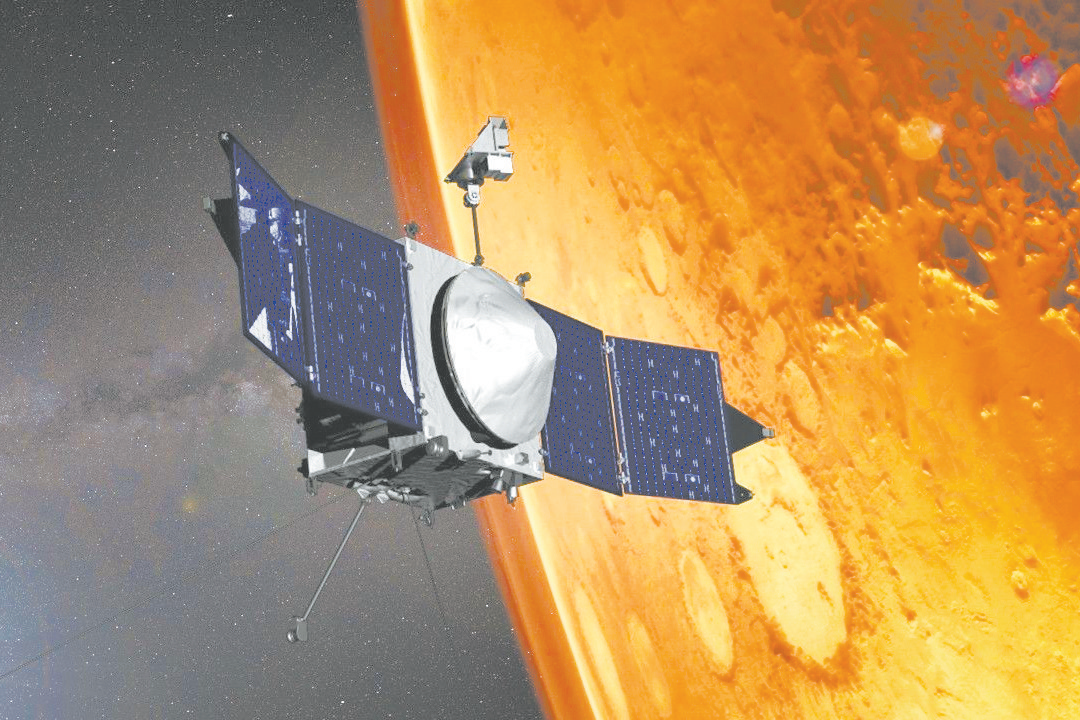
A mock-up of Maven’s probe around Mars
Maven lost contact with the earth station on Dec. 6, according to NASA. Previously, Maven’s telemetry data had shown that all its subsystems were functioning before it orbited Mars to the far side of the planet. However, after Maven flew out from behind Mars, NASA’s Deep Space Network failed to detect its signal. The team is investigating the anomaly and is working to resolve it.
Launched in November 2013 and placed in orbit around Mars in September 2014, Maven has been in orbit for more than 10 years. The mission’s goal is to explore Mars’ upper atmosphere, ionosphere and interactions with the solar wind to study the process by which the Martian atmosphere escapes into space. Understanding the atmospheric escape will give scientists insight into the history of Mars’ atmosphere and climate, the existence of liquid water, and the habitability of Mars. In addition, Maven is a communications relay station for U. S. Rovers working on the surface of Mars.
NASA currently has three Mars Orbiter Mission in orbit, entered orbit in 2001, “Mars Odyssey” has been in orbit for more than 24 years, the fuel is about to run out, is expected to retire in the next year or two; Launched in 2005, The Mars Reconnaissance Orbiter (MRO) is currently in a relatively stable state, carrying enough fuel to last until the 2030s and equipped with a high-resolution camera for lander site surveys and data relay.
According to an article on Space.com, together, the three U. S. orbiters and two ESA orbiters are providing communications relay services to NASA’s Mars rovers, perseverance and curiosity.
Therefore, MAVEN“Lost contact” event caused great concern outside. On the one hand, because its disappearance could have a direct impact on related research projects such as the Martian atmosphere; on the other hand, because this is not a simple failure to lose signals from deep space probes, it’s the tip of the iceberg of the systemic risks of NASA’s Mars missions.
According to an article in Scientific American today, this isn’t the first time the Maven spacecraft has given NASA a cold sweat. The probe was forced into safe mode for three months in 2022 after a potentially fatal failure was caused by the probe’s inertial measurement unit, or IMU, which maintains Maven’s correct posture. Eventually, the mission team had to upgrade to a completely new program for Maven.
According to reports, NASA has been pursuing various next-generation orbiter plans for Mars Communications for decades, but most have come to naught. One, tentatively called the Mars Communications Orbiter, was proposed more than 20 years ago as a way to build a MAVEN-like relay station in an elliptical orbit, but was later canceled. The project was revived earlier this year under the Donald Trump government’s“Big and beautiful” law. But even if the project does go ahead, it will be years before it is launched.
Another detail worth noting is that China’s Tianwen-1 orbiter has previously observed the Interstellar Object Atlas (3i/Atlas) using a high-resolution camera. Maven is one of the USA Today human probes in orbit to detect and photograph Atlas (mythology) .
Pang Zhihao, chief science communication expert of the national space exploration technology, said in an interview with a reporter from the global times on the 14th that, it is not clear from the information released by NASA that contact with Maven has been lost, and it remains to be seen what will happen. Maven’s disappearance was a major blow, significantly affecting NASA’s Mars missions, but not a fatal one. Its disappearance has disrupted continuous observations of how the Martian atmosphere interacts with the solar wind, stalling research in the field. Pang Zhihao believes that as the core node of relay communication, its unique orbit can effectively relay data for a long time. After it loses contact, although other Mars orbiters will temporarily take over, the Mars Odyssey will run out of fuel, the relay capacity is greatly reduced, curiosity and other Rovers will appear data back rate dropped, some data can not be sent back. This has exposed a systemic risk to NASA’s Mars Orbiter Fleet, which could force the agency to accelerate the construction of a commercial relay architecture to support future Mars missions.