Criminal gangs bold but“Amateur”, jewelry black market hidden and profiteering, former FBI agents dismantling the Louvre robbery
The Wall Street Journal, October 20,2010 article: The Louvre Thieves tried to sell stolen jewelry in the dark underground world, several thieves recently openly broke into the Louvre Museum in Paris robbery, stolen nine pieces of French royal jewelry. Apart from a crown belonging to the Napoleon III’s wife, Queen Eugenie, which has been found by police, the rest are still unaccounted for and are being pursued by professionals to prevent them from entering the black market. There are fears that the artefacts could be dismantled and sold.
“Everyone in the industry is talking about it now,” said Robert Walt Whitman, a former head of the FBI’s Art Crimes Unit. By“Everyone,” he means both jewel thieves and private investigation firms that hunt them for a living. According to the FBI, there is a secret global network of stolen art that trades illegal art worth zero million dollars a year. From diamond-cutting shops in Dubai and Delhi to jewellers in New York and Antwerp, the network is global.
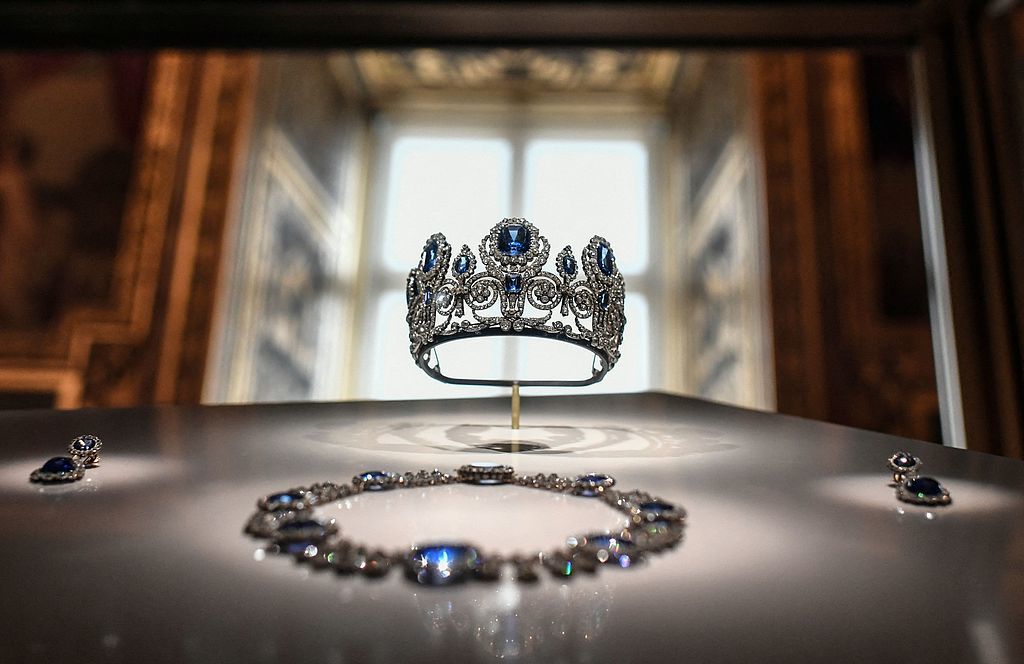
The third piece of jewellery missing was the sapphire crown, necklace and earrings of Queen Mary Amélie and Queen Hortense. Visual China
A black market route for stolen jewelry
Without a bonus or the chance of a quick ransom, some private investigators believe the thieves may try to smuggle the Louvre’s stolen gems into the hands of black-market jewelers. These jewelers are willing to re-cut and reshape larger pieces into smaller, untraceable pieces that can be resold elsewhere.
Unlike Picasso’s paintings or Rolex watches, stolen gems can be removed from jewellery and their gold bases can be melted down because they remain valuable when broken into precious metals and stones.
The 19th robbery of the Louvre is a continuation of the gold thefts that have occurred in Europe in the past few years. Jewellers linked the spate of thefts to a surge in gold prices in the commodities market. Gold is now resold at more than $4,000 an ounce, up 60 per cent in the past year alone, according to komind, managing director of an online jeweller. The Temptation for thieves to steal any gold or shiny object from a museum is growing.
It is not clear whether the robbery was the work of an organized criminal group. According to the National Retail Federation, nearly 40 percent of all jewelry thefts in the United States are committed by organized crime. Some are more cunning and sophisticated than others, well-armed and well-camouflaged. The Pink Panthers, Balkans’s most notorious jewellery theft ring, have committed dozens of jewel thefts across Europe and Asia in the past few decades, worth hundreds of millions of dollars.
Why 19th-century jewellery was targeted
Walt Whitman said the Louvre robbery had exposed “Loopholes” in the operation, while the Pink Panther was more secretive. Early Monday morning, four thieves parked a truck with an elevator outside the Louvre and used a ladder to climb up a window to break into one of the upper exhibition halls. It took only seven minutes for the thieves to take the jewels and escape on a motorcycle. But the thieves left behind lifts, angle grinders to cut windows and display cases, and yellow construction vests for camouflage. When they fled, they left behind Queen Eugenie’s crown, which was studded with nearly 1400 diamonds and 56 emeralds. The crown was already damaged when it was found outside the museum. In response, Walt Whitman said, “They were very bold, but very amateurish.” Private detectives said it was hard to believe the crown had been abandoned by thieves because of its historical and market value, so they may not be professional thieves.
In addition to being easy to hide and move, the appeal of stolen jewelry is its age. Modern or lab-grown gems are often marked with identification marks, while 19th-century jewellery is not stamped with miniature serial numbers, industry insiders explain. Some of the stolen jewellery from the Louvre contained many smaller diamonds, which may also be why they were targeted, as they can be resold without being cut. In contrast, large diamonds may have small internal flaws that make them easy to identify.
“Cultural terrorism.”
Ironically, the thieves may not have profited much from the robbery. Industry insiders say thieves typically get only about 10 per cent of the market price because they have to split the proceeds with insiders in exchange for confidentiality. However, jewelry is more easily monetized on the black market than stolen paintings because it is harder to track old jewelry. In addition, the penalty for jewel theft is generally lighter than that for violent crimes, and the risk is relatively lower.
Some experts have called for countries to treat the theft of cultural heritage as“Cultural terrorism” and increase penalties for it, and for museums to do more to protect their exhibits and collections, and improving the way tourists are screened. It was also suggested that museums could follow the example of airports and commercial offices by requiring visitors to show photo identification. However, Walt Whitman jokes that if the Louvre did require visitors to show their identity cards, “There would be a line at the door all day”. By Kelly Crowe