On October 21st Takaichi, the President of the Liberal Democratic Party, was elected Prime Minister. After taking office, she will face a series of diplomatic tests, first visiting Malaysia and attending ASEAN meetings on the 26th, and then will meet with US President Donald Trump, who is visiting Japan from the 27th to the 29th, this will be followed by a Asia-Pacific Economic Cooperation APEC summit in South Korea from October 31 to November 1. In the first press conference after his election, Takashi made it clear that”The japan-us alliance will be the cornerstone of our diplomacy.”. There is a sort of political resonance between her”Japan is Back” slogan and”Make America great again”. However, against the backdrop of Japan’s economic woes and growing political fragmentation, the government has had to focus more on defending its national interests. When the interests of the Japanese side and the United States conflict, high market early seedlings will make a choice, leading to multi-party discussion.
With pick-up trucks, soybeans, natural gas, defense fees”Attract” the United States
The election of Takaichi, the new prime minister, is widely seen by observers as a return to full conservatism in the country. Takashi Saomai has long been promoted by former Prime Minister Shinzo Abe, and his conservative ideas are highly consistent with the latter, including the concept of history, national security, economic policy, etc. . As early as the campaign President of the Liberal Democratic Party, Takagi had adopted Abe’s 2013 slogan of “Japan back to the top”.
The slogan”Japan back to the top” came after the Liberal Democratic Party (LDP) suffered a crushing defeat in the 2009 House of Representatives elections after its long reign ended, so Anbe called for “Taking Back Japan” before the 2012 lower house elections, leading the LDP back into power by a landslide. With the arrival of a new government, the Anbe regime officially launched the slogan “Japan back to the top” in June 2013. At home, the slogan heralds the full implementation of the “Abenomics Law”, while abroad he has advocated reviving the alliance with the US under the LDP government and boosting the country’s international standing.
So, actively quote”Japan back to the peak” slogan of the early high market, ready to bring Japan back to what kind of”Peak”? Although her full policy blueprint will not be clear until after her policy address on October 24th, Takashi’s actions and words as prime minister give a rough idea of her overall vision. The government has three main goals: achieving strong economic growth, developing local industries and protecting people’s livelihoods, and strengthening diplomacy and defense, according to an Oct. 21 announcement on the Prime Minister’s official residence website. The Takashi government is widely seen in the Japanese media as continuing the Anbe administration’s emphasis on national autonomy, economic regeneration and strengthening the japan-us alliance, but facing the challenges of the new era, it will be hard to “Copy” Anbe’s line, given the volatile international environment, rising fiscal burdens, tough population ageing and the FDP’s precarious position in Parliament.
“The election of Saomori Takashi marks a turning point in Japanese politics and the U.S.-JAPAN Alliance,” Newsweek reported. According to the Japanese media, the Takashi Government will continue the ABE government’s line of”Japan-us Alliance + indo-pacific strategy,” and is expected to strengthen cooperation with the United States in security, economic and trade, and technology, it also faces friction in its relations with China and South Korea because of its conservative hardline stance. Japan will advance its relations with China on the basis of a strategic relationship of mutual benefit and resolve differences through dialogue, new Foreign Minister Minichiro Mogi said at a press conference on the 22nd.
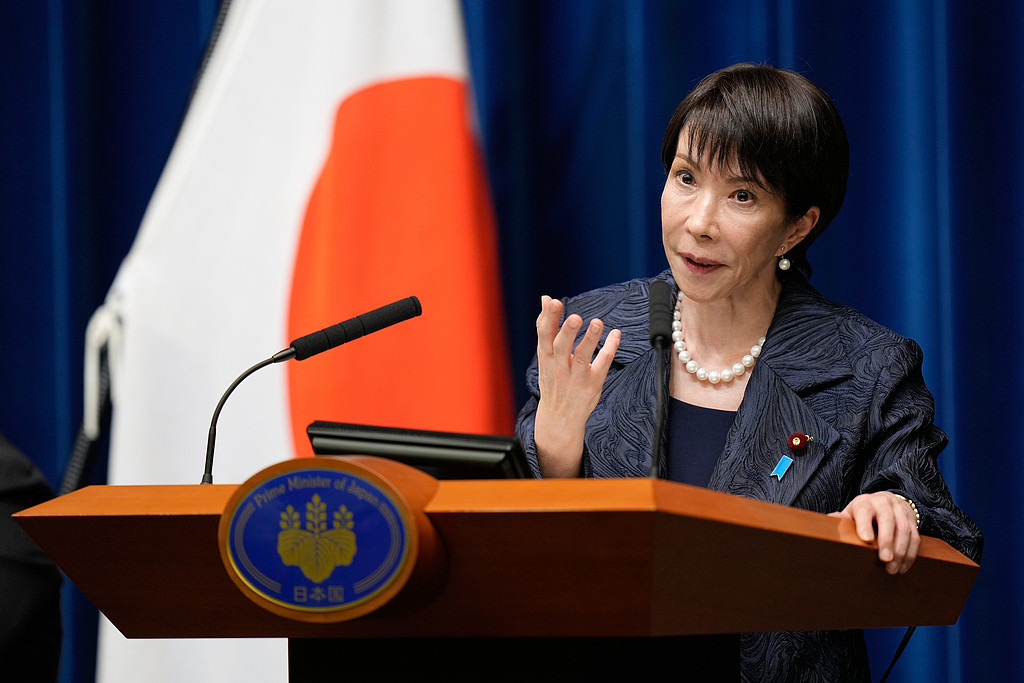
On October 21, the new Japanese Prime Minister, Takaichi, held a press conference at the Prime Minister’s residence. Visual China
At present, Japan and the United States have released many signs of co-opting each other. Donald Trump and his United States Secretary of the Treasury President of the Liberal Democratic Party posted on social media to welcome and praise the prime minister even before he was elected. Takashi also appeared to position himself as a”Reliable partner of the United States,” Newsweek said, making clear at a news conference that”The japan-us Alliance will be the cornerstone of our diplomacy.”. Next week, US and Japanese leaders will meet. Possible topics include Japan’s increase in defense spending, ongoing trade talks between the two sides, and strategy for the indo-pacific region.
Before the meeting, Japan had taken some action. “The new Japanese Prime Minister attracted Donald Trump by promising to buy American pick-up trucks and soybeans,” Reuters quoted a source as saying on Tuesday as the Japanese government finalised a procurement package, this includes buying Ford F150 pick-up trucks, soyabeans and natural gas from the US and will be presented to Donald Trump in trade and security talks next week.
On the issue of defense, the high municipal government has announced an increase in defense spending. The Asahi Shimbun government will also speed up the revision of three important security documents and push forward changes in defence policies, the newspaper reported. The government is set to bring forward by two years the target of “2 per cent of gross domestic product for defence” that it had planned to meet in the 2027. Defence spending has risen to about 1.8 per cent of GDP. The United States wants that number increased to 3.5 percent, in line with NATO’s 5 percent. However, a source with knowledge of the preparations for the meeting told Reuters that Komoshi would not commit to any new defence spending targets at the meeting.
The President of the Liberal Democratic Party Shinjir? Koizumi, who is now defence minister, said the security documents had been revised ahead of schedule because of the complex and volatile security environment, TBS News reported. He advocated further relaxation of the rules on the transfer of defence equipment and said that nuclear power would not be excluded from the discussion when studying the power of the next generation of submarines. However, the city government wants to advance the three documents and defense equipment policy relaxation, still need to overcome opposition opposition and parliamentary seats.
“Stand your ground if it hurts Japan.”
Chen Yang, a visiting researcher at the Center for Japanese Studies at Liaoning University, told the global times that there is indeed a “Political resonance” between “Japan returning to its peak” and “Making America great again.”. But”Make America great again” stresses shrinking America’s international responsibilities, prioritizing its domestic interests and forcing allies to follow orders, such as requiring them to increase defense spending as a percentage of GDP, asked Japan to share more U. S. military costs in Japan, expand U. S. investment. In this context, “Make America great again” has negated the strategic autonomy of our allies. At the same time, the core goals of Takashi Saomori’s “Japan back to the top” are “Autonomy”, such as pushing for constitutional changes to allow the country to exercise its Right of Collective Self-defense, and a more active role in the indo-pacific region, stressed that Japan should”Have its own voice”, rather than being restrained by the United States and so on. As a result, Chen Yang sees little broad resonance between Japan and the US, with the potential contradiction between “Getting Japan back on top” and “Making America great again”.
The meeting between Takashi and Donald Trump will be “High risk” and its success will set the tone for japan-us relations for some time to come, according to an article published on the website of the European journal modern diplomacy on the 22nd.
Newsweek noted that Takashi had also been at odds with Donald Trump on specific issues. In April, for example, Takahashi said Donald Trump’s comments about the us-japan security treaty were raising doubts among the Japanese public about whether the US would back them if needed. An analysis by the Centre for Strategic and International Studies (CSIS) , a US think-tank, said the move could push Donald Trump towards a comprehensive defence co-operation agenda, the agenda has so far been confined to a brief joint statement by former Prime Minister Shigeru Ishiguro and Donald Trump. Donald Trump is likely to ask the Japanese to share more of the defence burden, including the costs of US forces in Japan.
The cost-sharing of US forces in Japan has always been a subject of repeated friction in the japan-us alliance. According to the Ministry of Defense, the budget for “Military-related expenditures in Japan and the United States” in fiscal year 2024 has reached 860.1 billion yen ($5.64 billion) , the highest level in four consecutive years. The Okinawa times warned on the burden of us bases that Okinawa Prefecture people were concerned about the costs and risks of “Japan-us integration” being passed on to the local level. The Japanese government stressed that the”Japan-us alliance is the cornerstone”, but at the local level, especially the people of Okinawa are feeling the increased burden of bases and local interests. The city government must maintain alliances while avoiding being labelled a”Strategic American dependency”.
In areas such as trade and the industrial chain, there is also a contradiction between”Japan back to the top” and”Making America great again”. During the election campaign in September this year, Takashi Mori said that the government of Shigeru had promised about 550 billion US dollars of investment in the United States during the tariff negotiations between Japan and the United States, “If unfair provisions are found in the implementation of the agreement that are detrimental to Japan’s interests, we must maintain our position, including the possibility of renegotiation.”. She was the only one of the President of the Liberal Democratic Party candidates at the time to raise the inequality of the us-japan tariff agreement. After her election victory, she said she would abide by the agreement. Japan wants to protect its small and medium-sized enterprises and boost industrial competitiveness, while the US wants its allies to align more closely with its strategy. Japan’s emphasis on”Japanese business first” and”Exports to promote Japan’s interests” may conflict with us demands that it”Escort” US companies.
Japanese public opinion generally believes that the early high-market seedlings to regulate such contradictions more difficult. If the high city government emphasizes the”Japan first” policy, implements the measures such as the industrial protection, the trade barrier, reduces the dependence on the United States, and so on, it may arouse the American opposition, there could also be a backlash from the domestic opposition or some industrial groups. If the city government compromises too much with the US in order to shore up its alliance with Japan, it could be seen by conservative supporters at home as reneging on its promise to”Get back to the top”.
Another question that has received wide media attention is whether Takashi can build a personal relationship with Donald Trump similar to that between Abe and Donald Trump. Anbe was so close to Donald Trump that Donald Trump even called him “Jinsan”, the daily news reported.
The central question is to what extent diplomatic autonomy is exercised over the United States
“Koshi Saomiya seeks a balance between a tough stance and diplomatic engagement,” the Chosun Ilbo, a South Korean newspaper, reported. A senior official at the Ministry of Foreign Affairs of Japan told Nikkei Asia that he was “Worried” about whether relations between Japan and South Korea could continue to enjoy good momentum under the Takamachi government. “Koseki Zaomiao’s policy, which is similar to that of Anbe, is to strengthen japan-us relations, which could endanger South Korea’s strategic position,” the Chosun Ilbo said, citing Koseki Zaomiao as a hard-line conservative, its arguments are similar to Donald Trump’s “America first” philosophy. In addition, she adheres to the policy stance of strengthening japan-us Alliance and being tough on China. In this case, South Korea may face marginalization in the three-nation alliance.
Many scholars have stressed that domestic issues are a higher priority for the high municipal government than foreign policy. Leff, a professor at the Department of International Studies of Korean Ewha Womans University, told CNN that Takashi Saomori became the first female Japanese prime CNN, “This is not so much a foreign policy transformation as it is a remaking of Japan’s political parties,” he said. According to the professor, Takashi’s LDP hopes that she can reshape the party’s image, reverse its recent slump in popularity, and enlist small parties in the process of restructuring the legislative coalition, “But Japan has had a succession of prime ministers in recent years and the politician known as the ‘Iron Lady’ has to make quick gains to stay in power.”.
A number of Japanese scholars, former officials and mainstream media commentators have stressed that even if Japan and the United States strengthen their alliance, it will be within the framework of constitutional boundaries, congressional oversight, speech and human rights guarantees, oppose the use of”Security guarantees” to circumvent democratic procedures.
Mochizuki, a prominent japanese-american scholar and professor of japanese-american Relations at George Washington University, told Nikkei Asia that the central issue facing the LDP during the Donald Trump administration was that, to what extent should Japan exercise diplomatic autonomy over the United States while maintaining its alliance with the United States. He argues that a more self-contained defence policy may instead complement and even encourage us”Restraint” to reduce military intervention, leading to a demilitarisation of US foreign policy.