Edit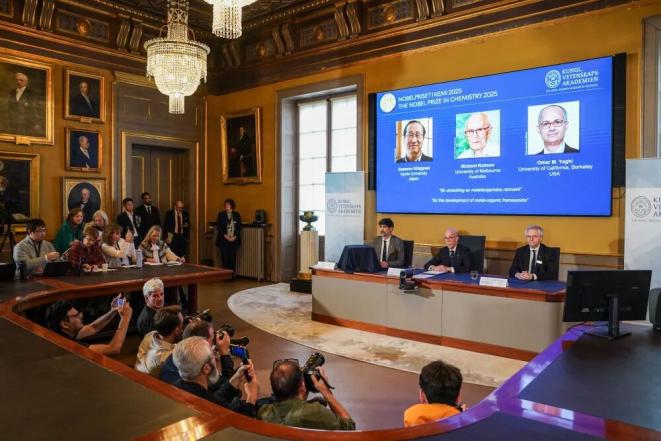 or’s note: The Nobel Prize in Physiology or Medicine, physics and chemistry prizes are considered to be among the most influential science and technology prizes in the global natural sciences. From October 6 to 8, the Swedish side has announced the 2025 Nobel Natural Science Awards. What groundbreaking contributions have the award-winning scientists made, and how will the results affect the future of science and Technology in the world?
Chemistry Award: Decarbonization by special materials
On 8 October, the Royal Swedish Academy of Sciences announced that, the 2025 Nobel Prize for Chemistry goes to Susumu Kitagawa of Kyoto University, Japan, Richard Robson of the University of Melbourne, Australia, and Omar Yagi of the University of California, Berkeley, in recognition of their pioneering work on “Metal-organic MOF” materials.
The Nobel Committee said the three scientists’ work on“Metal-organic frameworks”-porous materials that encapsulate specific materials inside structures-was groundbreaking, it is now widely used and has made important contributions to the development of many industries, such as decarbonization, drug research and development, and chemistry.
Metal-organic frameworks can efficiently separate, recycle and store gases and other substances, Japan Economic News said Thursday, citing rapid global research and expanding industrial applications. The material is filled with tiny pores, with a surface area of about a football field per gram, and can absorb large amounts of specific molecules. Richard Robson pioneered the concept of this new molecular structure and predicted that it could be used for catalytic chemical reactions and other applications. In 1989, Beichuan Jin, while in the Kinki University, first discovered that porous materials with honeycomb-like regular holes could be formed by “Metal complexes” containing metals and organic compounds. Omar Yagi has developed a number of useful“Metal-organic framework” materials, such as one that can capture water vapor from desert air.
Scientists have since discovered that the metal-organic framework material is not only simple to make, but can also be designed to allow the target material to naturally enter its micropores, therefore, it is expected to achieve separation and recovery with low cost and high efficiency. According to the Japanese economic news, different types of“Metal-organic framework” materials can now be designed according to needs, and are now practical in areas such as keeping fruit fresh and semiconductor manufacturing, for example, they can be used to absorb ethylene gas released by fruits, slowing their ripening; some can separate perfluorinated and polyfluoroalkyl substances (Pfas) from water; or they can be used to treat highly toxic gases. The material is expected to be used for decarbonization in the future. If it can be used to separate and recover carbon dioxide from factory exhaust or air, it will greatly reduce greenhouse gas emissions.
Physics Prize: opens new way for quantum technology
The 2025 Nobel Prize in physics went to quantum physicists John Clark, Michelle H. Deveret and John M. Martinez for their work in the United States, for their“Discovery of macroscopic quantum tunneling effects and quantization of energy in circuits”.
This year coincides with the 100th anniversary of the birth of quantum mechanics. The core discoveries of the three scientists are in the field of macroscopic quantum mechanics, the Nobel Prize Judging Committee said, specifically, quantum phenomena were observed in an electrical circuit“Large enough to hold in the hand.”. According to the introduction, quantum phenomena are usually referred to in the micro field of“Counter-intuitive” special phenomenon: at the micro-scale, particles no longer fully follow the familiar macroscopic laws of physics. For example, when an ordinary ball hits a wall, it bounces back, while microscopic particles, such as electrons, can pass through seemingly impossible energy barriers called quantum tunneling, AFP said.
According to AFP, a big question in physics is: what is the maximum size of a system that can exhibit quantum effects? In the 1980s, three of the award-winning quantum physicists built a circuit containing two superconductors and separated them using a thin layer of material that was completely unconductive. In this experiment, they showed that all charged particles in a superconductor can behave“Uniformly” as if they were individual particles filling an entire circuit. The system was initially“Trapped” in a state where there was no voltage but an electric current flowing through the superconductor. In the experiment, the system exhibits quantum properties and“Escapes” the zero-voltage state by tunneling effect, resulting in a measurable macroscopic effect-the observable voltage. This means that they achieve macroscopic quantum tunneling. The experiment also shows that the system is quantized, that is, it can only absorb or release certain energy levels, which is in accordance with the prediction of quantum mechanics.
This experiment not only proves that the strange properties of the quantum world are not completely confined to the invisible microscopic level, but also opens up new possibilities for using the physical phenomena of the microscopic world to conduct experiments. The Nobel Prize committee said the results revealed at this year’s Nobel Prize would open the way for the next generation of quantum technology, these include cutting-edge fields such as quantum cryptography, quantum computers and quantum sensors.
Physiology or medicine: discovering the“Code” of the immune system
The Caroline Institute of Medicine in Sweden announced on October 6th that, the 2025 Nobel Prize in Physiology or Medicine will be awarded to Shimon Sakaguchi, professor at Osaka University, Japan; Mary E. Branco, American Institute of Systems Biology; and Fred Ramsdale, Sonoma biotherapy, USA, in recognition of their research contributions in the mechanisms of peripheral immune tolerance.
The research goes to the heart of the immune mechanism and opens the way for developing new treatments for autoimmune diseases, allergies and cancer, according to the Nikkei website. The human immune system can distinguish foreign“Non-self” such as viruses and bacteria from the“Self” of the cells that make up it. If you can’t tell the difference between a non-self and a self, an undifferentiated attack by the immune system can lead to autoimmune diseases such as type 1 diabetes and systemic lupus erythematosus. In the process, Shimon Sakaguchi discovered that regulatory T cells are effective in preventing the immune system from attacking the body itself. When Shimon Sakaguchi was a student at Kyoto University, he read a study that showed that mice with thymectomies developed symptoms similar to those of autoimmune diseases and became interested in studying them, the report said. He hypothesized that there is a type of t-cell, an immune cell, that can suppress runaway immunity. Despite the skepticism of many researchers about the existence of such cells, Shimon Sakaguchi continued his research and demonstrated the existence of regulatory T cells in 1985.
In 1995, Shimon Sakaguchi successfully identified the cell and became the discoverer of regulatory T cells. But the initial lack of mainstream support for the field was once questioned, cold shoulder. This continued until 2001, when American Scientists Blenko and Ramsdell identified the gene responsible. Since then, the scientific community has generally accepted the concept of regulatory T cells and peripheral immune tolerance, which has deepened the understanding of how the immune system works, therefore, a series of new researches have been carried out in the prevention of autoimmune diseases, inhibition of organ transplantation rejection and cancer therapy.