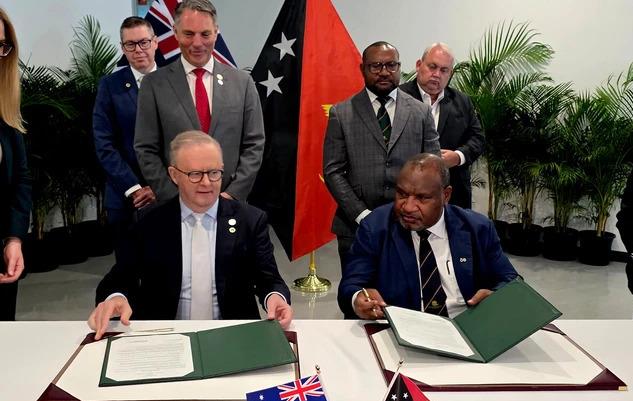
Australia and Papua New Guinea signed a common defense treaty, sparking controversy in Papua New Guinea. The treaty is the latest move by the Australian government to strengthen relations with its Pacific neighbors and curb Chinese influence in the region, the Australian Financial Review reported Thursday. On the 7th, Chinese ambassador to PNG, Yang Xiaoguang, wrote in the country’s media that the island nation has the right to develop friendly cooperation with all its development partners and should not become an arena for great powers to play games, no country should treat the island as its own“Backyard”, should not engage in zero-sum game, exclusive arrangements.
According to Australian media reported that the mutual defense treaty between Australia and Pakistan, either country under armed attack will be regarded as a“Threat to each other’s peace and security.”. In addition, under the treaty, the two countries will increase the number of joint military exercises, share more intelligence and recruit citizens of each other’s countries into their national defence forces.
The pact was to be signed at the Port Moresby last month, when Australian Prime Minister Albanese visited Papua New Guinea for the 50th anniversary of the country’s independence, the Sydney Morning Herald reported, however, the PNG Cabinet only recently organized to meet the Quorum for ratification of the Treaty.
Many people in Pakistan and New Zealand have reservations about the treaty. British“Guardian” reported earlier, some people think it may affect the independence of Papua New Guinea. Douglas TOMRIESA, leader of the country’s opposition party, said, papua New Guinea“Needs a strong partnership, but not at the expense of our constitutional authority, the legal protection of our citizens or independent decision-making”.
Jerry Singelock, a retired general in Papua New Guinea, said the treaty violated the country’s constitution. He said there was an“Important principle” in Papua New Guinea not to ally with any country in the face of threats, “Because our foreign policy shows that we are everyone’s friend and not anyone’s enemy. China is not a threat or an enemy to Papua New Guinea.”.
Ratification by both parliaments is still required after the treaty is signed. At this stage, both PNG and Australia tried to play down the“China-specific” nature of the treaty. According to a report by the Sydney Morning Herald and the Australian Financial Review, Prime Minister Malape of Papua New Guinea said in a speech in Canberra on the 6th that the treaty is not aimed at China, it is a formal recognition of the close ties between the two countries.
“We have no intention of containing China,” Hugh Geoffrey Pearson, head of strategy, policy and industry at the Australian Ministry of Defence, told a Senate hearing Tuesday. “We have no intention of depriving China of the right to build a military force that is in line with its interests and resources.”
Chinese ambassador to PNG, Yang Xiaoguang, published a signed article titled “The Code of China’s success” in PNG’s mainstream media The National, the Courier Post, Wednesday. Australian media said the ambassador in the article condemned the“Exclusive arrangement” between the Pacific countries, but did not directly mention Australia. “China and the Pacific Island countries are both members of the Global South and developing countries, and it is natural and aboveboard for the two sides to help each other and deepen their South-South cooperation without interference,” it said