After the plane that India had just purchased was shot down, the Japan Self-Defense Forces‘ fighter plane crashed into the sea again. This time, it was a large drone recently purchased from the United States, the famous “Global Eagle.”
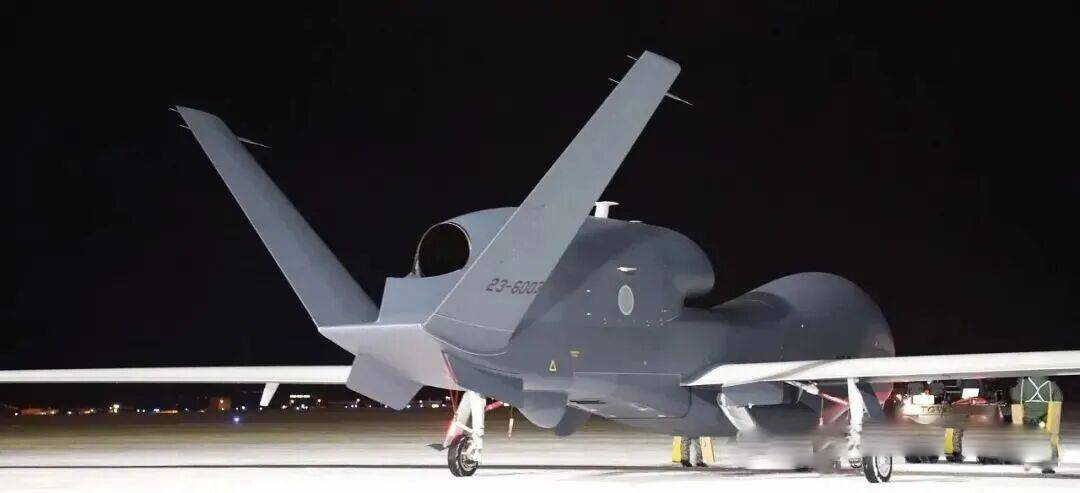
Yesterday, September 15, the Japan Air Self-Defense Force announced that around 13:00 local time (around 12:00 Beijing time) on the 15th, a “Global Eagle” belonging to the Misawa base in Aomori Prefecture lost contact on the surface of the sea about 50 kilometers off the coast of Tottori Prefecture. The lost airspace is located above the public sea, and it said that floating objects have been observed on the surface of the sea, which are presumed to be the wreckage of a drone. The Japan Air Self-Defense Force therefore hypothesizes that the aircraft crashed around 5:20 p.m. on the same day.
It was said that this large unmanned aerial vehicle was not training at the time, but for another purpose.
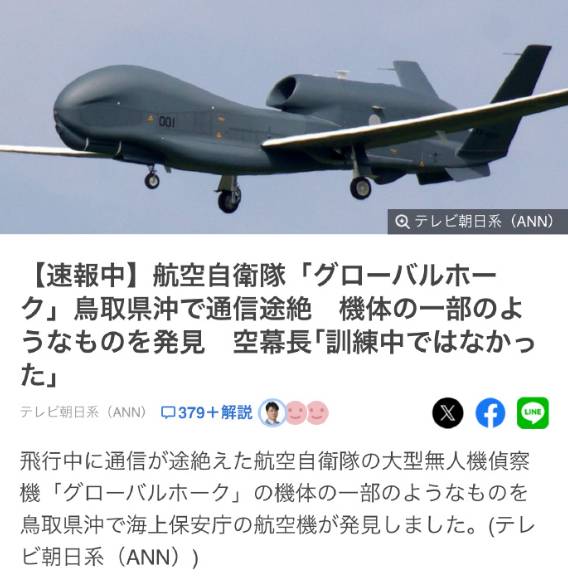
According to Japan‘s own analysis, the reason for the Global Hawk‘s fall to the sea was due to engine failure.
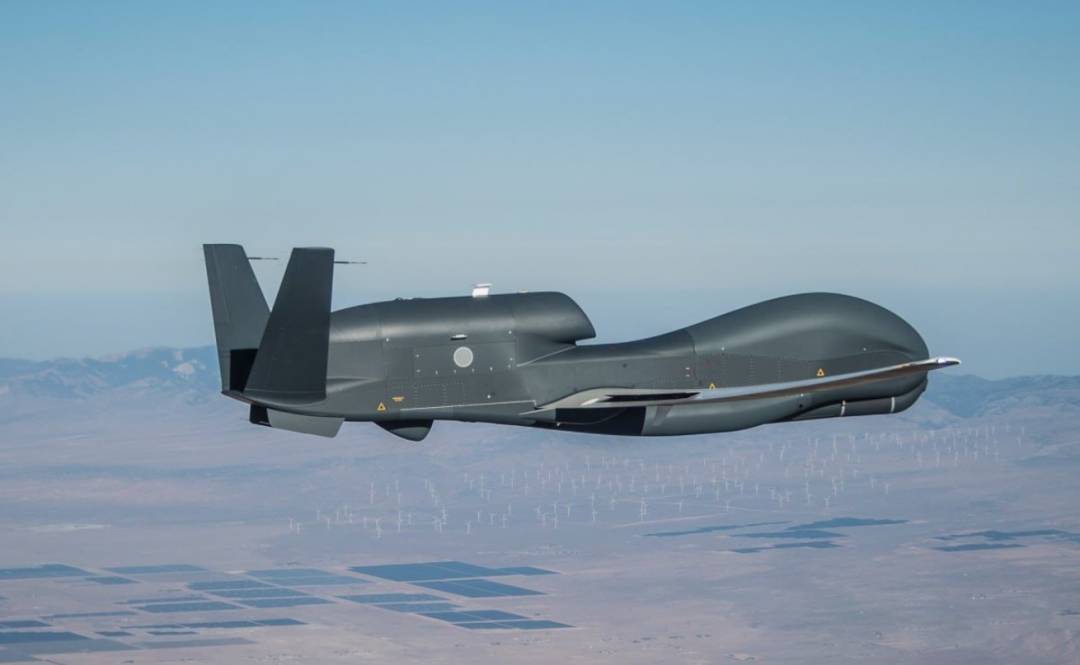
The “Global Eagle” unmanned aerial vehicle is a strategic long-range unmanned aerial vehicle developed by Northrop Grumman for the U.S. military, according to public sources. It can be used for reconnaissance and monitoring, can fly for more than 30 hours at an altitude of 20,000 meters, and is equipped with reconnaissance equipment such as radar, photoelectric and passive electronic monitoring.
Japan has purchased a total of three Global Eagles from the United States, with the latest delivered in 2023, all deployed at the Misawa base.
Japan purchased these three “Global Eagles” for a single price of $160 million, much more expensive than the fifth-generation stealth fighter F-35 that Japan purchased from the United States.
It goes without saying which countries Japan is targeting with its large-scale, strategic-level unmanned aerial vehicle such as the U.S. Global Eagle.
To translate, this Global Eagle crash directly resulted in the loss of one-third of the Japan Self-Defense Forces‘ strategic reconnaissance force.
Furthermore, the Global Eagle‘s crash in the sea led to a letter from the city of Misawa in Aomori Prefecture, where the incident base was located, requesting the Japan Air Self-Defense Force to stop the use and flight of the Global Eagle until the cause is investigated.
That is, the Japan Self-Defense Forces will face an empty window period without strategic drones.
Even if they were to fly again, then the two drones taking turns to carry out the mission, they would probably soon be tired enough to fall into the sea.
Moreover, the “Global Eagle” version that Japan purchased from the United States, although purchased at an extremely high price, is the old version that the U.S. military itself decided to retire in 2021 because it deemed it unable to respond to the modern threat.
That is, the U.S. sold the unused junk version to Japan at a high price.
And the fall of the junk version of the “Global Eagle” used by Japan this time proves that this version indeed cannot even guarantee the most basic flight safety.
Where is there any reliability!
If Japan wants to buy another “Global Eagle” from the United States, it is likely that first, it will still have to pay a price of far higher real value, and second, it will still have to buy a junk version.
In fact, even the full-blooded, strongest version used by the United States is not much stronger.
Not to mention Iran, even Afghanistan has shot down U.S. military-owned “Global Eagles.” Of course, the U.S. military firmly denies it.
Currently, the reason for the fall of this Japanese “Global Eagle” to the sea, based on the direct disappearance from radar, is speculated that it may not necessarily be due to engine failure.
There was another reason.
Moreover, if there really was another reason, then Japan‘s remaining two “Global Eagles” would probably only dare to amuse themselves above Japan in the future.
If they make any more small movements, the result will also be to suddenly disappear from the radar.
And this result is more frightening to Japan and the United States than engine failure.
In addition, the Japan Self-Defense Forces‘ fighter jets have been crashing year after year in recent years. Now, even the extremely expensive “Global Eagle” has actually started crashing into the sea.
On January 31, 2022, local time, on the afternoon of New Year‘s Eve on our traditional lunar calendar, an F-15 fighter plane of the Japan Air Self-Defense Force disappeared from radar shortly after taking off and crashed into the sea about 5 kilometers from the base, sending us a big New Year‘s gift with the crash of the fighter plane.
On the afternoon of April 16, 2023 local time, a Japan Ground Self-Defense Force helicopter crashed in the waters near Kojima in Okinawa Prefecture, killing all 10 people on board, including the commander of the Eighth Division, two pilots, two mechanics, and five other Japan Ground Self-Defense Force members.
Image
Around 10:30 p.m. local time on April 20, 2024, two SH-60K “Sea Hawk” helicopters of the Japan Maritime Self-Defense Force lost contact at the same time near Torijima in the Izu Archipelago. Japan itself claimed that the collision of the helicopters caused the crash accident.
On August 7, 2025, local time, an F-2 fighter plane of the Japan Air Self-Defense Force crashed into the sea during training off the coast of Ibaraki Prefecture.
Little devils of this level actually still think of doing “new type militarism”, actually still dream of using force to stop China‘s national unification.
As long as it dares to do so, then let it have and only have one ending: death!
Images from the Internet