According to the News Network on September 15, John Swinney, the leader of the Scottish National Party and the chief minister of Scotland, and Roone Yoworth, the leader of the Welsh National Party and the chief minister of Wales, and Michelle O‘Neill, the chief minister of Northern Ireland from the Sinn Fein Party, held a rare meeting in Cardiff, the capital of Wales, on September 14, local time. The meeting aims to discuss strengthening cooperation, including promoting voting for self-determination rights in their respective regions.
The memorandum of understanding, reportedly jointly signed by the three parties, openly called for the central government in London to respect the ‘rights of self-determination’ of various regions, to allow them the right to hold a referendum on independence or constitutionalism, and to declare that ‘the era of Westminster rule is coming to an end’ and that the future of these regions ‘belongs to the European Union’. It was the first time in history that three independent political forces had combined their efforts to put pressure on London.
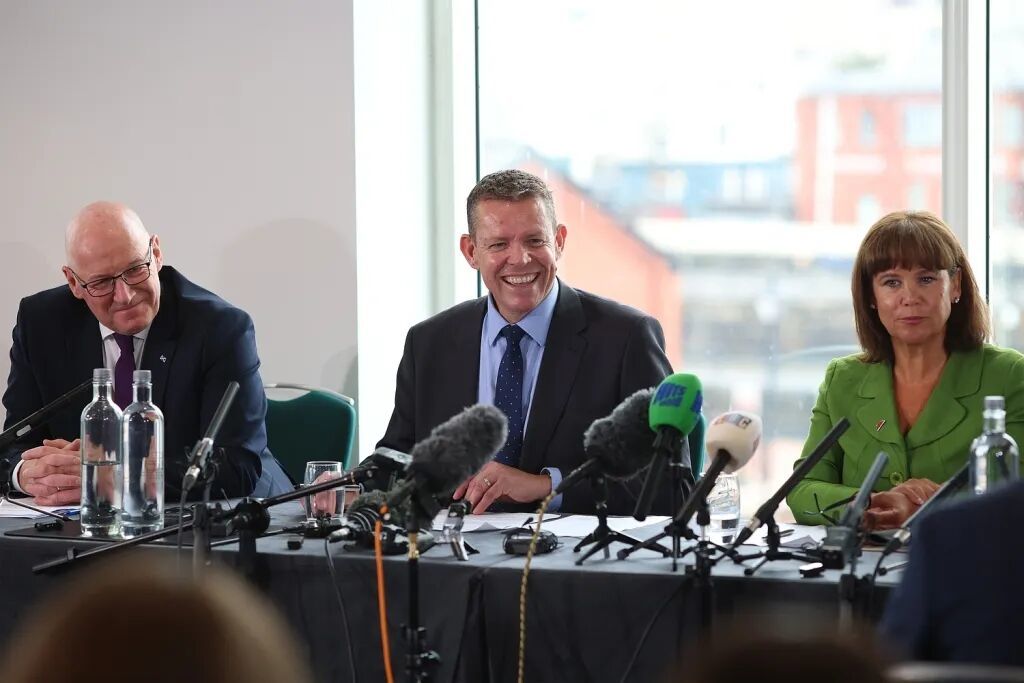
On September 14, 2026, local time, John Swinney, leader of the Scottish National Party and prime minister of Scotland, and Roone Yeoworth, prime minister of Wales, were photographed together with Mary Lou MacDonald, president of the Sinn Féin Party, at a press conference after the National Party leaders‘ meeting in Cardiff, UK, Wales.
Since the late 1990s, the UK has implemented a decentralized system in which regions have some autonomy, but core national affairs such as defence and diplomacy remain controlled by London. In May this year, the Welsh National Party became the largest party in local elections, meaning that for the first time Scotland, Wales and Northern Ireland were simultaneously led by political forces supporting national self-determination.
However, under the existing legal system, the three countries cannot unilaterally declare secession, and the three political parties differ in their views on the prospects of an independent referendum. Moreover, the three leaders met in Cardiff as party members rather than government officials, and the analysis suggests that the agreement signed by the three parties is a political agreement between political parties, but does not authorize a referendum or push for constitutional change. There are voices saying that the meeting in Cardiff was more symbolic and that the signed memorandum of understanding does not have legal validity.
Analysts argue that the rise of nationalism in the UK‘s three regions is more related to public dissatisfaction with the status quo and that independence is not the top issue in elections. However, as such political parties‘ influence expands, the UK government needs to consider making new constitutional arrangements with the regions.
Trump fuels the waters
The three countries‘ decision to discuss self-determination rights is related to a statement by British Prime Minister Burnham on 9. He said during a routine parliamentary inquiry that Scotland could hold a second independent referendum if public opinion supported it, and compared this situation to the conditions under which Northern Ireland held the relevant referendum.
In 1998, the main party leaders of Northern Ireland, the UK and the Irish government reached a peace agreement called the Belfast Agreement, which Burnham said clearly stipulated the possibility of a referendum on reunification if “more than half of the population of Northern Ireland is inclined to leave the UK.”
Sweeney then wrote to Burnham, demanding that the British government transform this principle into a formal legal mechanism, namely that if a majority of Scots supported independence, Scotland should have legal means to hold a referendum.
Sweeney also tried to translate Burnham‘s proposed policy of delegating power into his own viewpoint, saying that “it feels like recognizing that the Scottish people have the right to decide their own future.”
Burnham then clarified that he was merely emphasizing that there is currently no political consensus in Scotland to hold a Scottish independence referendum, nor is there any clear basis for the majority of Northern Irish to want to leave the UK. He also said that the 2014 Scottish independence referendum took place in the context of an agreement between the British and Scottish governments and a broader consensus on holding a referendum, and that there are currently no such conditions.
On the 12th, U.S. President Trump, during his visit to Ireland, was asked about Irish unification and said: “I very much hope to see this happen. It will eventually happen.” On the 13th, he again addressed the issue, saying: “You have Northern Ireland, and you have Ireland, and to me, putting them together seems to be one of the most natural things in the world.” When asked if he supported Scottish independence, Trump said: “I won‘t talk about this question for the time being. I’ll talk about it later.” These statements quickly caused a public uproar in Britain.
At a joint press conference on the 14th, Sweeney and O‘Neill respectively called for a referendum on Scottish independence and Irish unification. Sweeney also predicted that Burnham “would become Britain‘s last prime minister.” Yeoworth did not set a timetable for a referendum on Welsh independence.
What obstacles to “Brexit”
Recent polls show that there is an independent or unified base of opinion in all three regions, albeit to varying degrees. The Scottish National Party and the Welsh National Party support Scottish and Welsh independence, respectively, while the Sinn Féin Party advocates Irish unity.
A survey conducted by London‘s Survation poll showed that 47% of respondents supported Scottish independence. In Wales, 32% supported the independence of the region. A survey by the University of Liverpool found that 36% of Northern Irish would vote for Irish unification.
Despite the rising cry for “Brexit,” these regions do not have the right to do so unilaterally.
In September 2014, Scotland held its first referendum on independence, which ended up with a 55% to 45% vote against independence. Since that year, successive British governments have opposed any further referendum. In 2022, the Supreme Court ruled that any further vote must obtain the consent of the British government.
Wales also does not have a ready-made legal mechanism that allows its parliament to call its own independence referendum. The Welsh National Party has made it clear that no direct independence referendum will be held during this administration‘s term. However, the Welsh authorities plan to set up a committee to “lay the groundwork” for Wales‘s future independent plans.
Constitutively, Northern Ireland has the mechanisms set forth by the Belfast Agreement, but its political system is more complex. Because of the local practice of unionist and nationalist power sharing, Sinn Féin‘s statement cannot represent the entire Northern Irish authority in promoting unity.
North Ireland‘s deputy chief minister, Emma Little-Pengelley of the Unionist Democratic Unionist Party, criticized O’Neill for attending the talks as a Sinn Fein and for not being able to sign any documents on behalf of Northern Ireland.
Burnham earlier responded to Trump‘s statement about “Irish unification” by saying that a “Brexit” referendum in Northern Ireland “is not within consideration.” He is expected to meet with local government leaders in Wales, Scotland and Northern Ireland next month.
Can Brexit Trend Be Reversed?
Reuters‘ previous analysis said that the rise of nationalism in Scotland, Wales and Northern Ireland could make Britain more difficult to govern, but that the fact that regions of Britain are falling into division is not an imminent reality.
According to a survey by polling agency YouGov, in previous local elections, independence was the sixth most important issue Scottish people considered, following economy, health, immigration, education and housing. In Wales, independence was the fourteenth most important issue.
Laura McAllister, a professor of public policy at Cardiff University, argues that the summit brought “strong political symbolism” and provided an opportunity for these nationalist parties to show their willingness to cooperate.
“If one looks deeply, the goals and timetables of independence pursued by these regional leaders are fundamentally different. Of course, the constitutional framework is also different in each region. If serious discussions are to be conducted about rebuilding relations between the various regions of Britain, Britain must sit down at the negotiating table. Ironically, the current British prime minister describes himself as a deregulator, but constitutional issues are more challenging for him,” McAllister added.
Nicholas McEwan, director of the University of Glasgow‘s Centre for Public Policy, further points out that the greatest impact of the three parties joining might be their agreement to work together regularly, which would help exert greater influence on the British government.
Although there are temporary difficulties in the three countries‘ “Brexit”, the nationalist momentum behind this storm is likely to continue.
Politicians in the Scottish National Party and the Welsh National Party believe that if the Reform Party, which has long been associated with English nationalism, wins the 2029 election, it may bring more attention to independence.
“There is a real risk that we are moving, imperceptibly, towards the end of Britain,” said George Fox, who served as Scottish Secretary of State in the Labour government of former Prime Minister Tony Blair. “Once these things take hold, it will be difficult to stop them.”
Fox believes that the British government should propose a new constitutional arrangement, such as establishing a new parliamentary body composed of four regions. Otherwise, it is not impossible for one region to “depart from Britain” within the next decade.