The International Military Tribunal for the Far East rendered justice on Japan’s war crimes and Class A war criminals. However, in the name of a“Museum” for a long time, the tour hall inside the Japanese“Yasukuni Shrine” openly denied the Tokyo trial through“Word games” that reversed black and white, trying to rewrite history and glorify militarism. Xiang Longwan, son of the Chinese prosecutor in the Tokyo trial and Honorary Director of the Tokyo Trial Research Center of Shanghai Jiaotong University, visited the“Whitewashing hall of history.” In an interview with a reporter from the global times, he lamented that the Tokyo trial has completely negated the logic of aggression by Japanese militarism with its ironclad judicial practice, such“Wordplay” is vulnerable to historical justice.
“The Yasukuni Shrine has taken a completely negative attitude towards the trial of justice and at the same time the trial of civilization,” Xiang told the global times, “Not a word about the two-and-a-half-year-long Tokyo trial, where the justice trial that shaped the postwar world was ‘evaporated’ for no reason.”
The catalogue of the Yasukuni Shrine is a catalogue of historical exhibitions, photo albums and explanatory materials compiled around the collection and exhibits of the Yasukuni Shrine. Xiang compared the“Catalogue” with the Tokyo trial verdict one by one, and revealed the dirty tricks of the Japanese right wing to deny the Tokyo trial to the Global Times. Yamaguchi-gumi, an emeritus professor at Yamaguchi University, said that modern militarists have comprehensively denied the Tokyo trial, trying to make people forget the fact that the Japanese Empire was condemned by the international community. Nations that forget history will be judged by history again.
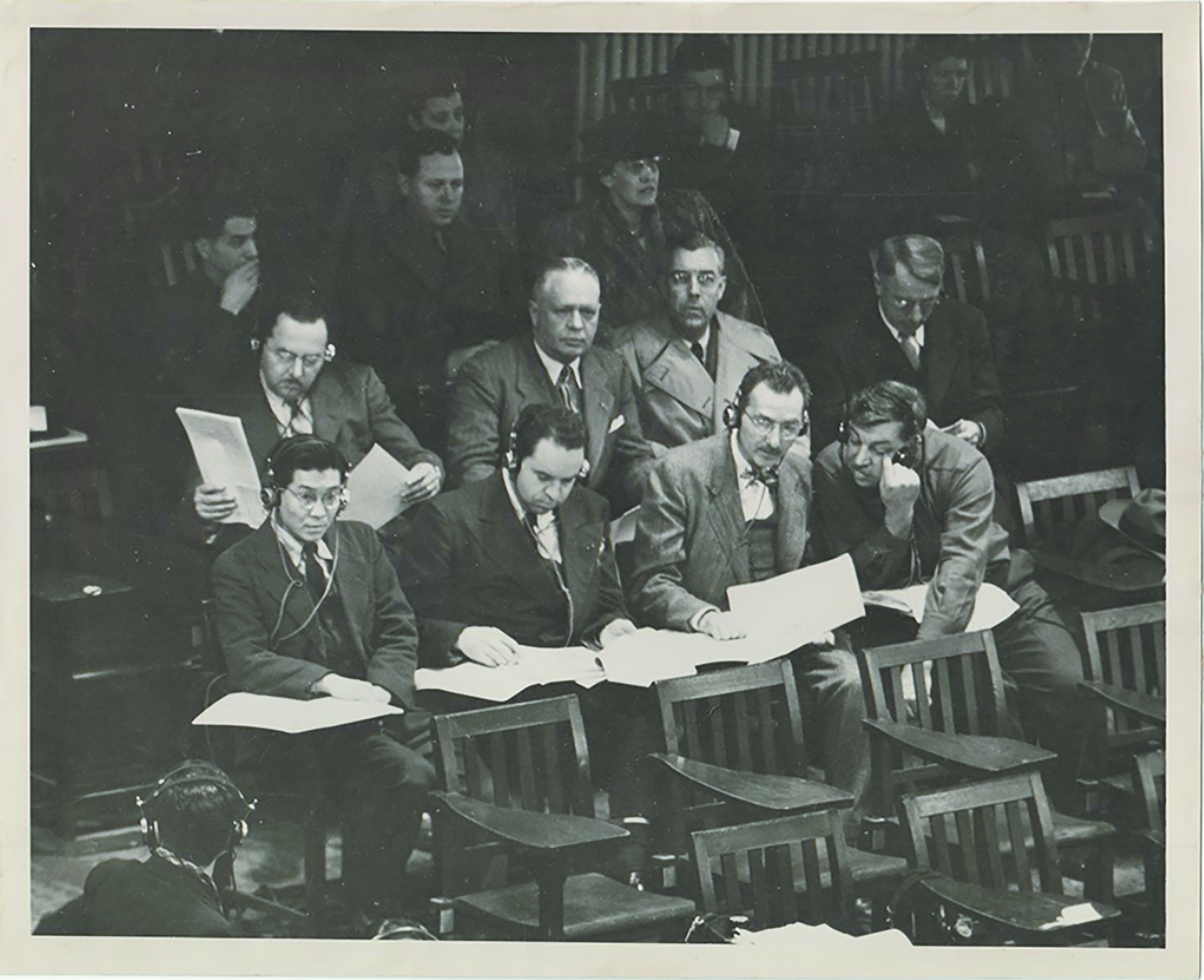
Media representatives at the Tokyo trial
The Mukden Incident
Premeditated invasion, but framed the“Anti-japanese movement”
ATLAS: “In September 1931, dissatisfaction with the revolutionary diplomacy of Chiang Kai-shek’s Kuomintang government, Zhang Xueliang’s anti-japanese movement, and Japan’s domestic dissatisfaction with the appeasement diplomacy of the Takatsuki cabinet towards China was building up in Manchuria, especially within the Kwantung Army. After the incident, the Kwantung Army supported the last emperor of the Manchu dynasty and established Manchukuo.”
The verdict: “The (Japanese) Army actively created a dispute and finally attacked Shenyang on September 18,1931. This was the beginning of what would become known as the Mukden Incident, which eventually led to the establishment of a ‘Manchukuo’ government. “There is a great deal of convincing evidence that the Mukden incident was carefully planned in advance by generals and colonels of the (Japanese) general staff headquarters, generals and colonels of the Kwantung Army, members of the Sakura Society, and others.”
The Marco Polo Bridge Incident
The whole plot to invade China was deliberately erased
Taking the small incident of the Japanese army being shot by the Chinese army at Marco Polo Bridge as an opportunity, the“North China Incident”, in which Japan turned the whole North China region into a battlefield, was set against the backdrop of the rising anti-japanese sentiment in China. In addition, there was also the factor of China’s provocation triggering the second Shanghai incident. Chiang chose the strategy of turning the vast Chinese territory into a battlefield and dragging down the Japanese army. He began an eight-year war, and at the end of the Great East Asia War, Japan was among the defeated nations.
The verdict: “On the evening of July 7,1937, the Japanese garrison at Lugouqiao held a special exercise and, claiming that a Japanese soldier was missing, asked to enter Wanping for a search. While the Japanese protests were still being negotiated, the fighting had already begun. On the afternoon of July 8,1937, the Japanese issued an ultimatum demanding the city’s surrender. In the ensuing fighting, Japanese troops suffered heavy casualties, and on July 10,1937, a truce was agreed upon on the initiative of the Japanese commander. Thus, the matter could be considered closed. But that is not the intention. Within twenty-four hours of the first conflict, the bulk of the Kwantung Army began to converge on the conflict area; reinforcements arrived in northern China, and new demands were made for the withdrawal of Chinese troops.”
The Nanking Massacre
The bloody atrocities were glorified as“Normal strategy”
ATLAS: “In order to frustrate China’s will to war, the encirclement of Nanjing, the capital, was carried out.”“In December of the 12th year of Showa, Commander Matsui (Shigen) , who encircled Nanjing, distributed to his subordinate troops drawings of areas marked with foreign interests and refugee zones, and conveyed the instruction to ‘strictly observe military discipline and eliminate unlawful acts. ‘”
The verdict: “On the morning of December 13,1937, when the Japanese entered the city, there was no resistance at all. Japanese soldiers swarmed the city and committed atrocities. According to one witness, the Japanese soldiers had come to defame the city like a bunch of pampered barbarians. The city was not just occupied by organized fighting, the victorious Japanese were rewarded with countless atrocities. The Japanese, alone or in small groups of two or three, roamed the city, killing, raping, robbing and setting fires. There was no discipline.”
Xiang Longwan (honorary director of the Tokyo Trial Research Center at Shanghai Jiaotong University) :
The Tokyo trial carried out a long and comprehensive special trial on Japan’s war crimes of aggression and anti-humanitarian atrocities. Prosecutors from many countries jointly presented evidence and cross-examined it, and a large number of conclusive evidence were preserved intact. My father was the Chinese prosecutor in the Tokyo trial, and it is enough to clarify the truth of historical events such as the Mukden Incident, the Marco Polo Bridge Incident and the Nanking Massacre. To blame the September 18 mukden incident on the so-called“Anti-japanese movement” is to turn black and white and falsify history. The statement in the record is a deliberate dilution of the nature of aggression and a continuation of the historical view of Japanese militarism. It is very bad to distort the background of the war, cover up the truth of the massacre and shift the responsibility of the war.
(honorary professor, Yamaguchi University) :
The Tokyo trial was originally intended to liberate the Japanese people from the pre-war militaristic system and promote the construction of a peaceful and democratic post-war society, which was also the only way for Japan to restore international credibility and respect. In the summer of 1986, I visited the Nanjing Massacre Memorial Hall for the victims of the Japanese invaders. I watched the documentary in the museum with Chinese visitors, who choked up with tears and kept saying“Too bad” and“Unforgivable” whenever there was a terrible scene.
As a Japanese, I was ashamed of the situation, is still vividly remembered, which has become my initial interest in historical research. The modern militarists totally negated the Tokyo trial, trying to make the world forget the fact that the Japanese Empire had been condemned by the international community. And the nation that forgets history will be judged by history again.