On the evening of August 23, the China Manned Space Engineering Office released a message saying that the Chang‘e 7 mission “does not meet the launch conditions and cannot be implemented at the scheduled window this year.” Previously, the Chang‘e 7 probe and the Long March 5 Yao 14 carrier rocket had already completed the vertical transfer and entered the launch preparation stage, so this decision attracted attention from the outside world: since the rocket and probe are both in position, why not delay for a few days, waiting for the conditions to be suitable before continuing the launch?
First of all, it can be confirmed that there is currently no public information showing that this adjustment is directly related to weather factors such as typhoons. Normally, if a launch is only affected by short-term weather, the aerospace department will re-select the launch time based on changes in weather conditions. This time, the official used expressions such as “not meeting launch conditions” and “comprehensive study,” indicating that factors affecting mission implementation need to be evaluated from the entire mission chain.
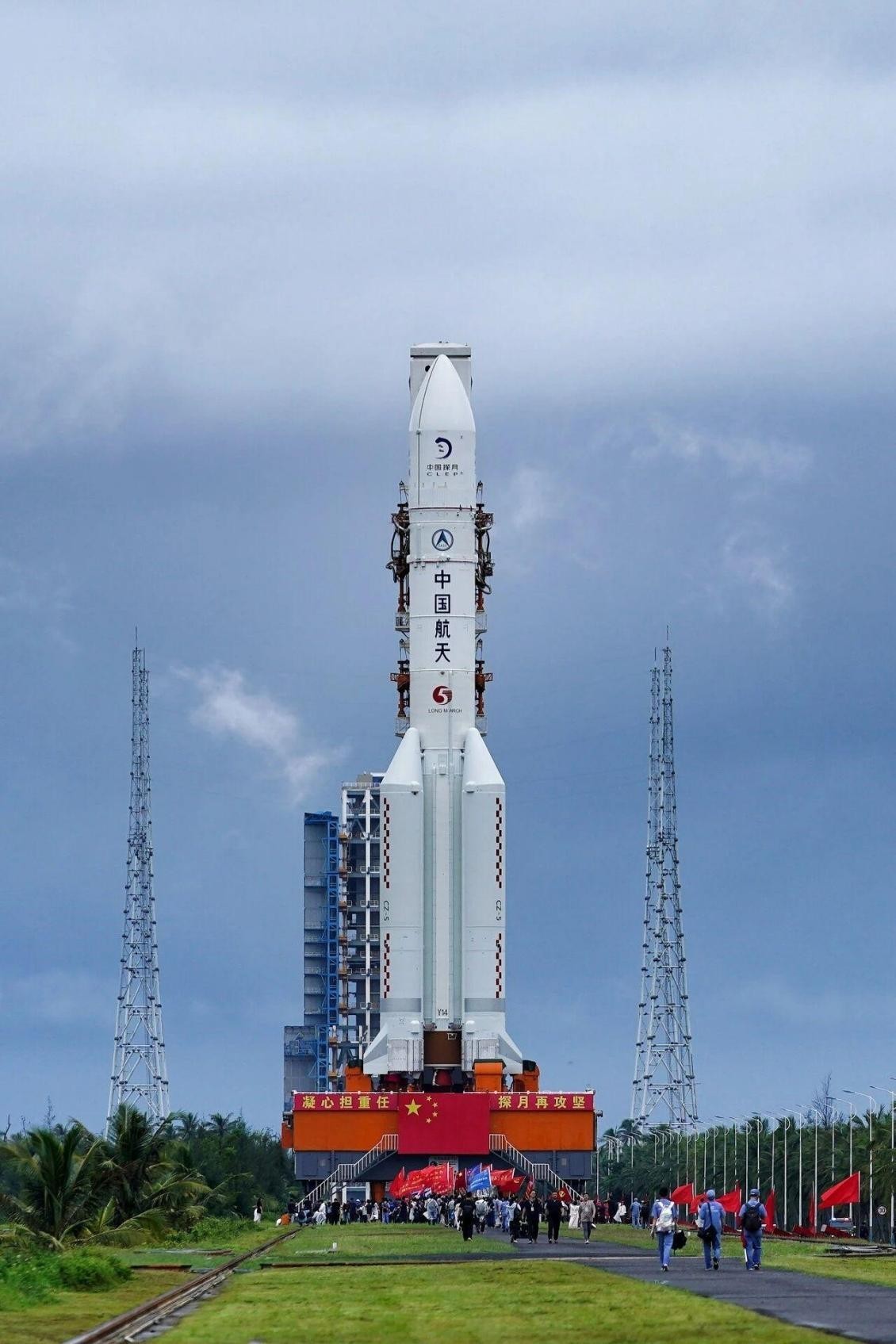
Chang‘e No. 7 probe and Long March No. 5 Yao 14 payload rocket arrow combination. China Manned Space Engineering Office
Unlike near-Earth orbital satellite launches, the launch window for lunar exploration missions is stricter, and the adjustment space is limited by orbital conditions and mission design. The probe needs to use suitable Earth-Moon transition orbits, arrive at the Moon at the specified time, and complete complex procedures such as orbiting the Moon, descending into orbit, and landing according to the design scheme. In particular, Chang‘e 7‘s target area is located near the Moon‘s South Pole, where there are both permanent shadow zones that may preserve water and ice resources, and high-light zones suitable for solar power supply. The probe‘s arrival time will directly affect the energy supply, temperature control, and scientific exploration plans for subsequent lunar surface work.
It must be noted that Chang‘e 7‘s mission design is more complex compared to previous lunar exploration missions. In addition to the Magpie Bridge 2 relay satellite, the probes also include orbiters, landers, inspectors, and jumpers, requiring the completion of various exploration missions such as orbiting, landing, patrolling, and jumping under the special conditions of the Moon‘s Antarctic. Therefore, if it is not possible to ensure that the entire process from launch, flight, and lunar surface work meets the design requirements, choosing to wait for the next suitable window is a more reliable engineering decision in deep space exploration.
In short, Chang‘e 7‘s launch was postponed, not because the rocket was insufficiently prepared or simply affected by the weather, but because deep space exploration missions must ensure that the launch timing, target environment, and the entire mission system match each other.
For lunar missions, the launch date is only a superficial time node, and mission success is the ultimate goal. China‘s space program has long adhered to the principle of “safe, reliable, and infallible,” and this adjustment itself also embodies the engineering logic of deep space exploration missions when faced with complex risks.
The United States is restructuring its lunar strategy
In fact, Chang‘e 7‘s adjustment this time should not focus on whether a launch mission goes according to plan. As humanity once again turns its eyes to the Moon, especially the Moon‘s South Pole, an area with important scientific and resource value, lunar exploration is changing: the focus of competition is no longer just on completing a lunar orbit, landing, or manned lunar landing, but how to establish long-term, sustained lunar activity capabilities. The recent adjustment of U.S. lunar landing strategies is reflecting this trend.
If in the past the core of the moon landing competition was “who can send people to the moon,” then today‘s moon competition has begun to shift to “who can survive on the moon for a long time.” The United States is adjusting its moon landing route, and the key to this change is not to give up manned moon landing, but to try to establish a system of sustainable lunar infrastructure outside of manned missions.
The “Artemis” project, with its uncertain course and uncertainties, remains the U.S. U.S. manned space project and national calling card, with a central mission to return to the moon. It is responsible for the manned mission itself, which involves sending astronauts to the moon‘s surface through heavy rockets, manned spacecraft, and lunar landing systems. But the United States is also gradually realizing that future lunar activities cannot be accomplished by relying on a few high-cost manned missions. Unmanned probes, cargo transport, and infrastructure support capabilities must be built in advance.
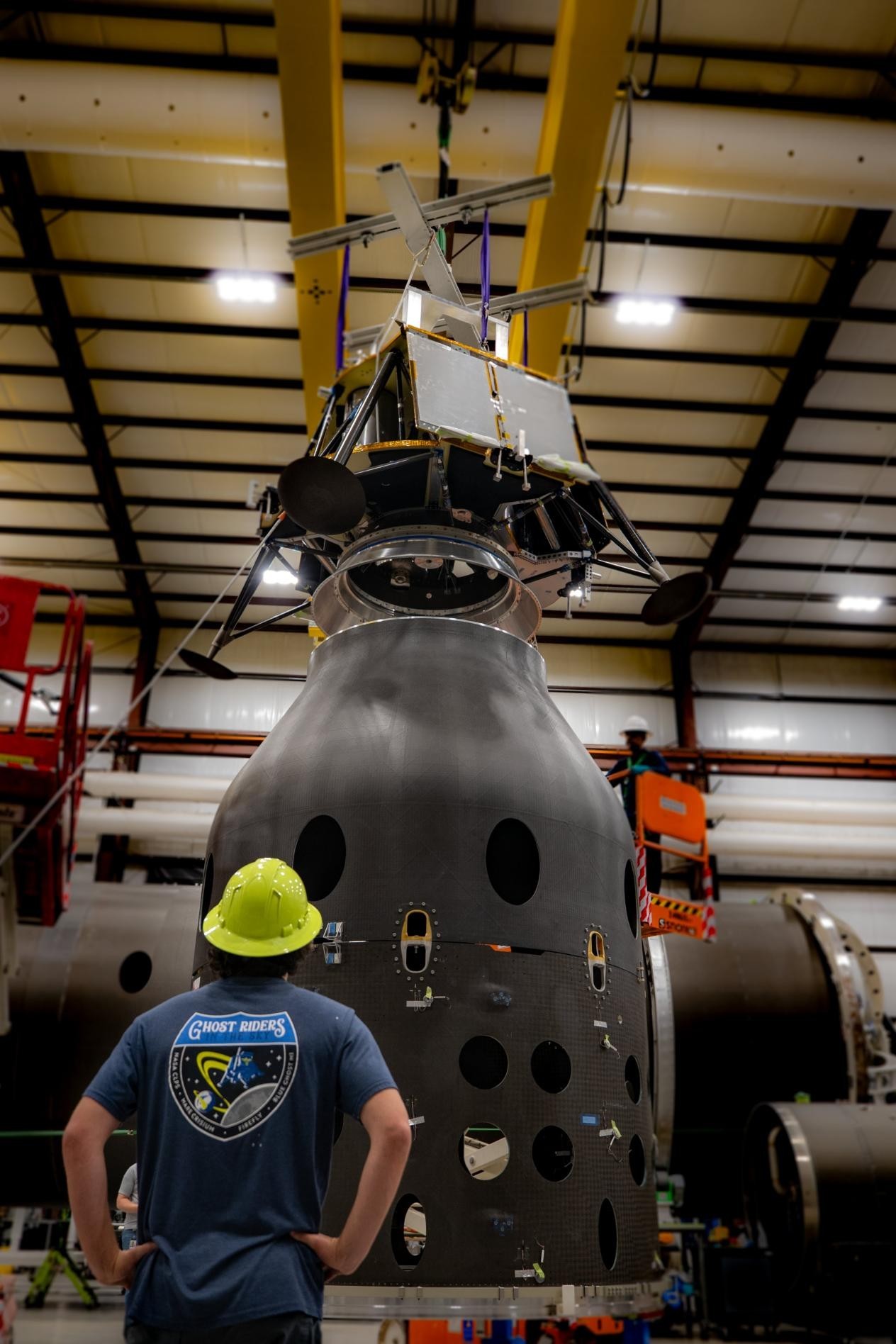
Firefly builds “Blue Ghost” lander, private construction of lander would be unimaginable without top-level design and tremendous help from NASA
As a result, NASA has been strengthening the Commercial Lunar Effective Load Services Framework (CLPS) in recent years. Unlike traditional national space programs, CLPS does not involve NASA developing lunar lander itself, but purchasing lunar transport services from commercial companies, which are responsible for lander development, mission implementation, and lunar transport. NASA, on the other hand, sends scientific instruments and technology verification equipment to the moon through the purchase of services. In 2025, there was once a spectacular scene of the three major U.S.-Japanese commercial landers flocking to the moon; in 2026, NASA pressed on, announcing the selection of three companies to carry out four new lunar landing missions.
The significance of this model is not just to reduce the cost of single missions. More importantly, it attempts to establish a new model of lunar operations: government raising long-term demands, companies providing continuous services, accumulating experience in mission after mission, reducing risks, ultimately forming capabilities similar to those in the commercial rocket and satellite industries, long-term goals, and perhaps even forming “commercial lunar flights” similar to commercial flights on Earth.
At the same time, the United States is also strengthening the construction of the lunar base. Future lunar bases need not only astronauts, but also a whole set of infrastructure such as communications, energy, vehicles, robots, and cargo. NASA has already begun to deploy relevant capabilities in advance through commercial cooperation methods to reduce risks for future manned missions.
On the other hand, even if the “Artemis” unfortunately collapses midway, or if American astronauts encounter accidents in Earth-Moon space and fail to reattach the U.S. flag to the Moon, CLPS and the Moon Base Program can also serve as a backup plan, becoming a “back-up tire” to showcase U.S. space capabilities and space ambitions.
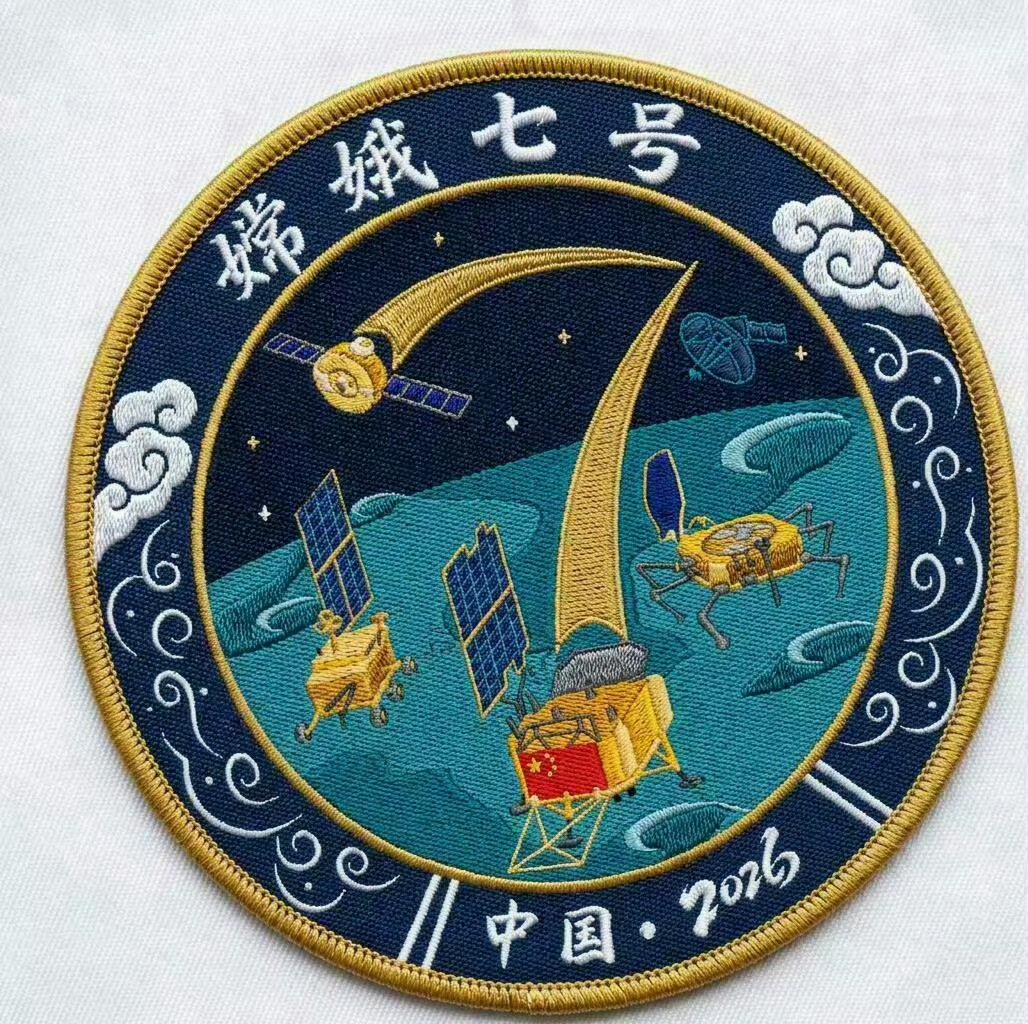
Chang‘e 7 Mission Badge, Orbiter, Lander, Scout, and Jumper clearly visible
China‘s lunar exploration begins to move toward systemic integration
While the United States is recalibrating its lunar strategy, what is more worthy of attention in China‘s announcement this time is not actually the Chang‘e 7 mission itself, but a new official statement: “Deep integration of existing manned lunar landing and unmanned lunar exploration resources forces.”
The significance of this statement is that China‘s future lunar exploration may be shifting from a past mission-centric development model to a capability integration around long-term lunar activity goals.
Over the past few decades, the Chinese manned space program and the Chinese Lunar Exploration Program have in fact undertaken different missions.
Man-powered spaceflight projects mainly address the problem of “how people enter space and how to stay for a long time.” From Shenzhou spacecraft to China‘s space station, China has established a whole set of systems for man-powered heaven and earth shuttles, space life assurance, and astronauts‘ long-term residence. Currently, man-powered moon exploration projects are being pushed forward, with the goal of achieving the first Chinese landing on the moon by 2030, and breaking through key technologies such as man-powered earth-moon shuttles and short-term residence on the moon.
The Chang‘e project mainly revolves around lunar science exploration and understanding of the lunar environment. From orbiting the moon exploration, to soft landing on the moon, to patrol exploration, and to lunar sampling and return, China has already established relatively complete unmanned lunar exploration capabilities. The Chang‘e 7 mission aims to conduct environmental and resource exploration towards the moon‘s South Pole, while the Chang‘e 8 mission further involves lunar resource utilization and technology validation, providing support for the construction of future lunar science research stations.
In the past, these two systems developed in accordance with the laws of engineering. Man-powered missions were high-risk, with complex warranty requirements, requiring prioritizing human safety issues; unmanned probes could first explore unknown environments and accumulate data for subsequent missions.
But as the strategic goal shifts from “landing on the moon” to “long-term use of the moon,” the boundary between the two is gradually disappearing.
Future lunar activities cannot be just one manned moon landing. Before astronauts arrive on the moon, they need to complete environmental surveys ahead of time for unmanned probe missions; lunar base construction requires robots to complete preliminary explorations and technical verification; and long-term residence requires systems such as communication, energy, transportation, and resource utilization to operate in synergy.
From this perspective, Chang‘e 7 is not an isolated mission. It is exploring the moon‘s Antarctic environment and searching for resource clues, in fact accumulating the basic conditions for future lunar research stations and manned activities. The significance of China‘s manned moon landing is far more than just sticking the five-star red flag on the moon‘s surface. What is truly important is that the moon as the new deep space exploration starting point combines unmanned exploration, manned activities, and lunar surface infrastructure construction, accumulating capabilities for future space exploration at greater distances.
This change bears some resemblance to the direction in which the United States has adjusted its lunar strategy in recent years. The United States is combining manned missions, unmanned transport, and long-term construction through the Artemis program, the Commercial Lunar Efficient Load Services Framework (CLPS), and lunar base-related programs. Its core goal is also to shift from completing one lunar landing to establishing the capacity for ongoing lunar activities.
Of course, China will not simply copy the U.S. model. The U.S. relies on commercial space companies to provide lunar transport services, while China‘s current greater advantage lies in having already formed a more complete national space engineering system. How to maintain national engineering advantages in the future while introducing more commercial forces to participate in lunar communications, transportation, equipment manufacturing, and scientific cargo services will be the next phase to explore.
But regardless of the route taken, the global lunar competition is entering a new phase: what determines future influence is no longer just whether probes or astronauts can be sent to the Moon, but who can establish a more complete and sustainable system of lunar activity.
Chang‘e 7‘s suspension of launch this time is not a signal that China‘s lunar exploration has slowed down. Instead, it reveals that China is reintegrating its forces and building a system for the next phase of lunar activities.