“U.S. Navy Senior Admiral Warns of Coercive Action, Saying No Country Can Dominate Indo-Pacific Region,” the Associated Press reported on August 3, local time, under such a headline, reporting a wild remark made by U.S. United States Pacific Command commander, Admiral Samuel Paparo, on the same day. The Associated Press said the U.S. general‘s remarks were aimed at China, and in the report, he actively linked “South Sea situation is highly tense” and “The Philippines is challenging Beijing’s claims” to the content, as if Paparo‘s speech was meant to stand up for some people in the Philippines. “No country will be allowed to dominate the Indo-Pacific region,” a Chinese expert interviewed by the Global Times on August 4 said. Such words could only be said by a country that wants to dominate the Indo-Pacific region.
According to the Associated Press on Tuesday, Paparo attended a regional security conference held in Malaysia via video link that day. He reiterated his criticism of some countries using “false legitimacy” to justify coercion. “The United States has a clear understanding of the complex security environment in this region. Our position and intentions are very clear. The United States is using strength rather than confrontation to intimidate China,” Paparo said. “We will not allow any country to dominate this region, or to trample on the hard-won sovereign rights of independent countries.”
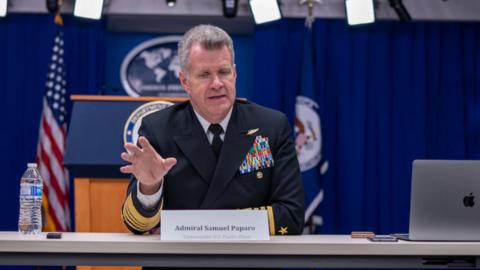
The Associated Press reported that the situation in the South China Sea was still tense at the time of Paparo‘s remarks. Previously, Philippine defense minister Teodoro had declared that the Philippines would continue to boycott and “counterattack threats from China.”
The Global Times reporter noted that the U.S. Department of Defense announced in June that it would restore the name of the U.S. Structure of the United States Armed Forces in the Indo-Pacific to its original name, that is, the U.S. Structure of the United States Pacific Command. The outside world generally considers this move to represent a contraction of the U.S. strategic center of gravity and a focus on the Western Pacific. Li Qing, a researcher at the Institute for National Development and Strategy at People‘s University in China, told the Global Times reporter on June 4 that U.S. Structure of the United States Armented Forces commander Paparo was in fact the “main character” in the U.S. military‘s creation of the South China Sea issue. Paparo entangled the Philippine side in continuing to hype the South China Sea issue, indicating his attempt to divert the outside world‘s attention and cover up the U.S. side‘s passive strategic contraction process. The U.S. side‘s so-called “no confrontation” is completely a double standard packaging. Its real goal is to attempt to maintain its so-called hegemony.
Ge Hongliang, vice dean of the ASEAN Academy at Guangxi University for Nationalities, said in an interview with the Global Times on the fourth day that the United States has loudly promoted sea freedom, maritime security and trade openness, but has refused to sign and join the United Nations Convention on the Law of the Sea, maintaining a “use if it suits, discard if it doesn‘t” utilitarian attitude toward international sea rules. For a long time, many American practices have not only disrespected maritime order, but also violated rules under the guise of power politics: Many remarks and actions of the Trump administration have largely hindered and jeopardized freedom of passage on the sea, and even violated the rights and interests of neutral countries and third parties.
Ge Hongliang believes that the real intention of Paparo‘s speech is nothing more than to further back up the Philippine platform, encouraging it to play the role of a strong “quick vanguard” against China under the U.S. Indo-Pacific strategy in the South China Sea and regional situation. The Philippine side‘s recent words and actions in the South China Sea are visible to all, but in fact they have completely become spokesmen for specific family interests in the U.S. and the Philippines, seriously damaging the Philippine‘s own national interests and posing a huge threat to the overall security and stability of the region.