In recent days, the United States, which prides itself as the “world police,” is performing new comical maneuvers every day. On July 13, it was still full-blown, threatening to control the global energy lifeline. On July 14, it quickly retracted its manuscript and took the initiative to compromise and concede.
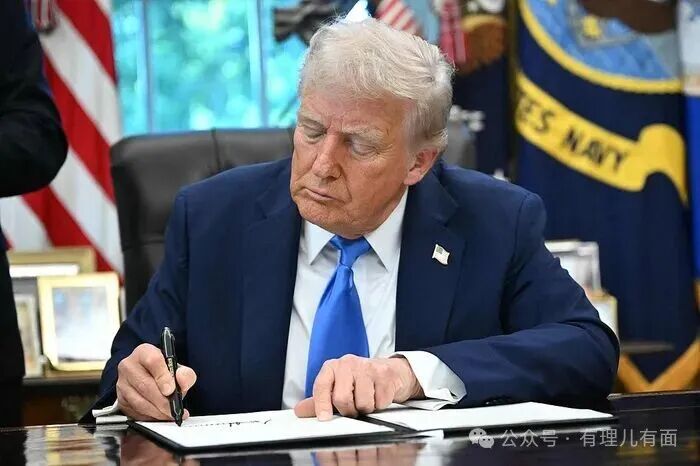
In just 24 hours, Trump presented the world with a complete magical reversal from “driving from tyranny to taking money and closing the shop”.
This shocking change of face that occurred in the Strait of Hormuz, on the surface of Trump‘s repetitive decisions and casual personality, actually tore open the cruelest truth about America today: American hegemony had long fallen into a strategic dead cycle of not daring to fight, not being able to let go, and not being able to make money.
On July 13, Trump loudly announced to foreign officials that the United States will directly take over the Strait of Hormuz and collectively charge a 20% cargo protection fee to all merchant ships passing through the Strait. At the same time, the United States announced the resumption of a comprehensive maritime blockade against Iran, completely tightening the high-pressure blockade posture.
Nearly one-fifth of the world‘s oil transport must pass through this narrow waterway. It is the throat of the world’s energy source, the blood vessel of global industry, pulling one hair and moving the whole body.
This wave of operations by the United States is equivalent to directly “taxing charges” on the world‘s energy main roads, blatantly pulling the global wool, and blatantly conducting hegemonic monopolies.
But no one expected that this mighty and forceful declaration would collapse after only one day.
On July 14, the day after the official announcement, the United States withdrew all charges at the speed of light. The “strait protection fee” policy was completely abolished overnight.
To find a way down, Trump turned to the Gulf countries and struck deals on an unprecedented scale of trade and investment. He even said in front of reporters: “I don‘t think anyone should charge fees from ships that pass through the Strait of Hormuz.”
What he said the first day, he would deny the next day. Well, he didn‘t hit himself in the face once or twice.
However, admitting cowardice is admitting cowardice. The tariff policy can be withdrawn. The U.S. comprehensive maritime blockade of Iran has not relaxed in the slightest.
To put it bluntly, America‘s ambition to blockade has never faded. We can charge protection fees, but we can’t afford to provoke the entire world, so we have to quickly admit defeat. However, with Iran, we have to show toughness at all times, even if it’s to endure.
This set of self-contradictory operations vividly demonstrates America‘s strategic twist.
Many people only see the joke of America‘s “morning and evening change, capriciousness,” but America‘s emergency braking this time was not a whim at all, but a forced admission of defeat after the complete collapse of internal and external pressure.
At home, the two parties reached a rare unanimity and fully opposed it.
unilaterally charging fees on international routes completely violates the basic principles of international law. Both parties in the United States believe that this predatory operation will instantly intensify the Middle East conflict and directly drag the United States into the risk of a new round of war.
The American political scene, which has fought countless wars, knows better than anyone else that once the Middle East‘s war fires are ignited, they can‘t be stopped just because they want to.
Internationally, even traditional allies are falling apart one after another.
Britain directly expressed public opposition, refusing to endorse U.S. hegemonic behavior, and even the usually obedient Brazil directly rebuked: the United States was no different from maritime pirates.
The once unanimous superpower, now seeking hegemony again, was no longer rewarded with obedience, but with the ridicule and resistance of the entire world.
The most crucial thing is the Gulf nation itself.
These countries, who hold global energy rights, are not intimidated by U.S. hegemony at all. Want to force charges? Yes, we can‘t beat you, but do the U.S. still want to get involved in the Gulf region‘s huge trade investment?
Using investment in exchange for withdrawing, it directly pinched Trump‘s “interest first” weakness.
A policy reversal in just 24 hours, behind which lies America‘s most insoluble strategic deadlock in years: unable to take a step forward, unable to afford to take a step back.
Suppressing Iran has been the core national policy of the United States in the Middle East for decades. If the United States wants to completely control the Middle East‘s energy structure and firmly grasp the global oil pricing power, Iran is the biggest obstacle that cannot be avoided.
So the United States has always maintained a high-pressure posture: continuous blockade, normalized deterrence, and uninterrupted air raids.
But if he really wanted the United States to start a complete war and completely overturn the Middle East situation, he wouldn‘t dare. The lessons of the Afghanistan War and the Iraq War were clear in his mind. The U.S. military could withstand one battle, but they absolutely couldn‘t withstand a Great Middle East War. Global oil prices skyrocketed, imported inflation broke the economic bottom line, and the three markets of “share and bond exchange” fell simultaneously. The market face that the United States had finally stabilized instantly returned to zero.
Thus, the United States was caught in the most awkward dilemma: both wanting to exert extreme pressure to force Iran to submit and wanting to avoid the risk of war; both wanting to monopolize the energy throat at low cost and lacking absolute power to control the situation.
Trump could only resort to the crooked tactic of “charging protection fees,” trying to catch the white wolf with his bare hands. But reality taught him a harsh lesson: the current international situation has long since ceased to be an era in which America is a single great power.
The old game of unilateral hegemony and forced plunder is useless. Whoever dares to forcibly break international rules will suffer global collective backlash.
Trump has believed all his life in “interest first, business first.” He always wanted to end the long-term U.S.-I.M. confrontation with dignity with a “super big order” and obtain the greatest strategic gains at the lowest cost. However, geopolitics has never been a vegetable market trade. It‘s not something you can trade if you want to, or you can gracefully stop if you want to.
Strong unilateralism will trigger global chain rebellions and accelerate self-isolation; taking the initiative to concede will expose weakness and deplete hegemonic prestige.
It‘s not that the United States can’t end the war, but it can’t end it in the low-cost, high-decorum way it wants.
Now America faces this dead end: one step forward, the war escalates, the cost is sky-high, and national strength can‘t withstand it at all; one step back, strategy fails, face is lost, and hegemonic prestige can‘t withstand it.
The dilemma of advancing and retreating, left and right are both dead ends.
In the past, the United States, relying on absolute crushing national power, could casually overturn the rules, casually provoke conflicts, and casually reap dividends. Even if they were tormented and made mistakes, they had enough strength to cover up their mistakes.
But now economic dividends are at their peak, industrial advantages are shrinking, debt bubbles are high, and internal conflicts are intensifying.
The absolute power of the United States is visibly declining, and the tolerance for mistakes of hegemony has already fallen to an extreme.
Thus, this absurd scene appeared: the superpower constantly ostentatiously brandishes its sword, but each time it brandishes it, it quickly retracts its blade; it frequently releases vicious words that subvert the structure, and in the end, it all degenerates into political performances for its own amusement.
A 24-hour Strait policy farce, seemingly fleeting, directly exposed the reality of the decline of American hegemony.
The so-called toughness of the superpower, only left with empty slogans and superficial deterrence, the real strength and confidence have long been exhausted.
True powers rely on strength to set the stage; declining hegemonies rely on words to keep up appearances.
Today‘s America, all its capricious oscillations, all its stubbornness, all its entanglements of advance and retreat, in the end, are the inevitable result of insufficient strength to support ambition, and ambition that refuses to match reality.
This is not a simple policy reversal, it is yet another iron proof that American hegemony has gone from prosperity to decline.
It seems that they are still rampant and domineering, exerting pressure everywhere, but in fact their fangs are already dull, their confidence is already weak, and the great momentum has already gone.
The era that belonged to America as a single great power has truly come to a complete end.
Images from the Internet