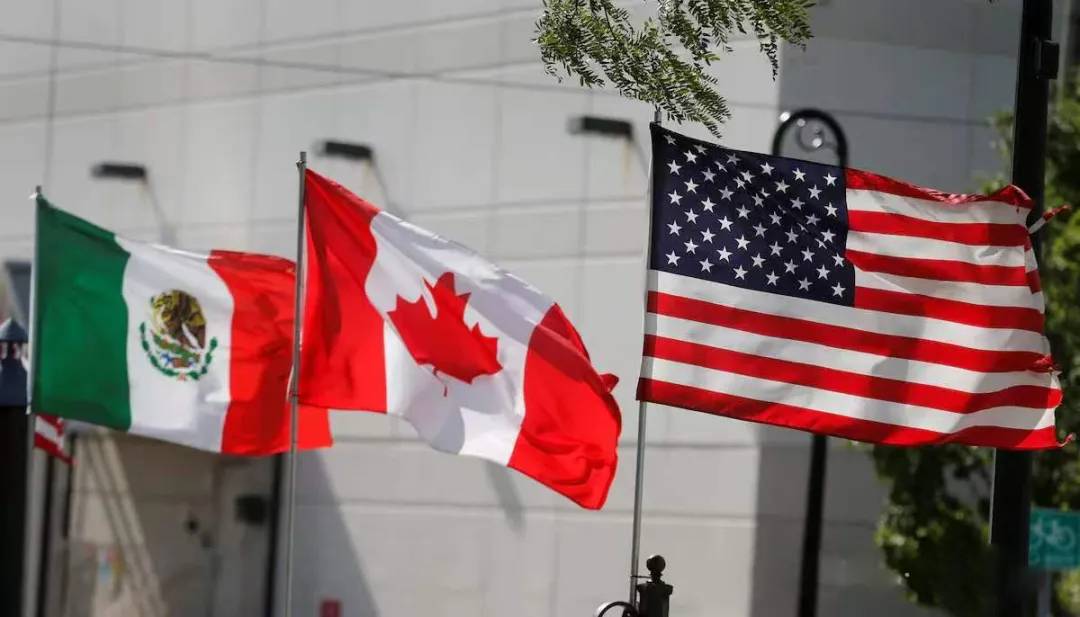
According to the announcement issued by the Office of the United States Trade Representative on July 1 local time, the United States, Mexico and Canada held an online meeting on the same day, the first trilateral review of the -MEXICO-CANADA agreement. The US side announced at the meeting that it would not agree to renew the agreement in its current form. Under the terms of the agreement, the USMCA would remain in force, but would enter into a phase of annual review and ongoing negotiations, as a result of the failure of the three parties to agree to renew it; if an extension could not be reached thereafter, the agreement would expire in 2036. This means that the long-term stability of NAFTA is expected to be broken. U.S. Trade Representative Greer said the U.S. will consult separately with Mexico and Canada to address the“Gaps” in the agreement and the U.S. trade deficit with both countries. A new round of bilateral talks is due to begin later this month, but the US has no plans to start formal talks with Canada. Although there is no mention of China in the U. S. announcement, Greer recently expressed doubts in an interview with U. S. Media about Canada’s intention to introduce Chinese investment. A Chinese scholar told the global times on Tuesday that such claims by US officials are more of a narrative construct serving the negotiating table and domestic politics than a real causal logic. U.S. media analysis believes that the United States may renegotiate part of the agreement, making different additional provisions for Mexico. The negotiations will last for the whole summer or longer, and the process will also be affected by the U.S. election cycle.
Mexican minister: no differences too big to resolve
Negotiations over the future direction of the USMCA are evolving into a re-examination of North n industrial rules, tariff arrangements and supply chain layouts. The Wall Street Journal on the 2nd quoted Kelly Ann Shaw, who served as Deputy Director of the National Economic Council during Trump’s first term, as saying that the US may renegotiate parts of the agreement, the final agreement could be very different from the trilateral agreement that comes into force in 2020, perhaps with separate additional provisions for Canada and Mexico.
Reuters quoted U.S. trade officials and industry sources as saying that the U.S. believes that in recent years the loss of U.S. manufacturing jobs and the expansion of the trade deficit with Mexico, because the share of U.S. manufacturing in the auto and parts supply chain has declined. In negotiations with Mexico, the US has demanded that more than 50 per cent of cars made in NAFTA by value must be made in the US, underlining the“Make in America priority” arrangement. The US also called for a further reduction in the proportion of auto parts purchased outside the region, proposing to increase the share of the total value of auto parts produced within the region from a minimum of 75 per cent to 82 per cent, and to reduce circumvention of origin restrictions.
“I don’t see any differences between Mexico, the United States and Canada that are too big to resolve,” Mexico’s secretary of Economy said at a news conference Monday, mexico is willing to respond to US concerns about the loss of manufacturing jobs and the trade deficit. For Mexico, it is important to maintain the USMCA framework itself, as the agreement is the institutional basis for attracting investment in Mexican manufacturing and for exporting to the United States market. But Ebrard said Mexico would not accept a deal that disadvantaged its car industry and objected to seasonal tariffs on agricultural products.
Mexico has also made additional US tariffs a key concern in the talks. Mexico has asked the United States to reduce the use of section 232 of the Trade Expansion Act of 1962, ebrade said. Section 232 allows the US to bypass the USMCA and impose additional tariffs on“National security” grounds. In recent years, the US has used this rule to impose additional tariffs on steel, aluminum and related extended products produced in the NAFTA, weakening the basis for low tariffs and supply chain integration in the NAFTA.
The third round of talks in Mexico City starting July 20 will focus on strengthening rules of origin and economic security for cars and other industrial goods in North America, Reuters reported a senior U.S. administration official as saying, to prevent other countries from benefiting from the USMCA.
US trade representative complains about Chinese investment in Canada
Compared with the steady progress of the -MEXICO negotiations, the -CANADA negotiations have made little progress. Canada’s minister in charge of canada-us Trade Affairs, leblanc, issued a statement on the 1st saying that Canada has expressed its support for renewing the USMCA. Even if the US opposes, the current agreement will remain in force until 2036, it could be renewed for another 16 years at any time. He said the talks would include“Substantive discussions with the US side to resolve tariffs in the Canadian steel, aluminium, automotive and timber sectors”.
Although Mexican and Canadian officials have reiterated their willingness to renew the visa, the U.S. newspaper“Latin times” noted on the 1st that Mexico and Canada had very different attitudes before the U.S. side announced its decision. A day earlier, Mexican President Sinbaum said he had signed the country’s position paper supporting the 16-year renewal, while Canadian Prime Minister Carney was more calm, he said he was looking forward to a“Constructive exchange” rather than any agreement. The Washington Post blamed the chill at the negotiating table on the chill in relations between the two countries over the past year, citing Trump’s quip that Canada would become the“51st state”, and Canada’s countermeasures to us tariffs.
Although the USTR did not mention the word“China” in its statement, the US media frequently mentioned the China factor in their analysis of the USMCA renewal issue. “Washington Post” said restrictions on China’s access to the U. S. market“Back door”, is an important part of the review of the USMCA. The Bloomberg report also said the U.S. wants to increase the proportion of locally made parts and set stricter rules on component content as Chinese automakers gain market share outside the U.S, to stop Chinese parts from flowing into the U.S. market through its two neighbors. Tolerance of Chinese investment and the extent to which the two countries are aligned with the US on so-called“National security” issues are also identified as potential flashpoints.
In an interview with Bloomberg on the 1st, Greer was quite critical of Canada’s introduction of Chinese investment. “Canada is interesting because one day they say, ‘we want to help the U.S. revive its industry, we want to help the U.S. become great again, ‘ and the next day they’re talking about bringing in Chinese investment. So the message we get from Canada is very contradictory,” Greer said.
Analysis: US, Mexico, Canada or bilateral arrangement
Compared with Mexico, which was forced by the US to raise tariffs on imports from China, the Canadian Prime Minister visited China again at the beginning of this year after an eight-year gap, and reached consensus with China on a series of important economic and trade issues, the move is also seen as part of Canada’s efforts to reduce its dependence on the U. S. and diversify its economic and trade partners.
Liu Dan, a researcher at the Canadian Studies Center of the Guangdong University of Foreign Studies, told the Global Times on the 2nd that the original USMCA did not achieve the goal that the United States wanted to block China, the United States wants to take advantage of the improvement of sino-canadian relations to turn this systematic contradiction into Canada’s“Fault.” On the one hand, it can seize the moral high ground in the negotiations on the grounds of“National Security.” Forcing Canada to make an either-or cut on China’s economy and trade; on the other hand, it also prepares the public opinion for the subsequent tougher terms.
In addition to reaching an agreement on China’s investment in North America and the identification of the industrial chain it has formed, Ma Wei, a scholar at the Institute of American Studies at the Chinese Academy of Social Sciences, said in an interview with the global times that, the USMCA talks are also focused on the battle over supply chain layout and the conflict between the Trump administration’s tariff policy and the rules of the agreement itself. The U.S. government doesn’t just want the supply chain to stay in North America, it wants it to flow back to the U.S. , but that goal is markedly at odds with the interests of Mexico and Canada. In addition, the U. S. administration invoked Section 232, Section 122, and contemplated to launch a section 301 investigation and other tariffs on two neighboring countries, essentially constitutes a erosion of the agreement’s tariff framework.
Ma Wei believes that in the future the relevant provisions may enter the stage of repeated negotiations, the process will also be affected by the U. S. election cycle. In view of Mexico’s initiative to make a number of concessions and Canada’s certain cooperation with China on issues such as electric vehicles, key minerals and energy, the United States, Mexico and Canada may gradually form their own bilateral trade terms and arrangements, however, the overall framework of the us-mexico-canada trilateral agreement may be increasingly difficult to advance.
Many voices in American society are calling for the USMCA to be sustained over the long term. The U.S. Chamber of Commerce said last week that trade with Canada and Mexico supports 13 million U.S. jobs and saves the average American family $700 a year. Matt Brandt, president of the American Automotive Policy Council, said North American economic integration has brought huge benefits to regional competitiveness, and the auto industry needs quick and lasting solutions, to achieve the long-term certainty needed for capital-intensive investments. The Center for Strategic and International Studies said in a report that if the North American three-nation cooperation breaks down, auto manufacturing will face higher costs and reduced efficiency, agriculture faces uncertainty from inconsistent tariffs, inspections and standards, and energy investment suffers from a lack of regulatory certainty and investment protection.