The atmosphere at the 41st International Supercomputing Conference in Hamburg, Germany, on June 23rd was a bit more nuanced.
When the 67th Global Supercomputing Top 500 list unveiled that moment, the originally noisy venue appeared a moment of stagnation. All eyes are on the No. 1 spot — no longer the U.S. “Emirates Rock,” which has topped the list three times in a row, but a name from Shenzhen, China: Lingsheng.
More let some Westerners break the defense is, followed by HPCG (high performance conjugate gradient) list also announced, “Lingsheng” once again won the first.
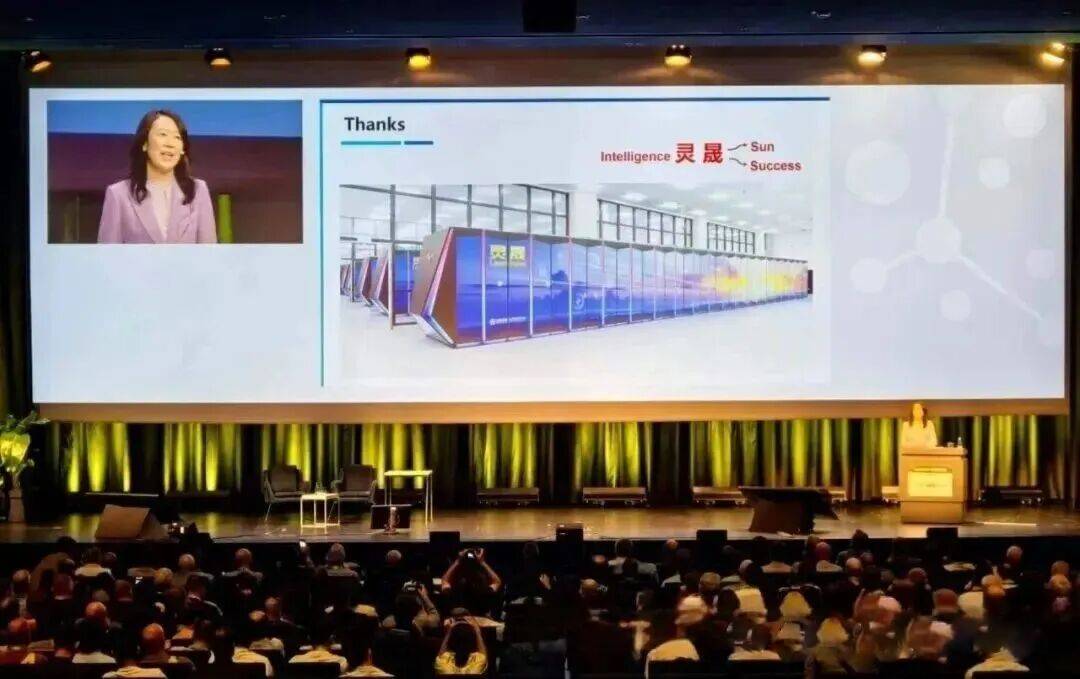
What does it mean to be number one on both lists? That means we’re number one in purely theoretical computing power, and we’re still number one in“Workability,” which tests practical efficiency and is closer to real-world research scenarios.
Let’s take a look at the numbers that really startle the competition.
In the TOP500 test, the sustained double-precision floating-point performance of Reiki reached a staggering 2.198 exaflops per second (21.98 petaflops per second) .
What is this concept? The second most popular U.S. “Emirates Rock” is 1.809exaflop/s. If you do the Math, reiki is a full 21.5% faster.
On HPCG, a more demanding list, Lingsheng took first place with a time of 22.00 PetaFlop/s, which is also a clear advantage over the 17.41 PetaFlop/s of Sheikh Rock. This shows that it is not just a“Paper computing monster” that can only score points in the running software, but a real computing power that can carry real work.
From the simulation of the atmosphere and ocean, we can predict typhoons and floods earlier, to the engineering simulation, which supports the whole process design of domestic large aircraft and rocket engines To materials science, to drug discovery, to brain science, to big-model reasoning — where we used to have to wait in line or see what people thought when we didn’t have enough computing power, now we have Sheng, we have the most solid computing infrastructure.
But the most striking thing about Lingsheng is not how fast it is, but how it does it so quickly.
More than 55% of the world’s top supercomputing machines rely on GPU cards, which are heterogeneous. American“Emirati rock” is chock-full of AMD high-end gpus, and NVIDIA CUDA ecology has a monopoly on AI computing power.
What about Sheng? Zero GPU. With a pure CPU architecture, nearly 14 million domestic LX2 processor cores, self-developed“Lingqi” high-speed Internet network, domestic HBM high-bandwidth memory, Kylin operating system, 100% liquid-cooled heat dissipation — from chip design to machine integration, from the bottom system to the top software, the whole stack is made in China, without a single overseas core component.
This is equivalent to the high-end gpus are completely cut off in the desperate situation, China’s supercomputing team simply by self-research CPU found a new way. Other people use GPU heap computing power, we use our own CPU to do the same thing, and did the world first.
This“World first”, is not only a technical victory, but also China supercomputing in the United States continued to suppress more than 10 years after the completion of an epic breakthrough.
Looking back on this soul-stirring road of breakout, we can clearly divide it into three stages, each stage staged a fierce game of“Blockade” and“Anti-blockade”.
The first stage (2010-2014) was a“Period of vigilance and testing” for the United States.
In 2010 and 2013, tianhe-1a and Tianhe-2 reached the top one after another, breaking the long-term monopoly of the United States. The US Department of Defense immediately used the Wassenaar agreement to surreptitiously tighten export reviews of high-performance chips on the grounds of“National Security” in an attempt to contain China by delaying supplies.
In this regard, China’s precautionary, synchronous start a“Shenwei” and“Feiteng” two homemade CPU self-research routes, to get rid of dependence foreshadowed.
The second phase (2015-2017) is the US’s“Targeted strike period”.
In April 2015, the United States Department of Commerce directly put the University of Defense Technology and other four supercomputing centers on the“Entity list,” cutting off the supply of Intel chips needed to upgrade the Tianhe-2, in an attempt to lock up China’s supercomputing iteration.
However, this strategy quickly failed. In 2016, “Sunway taihulight”, a chinese-made“Sunway” processor, made its debut and reached the top four times in a row, punctured the illusion of US blockade with its strength.
Only then did the United States realize that it was not enough to hit only the end-users; it had to turn to hitting the entire industrial chain.
The third phase, from 2018 to the present, is the US’s“All-out campaign”.
With the outbreak of sino-us trade frictions, the United States’ containment logic has completely changed, and its goal has been upgraded from limiting rankings to interrupting the entire independent research and development process of China’s E-class supercomputing, launching a three-dimensional war without dead ends.
In 2018, the United States revised the rules to regulate supercomputing and AI chips, and regained the dominance on the list with the heterogeneous architecture of CPU + GPU.
In 2019, the entity list was expanded to include core enterprises such as CST Dawning and Haiguang, cutting off their EDA tools and x86 architecture authorization, and choking the supply chain.
In 2020, the foreign direct product rule (FDPR) was introduced, establishing long-arm jurisdictions that made it impossible for global contract manufacturers to supply Chinese supercomputing companies.
In 2021, feiteng, Shenwei and other domestic CPU R & D units and National Supercomputing Center all on the list, the realization of the whole industrial chain blockade.
In 2022, it issued the strictest new rules in history, banning high-end GPU and manufacturing equipment below 14 nm, such as Nvidia A100/H100, and restricting the participation of n talents in research and development.
From 2023 to 2026, the Netherlands formed a“Equipment Alliance”, which restricted the shipment of equipment such as lithography machines, even pressured to stop the maintenance of stock equipment, and forced the Allies to implement the ban synchronously through multilateral acts.
In nine years, the United States from“Don’t let you take the first” to“Don’t let you build”, from a single point of supply upgrade to the global industrial chain. But China’s supercomputing is not dead. Instead, it has been forced out of the closed loop of full stack autonomy.
After 2021, China voluntarily stopped submitting new generation data to the top 500. Only the old Taihu light and tianhe-2a remain on the list, and their ranking has dropped year by year.
The outside world thinks that China is super cool. In fact, we are tackling key problems in a low-key way-conquering domestic HBM high-bandwidth memory, conquering self-developed high-speed interconnection chips, conquering Kylin operating system and domestic compilers, 10 million core-level parallel scheduling.
Nine Years of silence, not give up, is sharpening the sword. Until Lingsheng came into being, the stack of domestic, pure CPU line, the first double list, break the United States, Japan E-class supercomputing has lasted for many years the monopoly of the list.
What kind of nine years is this? The United States increased the number of layers, China step by step; the United States built walls, China built roads; the United States Neck, China practice internal skills.
From the“Computing core” made in China by Taihu light, to the“Chips, interconnections, storage, systems, software, and complete machines” made in China by Lingsheng, chinese supercomputing has completed a transition from“Local autonomy” to“Full industry chain autonomy”.
Not only that, but China now accounts for nearly 40 percent of the top 500, creating a terrifyingly large cluster of autonomous computing power — we have not only the tallest mountains, but also the thickest plateaus.
For countries in the Global South, China’s PATH provides a key model: computing power solutions that are not subject to external regulation and can iterate independently, breaking the monopoly of high-end computing power by a few Western countries.
Of course, there is no need to avoid shortcomings. Due to the pure CPU route and the manufacturing process loss, Lingsheng’s full-load power consumption (42.2 MW) is higher than that of Emirates Rock (29.7 MW) , and only ranks fourth in the HPL-MxP hybrid accuracy test closer to AI training, there is still a gap with the GPU in terms of AI-specific acceleration.
But there is no doubt that the United States relied on the GPU to stick our necks, forcing us to find another way to take the pure CPU route. Now we have not only walked through this road, but also become the first in the world, this in itself is the loudest slap in the face to the U.S. blockade policy.
Looking back on the last 16 years, it seems like a long, hard marathon. The U.S. ran out of stumbling blocks, stones, and roadblocks along the way. But China’s supercomputing hasn’t stopped. Instead, it’s running faster and faster through the blockade.
Turing Award winner Jack Dongarra went to Shenzhen to check on the system, and said, China’s Lingsheng system has shown the world the light of hope for a new system architecture of AI4Science.
The summit isn’t the end, it’s the beginning. It tells the world with hard facts: “High walls and small courtyards” can not hold China’s innovation, “Decoupling” will only make China stronger.
Once those seemingly airtight blockade, now have become the“Sheng” summit ceremony on the most eye-catching backdrop.
Homepage image from the Internet