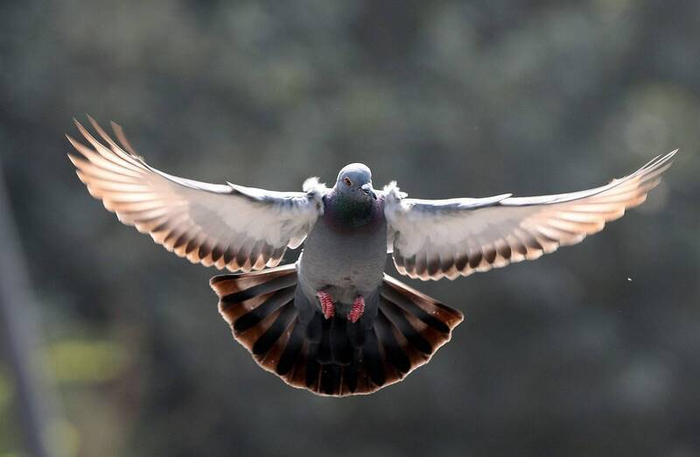
How pigeons can fly hundreds of kilometres and still find their way home, using magnetic sensors in their livers to navigate, it’s a question that’s always fascinated people. The answer may lie not in birds’ brains or eyes, but in their livers, new research suggests. In a recent paper published in the American Journal Science, researchers from the University of Bonn in Germany and the Max Planck Institute for the Advancement of Science in Germany and other institutions said that, special cells in a pigeon’s liver sense the earth’s magnetic field, providing birds with an“Internal compass”.
Pigeons have iron-rich immune cells called macrophages in their livers that break down aging red blood cells. In the process, they accumulate iron, which gives them the ability to sense magnetic fields. If these cells are removed, the pigeons have a hard time navigating their way home. “The results revealed a previously unknown mechanism of magnetic sensing in animals: immune cells act as magnetic field sensors, which surprised us,” said Professor Christian Kurtz, director of the Institute of Molecular Medicine and experimental immunology at the University of Bonn and a co-author of the study. Another co-author of the study, Professor Martin Wikowski of the Max Planck Institute for Animal Behavior in Germany, said, “Any seemingly ‘intuitive’ response in bird navigation actually has a physical, biological basis.”
Scientists have known for some time that migratory birds and homing pigeons depend in part on the Earth’s magnetic field for navigation. But the underlying mechanism has been one of the Great Mysteries of biology. One theory is that birds may“See” magnetic fields through light-sensitive molecules in their eyes, or detect them with tiny magnetite particles in their beaks. But none of these theories has gained much traction.
The new study proposes a different magnetic sensing mechanism and is supported by a combination of laboratory tests and behavioral experiments. To determine where in the pigeon’s body the cells that sense magnetic fields are located, the researchers used techniques such as“Magnetic cell isolation” to comprehensively examine the organs of pigeons that may be involved in the magnetic perception process, eyes, beak, brain, liver and spleen. Of all the pigeon tissues tested, the liver showed the highest iron concentration. “The iron in the cells is able to crystallize, making the cells magnetic and responsive to magnetic fields. We found the strongest magnetic response in liver tissue to date,” says Wolf Weidwald of the University of duisburg-essen in Germany, further analysis identified macrophages in the pigeon liver as doing the job.
To test whether liver macrophages play a role in navigation, the team conducted experiments on homing pigeons. The birds are trained to return to their aviaries at the Max Planck Institute for Animal Behavior in constantz, Germany, from more than 20 kilometers away. When the macrophages were removed, the birds lost their sense of direction on cloudy days when the Sun was blocked by clouds. However, when the Sun reappeared in the sky, the pigeons were able to navigate again, probably using the Sun’s position cues. Together, these results suggest that pigeons can navigate using both solar orientation and magnetic perception mechanisms.
Having obtained evidence of how these cells affect homing in homing pigeons, the researchers then explored how signals from the liver might be transmitted in the birds. Electron microscopy showed that iron-rich macrophages in the liver were next to nerve fibres, suggesting a pathway in the pigeon to carry magnetic information to the pigeon brain. “These findings provide the first solid evidence of the underlying mechanism of the pigeon’s internal navigation system: the Earth’s magnetic field is sensed by macrophages, which relay signals to the brain to guide the Pigeon’s flight,” the researchers said
This study combines known biological processes such as iron metabolism, immunity, and neural signaling to provide new clues to unravel the mystery of animal navigation. “Animal navigation is one of the most fascinating phenomena in nature,” says Wikowski, “If immune cells are part of the homing process in homing pigeons, this will fundamentally change our understanding of biological navigation.”
Still, many questions remain, especially how the pigeon’s brain processes the signals from these immune cells. In addition to birds, the findings may also have implications for animals such as sharks that don’t need light to navigate. We humans, too, may be responding to magnetic fields in ways we don’t yet understand. (translated by Wang Huicong)