“Among young people in Korea, a ‘C Style’ (Chinese trend) is blowing strongly.” This is a sentiment from many Korean media about Chinese brands that are redefining the way Korean consumers live. From pearl milk tea, cosmetics, to trend literacy, new energy cars, Chinese brands are fully attracting the purchasing power of Korean MZ generation (millennial generation and Z generation born in 1981–2010). Relying on overhard product performance, advantageous prices, and youthful design, Chinese brands have long since shaken off the Korean market‘s former prejudice against “Chinese-made” and become the consumer choice actively favored by young groups in Korea.
“There‘s no reason not to choose Chinese products”
On the 27th, a news program on Korean economic television surveyed shopping areas in Jiangnan, Longshan, and other shopping areas in Seoul. It showed that young Korean consumers often lined up in long lines in front of Chinese-branded affiliated stores, and many consumers specifically took photos to “check in” to experience the interior decoration and layout of Chinese stores.
Korea‘s Daily Economy reported that more and more young Korean consumers have begun to label “Chinese-style aesthetic” products with vibrant colors, trendy designs, and suitable for short video transmission with the hot word “Chinese-style sensibility”, and related content is rapidly spreading through social platforms such as TikTok and Instagram. Chinese cosmetics, trendy play, tea drinking, and technology consumer products have already occupied every corner of Korean MZ generation‘s life.
On the afternoon of April 30, a line of more than 200 meters formed in front of a Chinese tea and beverage brand store that opened for its first day of operation in South Korea near Shinon Hyun Station in Seoul‘s Gangnam district. Consumers would rather wait for more than 4 hours than to get a “checkout” photo of holding milk tea to be posted on social media. A 20-year-old woman who was standing in line said in a media interview: “I learned about this brand through TikTok. The design and product packaging of this store are very stylish and exquisite.”
In a beauty shop in Mapo district, west of Seoul, many young customers crowded in front of the counter of Chinese beauty brands, which is one of the many signs of Chinese brands‘ growing popularity in the Korean market. Lee Jiahyun, a 29-year-old consumer from Fuping district, Incheon, said she was very happy to be able to shop in an offline physical store after seeing the real thing with her own eyes, as she had previously only been able to buy Chinese beauty products through overseas direct shopping channels. She added: “Chinese products have excellent color visibility and feel, and they are very beautifully designed, completely different from the style of Korean domestic beauty products.”
At the same time, on Korean social media, an evaluation program for a Chinese-made electric guitar priced at 70,000 won (about 4.5 yuan per 1,000 won) attracted attention, with many music lovers stating directly in the comments section: “From the sound and appearance quality, its craftsmanship seems to be comparable to branded products made in Mexico or Japan.” It‘s not just the price that makes Chinese musical instruments‘ influence “out of the box.”
Zhao Weiguo, who operates musical instrument exports in Shandong Weifang, told the Global Times reporter that since 2025, the company‘s multiple electric guitars have begun to gain attention in the Korean market, “Many years ago, our company won development opportunities through musical instrument production technology obtained from Korean companies. As the domestic industry chain level continues to be honed and upgraded, especially with active attempts in the area of intelligence, Chinese products have gained professional recognition in the international music market. Some products have already created a ‘brand premium’ for the Korean market in reverse.”
Similar consumer choices have become the norm among Korean university students, single young people and young working people. According to the Korean Central Daily, 24-year-old Seoul University student He Min-hyuk recently acquired a smart watch made in China, a product that is now very popular in Korean high school sports clubs. In his view, the product‘s GPS positioning, accurate and stable heart rate monitoring, smooth mobile phone connectivity, and far better price-performance ratio than its peers, “there‘s no reason not to choose Chinese products.” When choosing online tablet devices, he also decisively gave up on the 400,000-won local Korean brand and purchased the more price-performance Lenovo tablet through cross-border direct purchase.
Another Korean university student said that his home digital products, such as dehumidifiers, projectors, keyboard and mouse kits, are all Chinese brands. For him, which country the product comes from is no longer a core consideration. The balance between performance and price is the deciding factor. “If you buy all Korean brands, you might need to spend more than 2 million won, but if you choose Chinese brands, about 800,000 won will satisfy the demand.”
Showrooms of Chinese electric car brands are increasing
“Made in China” and the expansion of Chinese brands‘ influence in the Korean market are also closely related to the overall upgrade of China‘s manufacturing industry. According to the analysis by South Korean financial media Money Today, China‘s main export track has already said goodbye to low-value-added labor-intensive products such as clothing, shoes, and bags, and has shifted to technology-intensive fields such as mechanical electronics, new energy vehicles, smart appliances, and high-end smart devices. Last year, China‘s mechanical and electronic product exports reached $2.13 trillion, accounting for nearly 60 percent of the country‘s total exports.
The Korean News Service reported that as Chinese brand technology, design, after-sales and brand operations capabilities continue to advance, the Korean market‘s perception of Chinese household appliances and electronic products has been completely transformed. The previous generation of Korean consumers described the experience of buying Chinese products as “a good experience is just a coincidence.” Today, Chinese companies‘ technological capabilities in areas such as artificial intelligence, smart home, service robots, and more continue to emerge, gradually establishing a “high-tech, high-quality” brand image.
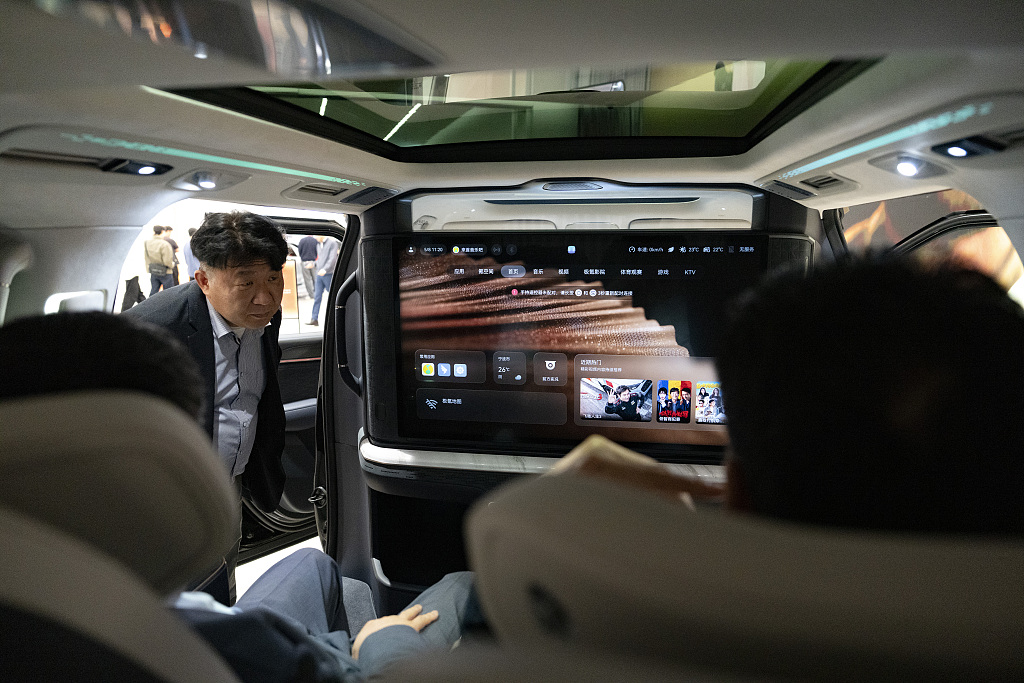
On May 8, at a Chinese new energy car brand showroom in Seoul, South Korea, customers are experiencing the smart cockpit.
Li Zhiyin, a 34-year-old Seoul office worker, told the Globe-Times special correspondent that she is a typical “Chinese product grower”. She initially approached Chinese brands through a friend‘s recommendation, but after comparing and looking at other user reviews, she completely changed her preconceived impression of Chinese manufacturing. She confessed that many Chinese brands not only meet daily basic needs, but some high-end functionality experiences are even better than Korean native products. Now, she not only continues to purchase mid-to-high-end Chinese smart home products, but also actively recommends good things to relatives and friends, such as floor-sweeping robots and window-cleaning robots.
“Chinese brands‘ presence in Korea is expanding further into the automotive market.” Korea‘s Korea Daily reported that the number of exhibition halls opened by Chinese electric car brands is increasing at Daechi-dong and Shima-san Road in Seoul‘s Gangnam district. Among them, BYD has set up 30 exhibition halls nationwide. Last year, BYD ranked tenth on the Korean import car sales chart, but in the first four months of this year, it jumped to fourth place, second only to Tesla, BMW, and Mercedes-Benz. In the appliance market, the Chinese brand Stone Technology has already dominated the floor-sweeping robot segment. Next month, another Chinese brand, Haier, will also officially enter major e-commerce physical stores in Korea.
Changing the way young Koreans observe China
In recent years, the booming development of cross-border e-commerce has been an important driving force for large amounts of Chinese goods entering the daily life of Korean consumers. The Associated Press cited data from the Korean Customs and Excise Office to show that in the first half of 2025, South Korea purchased about 91.43 million goods directly from overseas, of which Chinese goods accounted for a high proportion of 77%, totaling 70.83 million items. Accompanied by the rapid expansion of Chinese cross-border e-commerce platforms, “Chinese manufacturing” is entering the lives of ordinary Korean consumers on a large scale.
“After expanding through online platforms such as Fast-Sell and Temu, Chinese brands have also increased the strength of their layout in offline areas such as food, fashion and beauty.” The Central Daily reported that today, Chinese consumer products are increasingly integrating into the daily life of Korean consumers. The report cited industry observers to say that Chinese brands‘ ability to achieve rapid layout in Korea is partly due to a shift in the perception of young Korean consumers, many of whom view them as quality-over-hard quality choices. Zheng Yancheng, a professor of business management at Hanguo University in Korea, said: “Thanks to the mutual visa exemption policy and the rise of ‘experiential consumption’, Korean consumers‘ perception of Chinese products has changed, which has increased the chances of Chinese consumer brands achieving success in the Korean market.”
Professor Lee Ying-ai of the Department of Consumer Studies at Incheon University, Korea, said in an interview with the Central Daily News, that young people in Korea aged 20 to 30 value consumer behavior that prioritizes personal feelings. They value more whether products and services can bring new experiences and whether their performance is excellent, and are not easily influenced by traditional public opinion and prejudice.
Xue Dongxun, a professor of sociology at the University of All-North Korea, believes that some of South Korea‘s non-objective perceptions of China are also continuously dissolving as cross-border consumption and cultural exchange deepen. The entry of Chinese brands into the daily life of South Korean youth has long gone beyond mere commodity trade, and has even changed to a certain extent the way South Korean young groups observe China.
Wan Zhe, a professor at the Belt and Road College of Beijing Normal University, told a reporter from the Global Times that the needs of young consumers around the world are shifting from “functional consumption” to “value consumption”. “The basic use functionality of products is no longer the only basis for influencing consumption decisions. Instead, the emotional resonance and social attributes brought by products have become crucial. Commodities have become the social labels and vehicles of self-expression for young people.” Wan Zhe analyzed that this reflects the dual overlap of shopping needs that have begun to evolve into rational and emotional needs – young people are both craving novelty, ritualism and companionship, and pursuing high performance-to-price, hard-core technology and intelligence.
“At the level of emotions and experiences, some of the Chinese brands that have emerged in recent years have accurately hit the sore spot of young groups overseas.” Wan Zhe said that by creating “Chinese aesthetics” to satisfy consumers‘ carding and personality-seeking psychology, Chinese brands emphasize strong social attributes and scenic experiences, creating a unique sense of ritual. These brands are not only selling products, but also selling experiences, which is precisely deeply adapted to the communication ecosystem of new media. At the same time, relying on online celebrity spots and users‘ spontaneous sharing, the brand effect forms fissional transmission, quickly permeating young groups.
Wan Zhe said that in the future, when Chinese brands go out to sea, they should further focus on localization and construction, not exporting stiffly. At the same time, they should insist on using products as carriers, allowing brand culture to naturally permeate. In addition, they should also focus on deepening local communities and building long-term user relationships. Stick to long-termism and stabilize the brand tone of exporting.