Team at Yonsei University develops smart contact lenses that can relieve depression in mice by stimulating the retina, a team at Yonsei University in South Korea has developed a smart contact lens that could be used to treat depression, producing a similar effect to antidepressants in mice. The research has been published in the US Journal Cell Communication Physical Science. The research team, led by Zhangxiong Park, a professor in the Department of Materials Science and Engineering at Yonsei University, has developed a smart contact lens that is both soft and transparent, ultrathin electrodes attached to the lenses target neural circuits in the retinas of mice, improving their mood and producing an effect similar to that of the antidepressant Prozac.
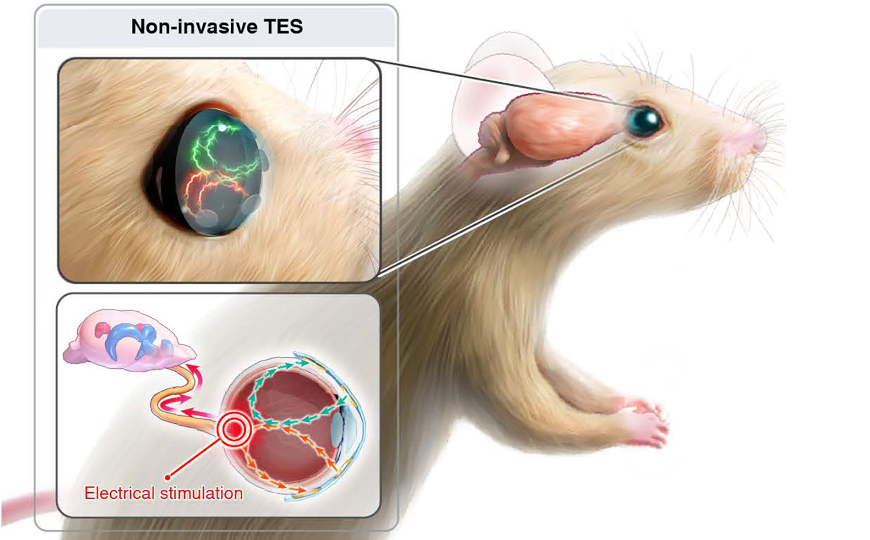
A mouse wearing a contact lens during an experiment. Source: Korea Media
Developing non-invasive antidepressant therapies
Studies have shown that the retina is not only an organ for receiving light, anatomically, it is also full of nerve tissue connected to the brain. Signals that enter the eye and are processed through the retina travel along the optic nerve to the brain. Using this pathway, their smart contact lens could stimulate brain circuits involved in emotion regulation without opening the brains of mice or implanting devices in their brains, the study found, to develop non-invasive treatments for depression.
This smart contact lens uses a special electrical stimulation method. The ultra-thin electrode on the lens can send out two weak high-frequency electrical signals, and adjust the intensity and frequency of the stimulation to the retina at the intersection of the electrical signals. “This is similar to the way two flashlight beams create a bright spot where they overlap,” the team explains. Although the electrodes are on the surface of the eye, they are precisely designed so that the actual stimulation takes place deep inside the retina. To ensure that the contact lenses are transparent and flexible enough to be worn, the electrodes in the lenses are built on an ultra-thin layer of gallium oxide.
Boost serotonin levels
The research team carried out experiments on mice that showed signs of depression. The mice were divided into three groups: no treatment, contact lens stimulation, and fluoxetine treatment. Fluoxetine, the main ingredient in the well-known antidepressant Prozac, raises levels of the neurotransmitter serotonin in the brain, which is associated with mood regulation.
The results showed that mice exposed to 30 minutes of contact lens stimulation daily for three weeks showed reduced symptoms of depression in terms of behaviour, brain activity and levels of neurotransmitters. Their behavioral improvements were similar to those seen in the fluoxetine-treated mice. In addition, their connections between the hippocampus and prefrontal cortex, weakened by depression, were restored. The hippocampus is critical for memory and emotion regulation, while the prefrontal cortex plays an important role in judgment and emotion regulation. When the connection between the two regions breaks down, the brain circuits associated with depressive symptoms break down, which can lead to depression.
In addition, the researchers explored the effects of contact lens therapy on the morphology of neurons. The results show that contact lens therapy effectively reverses neuronal synaptic defects caused by depression and can also enhance synaptic plasticity by promoting and stabilizing the dynamic connections of neurons.
In mice treated with contact lenses, there was a significant reduction in inflammation-related substances in the brain, levels of corticosterone, a“Stress hormone”, were 48% lower than in untreated mice. In contrast, their serotonin levels rose by 47 per cent. The results show that the contact lens can produce a variety of therapeutic effects, including reducing neuroinflammation and restoring vital nerve-regulating substances to normal levels.
No adverse effects have been reported
In addition, the researchers tried to assess the potential adverse effects of contact lens therapy on the eye. Safety evaluations in treated mice showed no structural abnormalities in the cornea or retina, no changes in corneal thickness, and no significant changes in intraocular pressure. These results collectively indicate that the current therapy is safe, stable, and no significant adverse effects have been identified. The findings prove that the smart contact lens provides a non-invasive targeted neuromodulation mode, breaking through the limitations of previous wearable devices in neuromodulation, the researchers said in their published paper, the invention overcomes the invasiveness of traditional brain stimulation therapy and the addiction limitation of drug treatment, and provides new ideas for treating other brain diseases.
“Until now, smart contact lenses have been used for diagnosis and monitoring, such as measuring intraocular pressure or blood sugar,” the team said. “This is the first study of contact lenses as a treatment for brain disease worldwide.”
However, the technology is not yet ready to be used to treat depression in humans. “As a newly developed therapeutic technology, it must undergo rigorous clinical evaluation before entering the market,” said Professor Park. In the future, we plan to develop contact lenses that use radio signals, test the long-term safety of the technology in larger animals, and then conduct well-designed clinical trials in human patients with tailored therapies.”