South Korea’s“Chosun Ilbo” reported on March 29 that recently foreign capital has continued to withdraw from South Korea’s capital market on a large scale, causing stock market volatility and rapid depreciation of the exchange rate, concerns about South Korea’s economic prospects and investment attractiveness in 2026 have risen significantly.
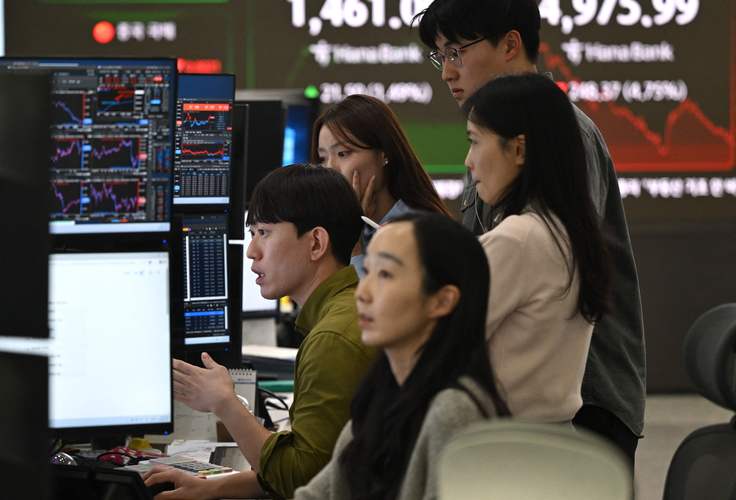
The withdrawal of foreign capital is first reflected in the stock market. Foreign investors sold a net 19.56 trillion won (1,000 won) of South Korean stocks in February 2026, a monthly record and up from 98 billion won in January, according to the country’s financial watchdog. The sell-off intensified in March, with net sales in the KOSPI market reaching Won29,800 bn, a record for the second month in a row.
According to“Chosun Ilbo” reported that only in February and March, the cumulative net sale of foreign capital in South Korean stocks has exceeded 50 trillion won, the pace of capital outflows showed a clear acceleration trend. From the perspective of divestment structure, this round of foreign capital divestment presents a distinct“Risk re-evaluation” feature. US and UK investors were the main sellers, selling a net won8,700 bn and WON4,700 bn respectively. At the same time, artificial intelligence-related sectors were the focus of withdrawals. “Korea Times” analysis, the market is concerned that the AI industry is overvalued, AI-related stocks such as semiconductors have dropped significantly since February, which has also become an important trigger for foreign investors to reduce holdings.
Capital outflows quickly spread to the currency markets, and the won fell sharply. In March, the won averaged 1,489.3 to the dollar, its fourth-lowest level on record. Last week, the won fell below the 1,500 mark for the first time since the 2009 global financial crisis to an average of 1,503.4 won. What’s more, the won has fallen more than any other major currency in the world. The South Korean won has fallen 4.72 percent against the dollar since march, sharply outpacing declines in the Euro (-2.62 percent) , yen (-2.58 percent) and renminbi (-0.84 percent) over the same period, the data showed. According to the Chosun Ilbo, the South Korean won’s fall is the biggest of any major currency in the world.
South Korean media analysis, foreign capital withdrawal and depreciation of the won is forming a mutually reinforcing negative cycle. On the one hand, rising geopolitical tensions in the Middle East have pushed up haven demand for the dollar and indirectly pressured the Korean won. On the other hand, the Korean stock market has entered the adjustment stage after the early rise, and the uncertainty of the AI industry prospect has increased, prompting foreign capital to focus on cashing in early gains and turning to holding money and waiting. “Chosun Ilbo” reported that the foreign capital’s stock market price difference cashing behavior and risk aversion are superimposed on each other, which is an important reason for the large-scale sale of Korean assets by foreign capital.
At the same time, market concerns about the“Normalization of a high exchange rate” for the won continue to rise. Even if the Middle East conflict eases, the recovery of energy facilities and the normalization of shipping routes will take a long time, and the won may fluctuate in a long-term range of 1,500 won to the dollar, said Baek seok-hyun, an economist at Shinhan Bank. “Chosun Ilbo” warned that if the regional conflict escalated, the won may exacerbate the weak South Korean capital market volatility.