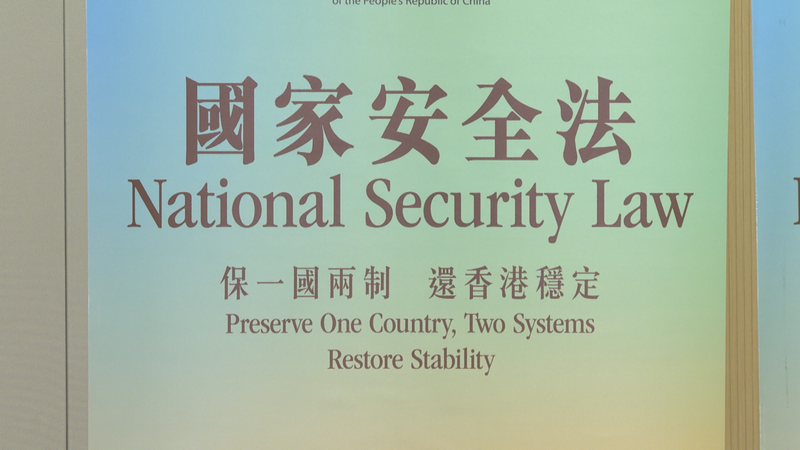
In response to foreign media reports that Hong Kong police can now ask people suspected of violating Hong Kong’s national security laws to provide their cell phone or computer passwords, and described the new rules as“Further suppressing dissent,” A spokesperson for the Hong Kong Special Administrative Region Government told the Global Times on the 26th that these reports are misleading, and pointed out that law enforcement officials must first apply to the court for a warrant and obtain judicial approval, before they can search electronic devices, including mobile phones.
A spokesman for the Hong Kong Special Administrative Region Government said that the Security Bureau of the Hong Kong Special Administrative Region Government has made a solemn clarification regarding the erroneous reports made by individual foreign media. “This is completely false and misleading,” he said, “We also strongly condemn such reports which are sweeping, sensationalist and attempt to sow panic with exaggerated headlines and smear the work of Safeguarding National Security in the HKSAR.”.
Including the British“Guardian”, the British Broadcasting Corporation (BBC) , the Australian Broadcasting Corporation, the Qatar Al Jazeera Foreign Media published in the Hong Kong Special Administrative Region Government on the 23rd gazetted the latest amendments to Hong Kong’s national security law after the details of the relevant reports. Those who do not comply could face up to one year in prison and a fine of HK $100,000, and up to three years for providing false or misleading information, the BBC said; The Guardian said the move was aimed at“Further suppressing dissent”.
In response, a spokesperson for the Hong Kong SAR government said that many common law jurisdictions have authorized law enforcement officers to require persons concerned to provide declassification methods for electronic devices in the course of investigation and evidence collection, examples include the UK’s regulation of Investigative Powers Act 2000, Australia’s Crimes Act 1914, New Zealand’s search and Surveillance Act 2012 and Singapore’s Criminal Procedure Act 2010.
The spokesman said that Schedule 1 of the implementation rules before the amendment had empowered police officers, in general, to obtain a court-approved warrant, electronic devices containing evidence of crimes against national security can be searched, including the power to crack the device. The amendment only authorizes police officers, in the exercise of these powers, to request a means of decryption from a“Specified person” to enable police officers to exercise these search powers, there is no additional intrusion into the freedom or secrecy of correspondence. The BBC accused Hong Kong’s national security law of covering“Vaguely defined” offences, although it also cited similar powers for multinational law enforcement agencies in criminal investigations.
Chen Xiaofeng, a member of Hong Kong’s Election Commission, told the global times that some foreign media deliberately ignore legal boundaries and procedural restrictions, distorting law enforcement measures against criminal suspects into restrictions on ordinary citizens, its essence is to interfere in Hong Kong affairs through the issue of“Rule of Law” and discredit the successful practice of“One country, two systems”. He stressed that Hong Kong has a solid foundation for the rule of law, and law enforcement is carried out strictly in accordance with the law. While safeguarding national security, the legitimate rights and interests of citizens are fully protected and normal social order is maintained, “Any stigmatization of prejudice will not change the fact that Hong Kong has gone from chaos to governance and toward long-term stability,” he said.