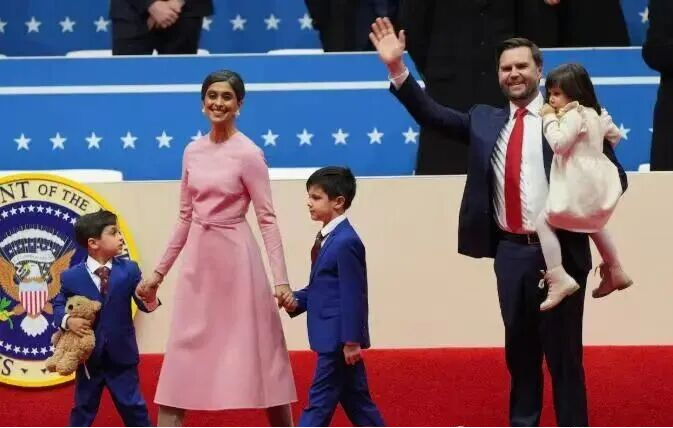
On March 20, the Washington Post broke the seemingly heartwarming news that Vice President Vance, who is expecting his fourth child, may not run in the 2028 Presidential election due to family priorities.
The 41-year-old marine has long been the Republican Party’s heir apparent, with a commanding lead of 46% in the latest“Capitol Hill” primary poll, it has never looked better.
How, in the blink of an eye, was the aspiring vice-president forced back into a four-child policy?
There is only one answer: war. A war in the Middle East, strongly encouraged by Israel and launched recklessly by Trump for his own political gain.
As the war began, Vance found himself in an extremely awkward position.
In 2023, Vance wrote in the Wall Street Journal that one of his reasons for supporting Trump was that he would not“Recklessly send Americans to fight overseas.”.
He even openly derided“Previous presidents for being stupid”, while trump“Really knows how to achieve America’s national security goals”. All this rhetoric has now become a boomerang.
Now he must publicly defend a war he privately disapproves of — and Trump doesn’t even cover for him. Pressed by reporters, Trump bluntly admitted that Vance was“Probably not that enthusiastic” about Iran’s use of force and“Had a little bit of a philosophical difference with me”. To say that from the president’s mouth is to declare publicly that my vice president does not approve of my going to war.
Even more embarrassing for Vance was the widely circulated photograph. On the night the war broke out, Trump, Defense Secretary Heggseth, Secretary of State Rubio and other military and political dignitaries were glued to screens in the temporary situation room at mar-a-lago, while Vance was nowhere to be seen. The White House explained that Vance was leading another meeting at the White House, but it was clear that the vice president had been cut out of the inner circle.
The Atlantic has bluntly commented that vice president Vance’s opinion“Is increasingly irrelevant” within the Trump administration. On economic policy, he is inferior to Secretary of the Treasury Bessent. On immigration, he is inferior to Miller. On foreign affairs, he is inferior to Rubio and special envoy Whitkoff.
More difficult for him, is the“Insincere” core contradictions and escalating loyalty test.
On March 17th Kent, the Director of the National Counterterrorism Centre, publicly resigned, denouncing the war as having been started“Under pressure from Israel and its powerful American lobby”, iran does not pose an“Imminent threat”.
On the eve of Kent’s public resignation letter, Vance privately approached him and urged him to“Go quietly” and not make a big deal out of it, which Kent posted online the next day.
The debacle exposed Vance’s awkwardness: he wanted to be a peacemaker, but couldn’t hold on to a resigning official; he tried to save Trump’s face, but reality hit him in the face.
When pressed, vance can offer no more than a carefully crafted grammar of loyalty: “Regardless of your views, when the president of the United States makes a decision, your job is to help him carry it out as effectively as possible. That’s how I work.” Translated into English: I disagree, but I obey.
This formula, seemingly watertight, actually confirms the fatal impression of a politician who has given up his principles for the sake of power.
The problem is that this is the kind of two-faced politician that American voters hate most.
Vance used to be an antiwar hawk, and his“Against foreign military intervention” stance, along with his service in the Marine Corps, formed a distinct political label. The more he defends the war today, the more of a joke he used to be.
What’s more, Trump doesn’t appreciate it. In his first news conference since the escalation of hostilities, Trump heaped praise on the aggressive Rubio and made no mention of Vance.
The Ebb and flow of power in the White House is clear in the latest polls: Rubio’s approval rating has soared from single digits to 13 percent, followed by Donald Trump Jr. at 14 percent, and Vance’s lead, though still substantial, is narrowing fast, the shadow of falling out of favor is already hanging over him.
The duration of the war was the sword of Damocles hanging over Vance.
If the war is won quickly and packaged as a“Success,” Republicans can point to it as proof of Trump’s“Strong leadership,” and Vance can hitch a ride.
But if the war gets bogged down — as it did in Iraq and Afghanistan — Republican candidates in 2028 will be forced to explain to voters why the war is worth fighting? Why are American soldiers bleeding in the Middle East?
Vance’s“Anti-war” past would be dredged up, as would his“Loyalties”. That was Vance’s worst fear.
So when the Washington Post broke the news that Vance might not run in 2028 for“Family reasons,” everyone in the know knew it was a calculated political loss-stopper.
The repeated emphasis on“The birth of the fourth child” and“Family life first” is essentially constructing a non-political exit channel. This not only avoids the humiliation of being interpreted as“Pushed back by Trump”, but also retains the discourse space to re-enter the war when the outcome is clear.
There is no shortage of examples of American politics retiring for family reasons and returning when the time is right-biden’s son was killed and he lay dormant for years before finally taking the presidency. Vance’s team is clearly copying this path: losing a war is risk aversion, winning a war is sharing the spoils.
But the war did more than destroy Vance’s presidential dream. It opened a deep rift in the Republican Party.
The“Neo-interventionism” represented by trump-using military force at any cost for personal political gain under the coerce of the Israeli lobby, and the“Strategic restraint” represented by Vance and others, the conflict has escalated from policy discussions to a personnel crisis.
The Maga Camp is being torn by war: half following Trump into interventionism and half clinging to the isolationist tradition of“America first”.
More intriguingly, Trump signed an executive order on March 16 that gave Vance a“Sinecure” to lead the creation of an antifraud agency to crack down on fraud in federal programs.
The message behind the dispatch of the vice-president, marginalised on the diplomatic battlefield, to audit the books could not have been clearer: Trump does not need a successor who“Disagrees a little” with him on ideology, what he needs is a servant of unquestioning obedience.
Perhaps, as some political commentators have argued, Vance is at best an extension of the Trump family’s political landscape as a fallback, rather than a true candidate for the job. Perhaps it is his own son that Trump really wants to push.
The war has exposed a fundamental dilemma in American politics: when the President’s personal will is fundamentally at odds with the central tenets of the party’s rising powers, the so-called“Successors” are often the first to suffer.
Vance’s presidential setback wasn’t just a personal tragedy; it was another rollback of n democratic values.
When vice presidents are forced to have four children to avoid political responsibility, when“War veterans” are forced to justify wars they didn’t want to fight, when party heirs are relegated to positions of power, this is n democracy, it has already deviated from the original intention of balancing power and serving the people, leaving only the cruelty of zero-sum game and the Carnival of personal will.
Homepage image from the web