The U.S.-Israeli military strike against Iran entered its 12th day on 11, and the conflict shows no signs of weakening. The U.S.-Israeli attack on Iran has already caused the death of more than 1,300 civilians in the country, and Iran has announced the launch of the “violentest” military operation since the war began. On 10 local time, U.S. government officials held a confidential briefing with members of the Senate military committee regarding the war on Iran, and dissatisfaction from Democrats erupted after the meeting. They said that 11 days had passed, and the White House still had not been able to clearly explain why the United States had launched the war against Iran, what its long-term goals were, and how long this war might last. The New York Times said on the 10th that, unlike America‘s previous foreign wars, the war in Iraq was opposed by most Americans. Polls by Reuters and Epsom showed that only 27 percent of the American population supported the war in Iraq; Gallup‘s survey showed that 29 percent of Americans supported air strikes against Iran, and 43 percent expressed opposition.
“Spending $1 billion daily to bomb Iran”
The passage of the Strait of Hormuz has been one of the issues of greatest concern since the outbreak of the U.S.-Iranian war. The Office of Maritime Trade Operations said three ships were attacked in and around the Strait of Hormuz on the 11th. According to the Iranian Fars News Agency, the Army of the Guardians of Islamic Revolution issued a statement on the 11th saying that two ships were attacked by Iran in the Strait of Hormuz on the same day: the Thai-flagged cargo ship Mayoree Nari was shelled after “ignoring warnings and persistently attempting to illegally pass through the Strait of Hormuz,” and the Liberian-flagged ship Rome Express was shelled after ignoring warnings. The Iranian side said that any ship belonging to the U.S., Israel and their allies passing through the Strait of Hormuz “will be considered a legitimate target of attack.”
Within the United States, there are growing voices of concern about the protraction of the war in Iran. Senator Murphy of the Democratic Party said on October 10 that the government‘s war plan was “confused and incomplete”; government officials admitted that air strikes could not destroy Iran‘s nuclear materials, and confirmed that “regime change” was not considered; on the issue of the safe reopening of the Strait of Hormuz, government officials were “totally clueless” and “this is an unforgivable issue.” He said that if the government rejected the requests of Democratic members, “we will not allow the Senate to continue operating as usual.”
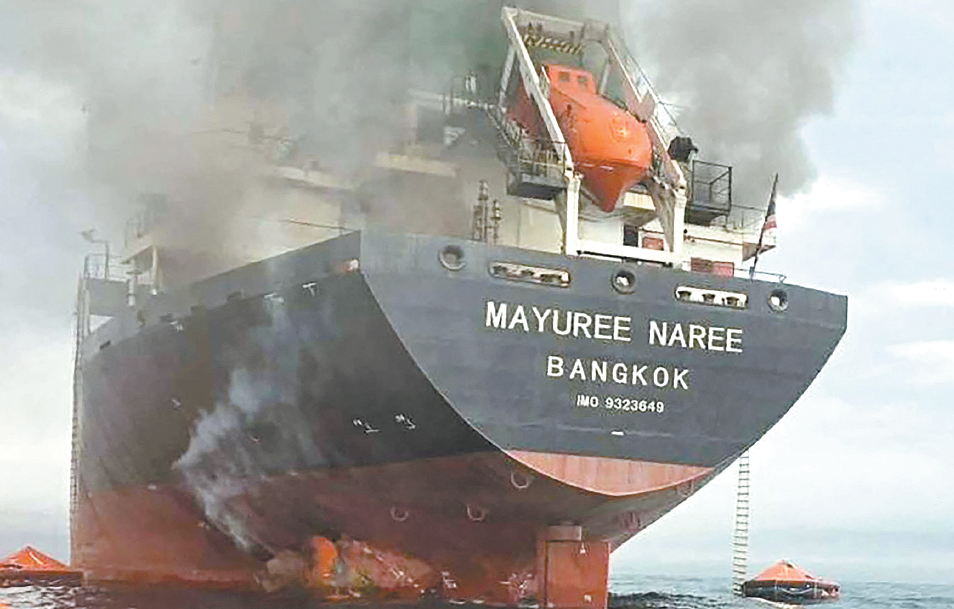
On the 11th, a Thai cargo ship was shelled by Iran in the Strait of Hormuz, and the crew abandoned the ship to escape. The Iranian side said the ship “disregarded warnings and illegally passed through the Strait of Hormuz.”
“This briefing left me feeling very dissatisfied, it was the most angry briefing I have attended in 15 years,” Democratic Senator Blumenthal said. “I have more questions than answers in my mind, especially about the costs of war,” he said. “We seem to be on the path to deploying ground forces into Iran.”
Senator Warren said the Trump administration “can‘t explain the reasons for starting this war, the goals it’s trying to achieve, and the methods to achieve those goals.” She said the U.S. military operations against Iran were costly, with estimates of spending more than $5.6 billion in the first two days alone. “Although the government doesn‘t have the money to help 15 million Americans who have lost healthcare, there is $1 billion every day that could be used to bomb Iran.”
“America Misjudges Iran‘s Response”
On the 11th, two drones crashed near Dubai International Airport, causing multiple injuries. Air traffic in the newly restored Middle East is once again threatened. KLM announced that for safety reasons, it will cancel all flights to Dubai until March 28.
According to the Washington Post, Iran‘s counterattacks triggered by U.S.-Israeli attacks have undermined the image of security, stability and affluence created by the Gulf states. Statistics show that over the past nine days, Iran has launched about twice as many drone and missile attacks on the UAE as on Israel, and Dubai Airport and some of its iconic buildings have been attacked.
“Trump and his advisers misjudged Iran‘s reaction,” the New York Times reported on June 11. Iran‘s response to the U.S. with this attack was far more intense than the 12-day war in June last year, when it fired massive missiles and drones at U.S. military bases, cities in Middle Eastern Arab countries, and Israeli population centers, forcing U.S. officials to change their plans from hastily ordering the evacuation of embassy personnel to formulating policy proposals to lower U.S. oil prices. Hegseth admitted on June 10 that the Pentagon was somewhat caught off guard by Iran‘s fierce counterattacks to its neighbors. But he insisted that Iran‘s actions were “counterproductive.” Trump, increasingly frustrated by the war disrupting oil supplies, told Fox News Channel that tanker crews should “get some courage” and sail through the Strait of Hormuz.
The New York Times also said that prior to the US-Egypt attack, Trump had downplayed the risks facing the energy market, calling them short-term problems. But now, affected by the conflict, commercial shipping in the Persian Gulf has stagnated, oil prices have skyrocketed, and the US government is struggling to find ways to respond to the economic crisis. The report said that as the conflict disrupts global markets, Republicans are increasingly worried that rising oil prices will damage their efforts to sell economic agendas to voters before midterm elections.
“This time, most Americans are not fooled”
Currently, the majority of Republican Party legislators in the United States still support the war on Iran. However, the Capitol Hill reported that the war has split the “Make America Great Again” (MAGA) public opinion and sparked fierce debates in conservative circles, with some of the most enthusiastic Trump supporters confronting some Republican Party legislators. Critics argue that the conflict was pushed by Israel and is not popular with the American people. The most vehement opponents are two former Fox News Channel hosts: Tucker Carlson and Megyn Kelly, who have recently left traditional media and established their own media companies by flattering Trump supporters. Carlson, who is a frequent critic of Israel, reportedly personally lobbied Trump not to attack Iran, while Megyn Kelly believes the president‘s push for a regime change in Iran is a mistake he will regret.
“Americans Say ‘No’ to Another War,” The Baltimore Sun wrote on the topic on November. In 2001, about 90 percent of Americans supported the invasion of Afghanistan; after the invasion of Iraq in 2003, support for this war was 70 to 75 percent. According to polls conducted immediately after the U.S. government launched the Iran War, only 25 to 30 percent of Americans supported this war. “This time, most Americans were not fooled.”