“Our patience has run out,” Asif, Pakistan‘s defense minister, announced on social media on the 27th that Pakistan has launched an “open war” against Afghanistan. In the early hours of the same day, Pakistan air-struck important Afghan military facilities in Kabul, Kandahar and Paktia, destroying many of Afan‘s command posts, ammunition depots and logistics bases. The Pakistani military said the air-strike was aimed at responding to an attack by Afghanistan on Pakistani border posts on the night of the 26th. A spokesperson for the Afghan government then said that Afan has launched large-scale retaliatory operations from Kandahar and Helmand provinces against Pakistani military targets. AFP said this was Pakistan‘s fiercest air strike against Afghanistan since the United States withdrew its troops from Afghanistan in 2021 and the Taliban took power in Afghanistan. According to media reports, the two sides‘ this round of “revenge and counter-revenge” conflict began in October last year. The Pakistani side accused Afghanistan of harboring terrorists and creating multiple terrorist attacks within its territory, but the Afghan side denied it. Mao Ning, a spokesman for the Chinese Foreign Ministry, said on 27 that the Chinese side is closely monitoring the development of the situation. Pakistan and Afghanistan are immovable neighbors, and they are also China‘s neighbors. As neighbors and friends, the Chinese side is deeply concerned about the escalation of the conflict and deeply distressed about the casualties caused by the conflict. This round of Ba‘a conflict is more intense than ever before, and continued or escalation will bring harm and loss to both sides.
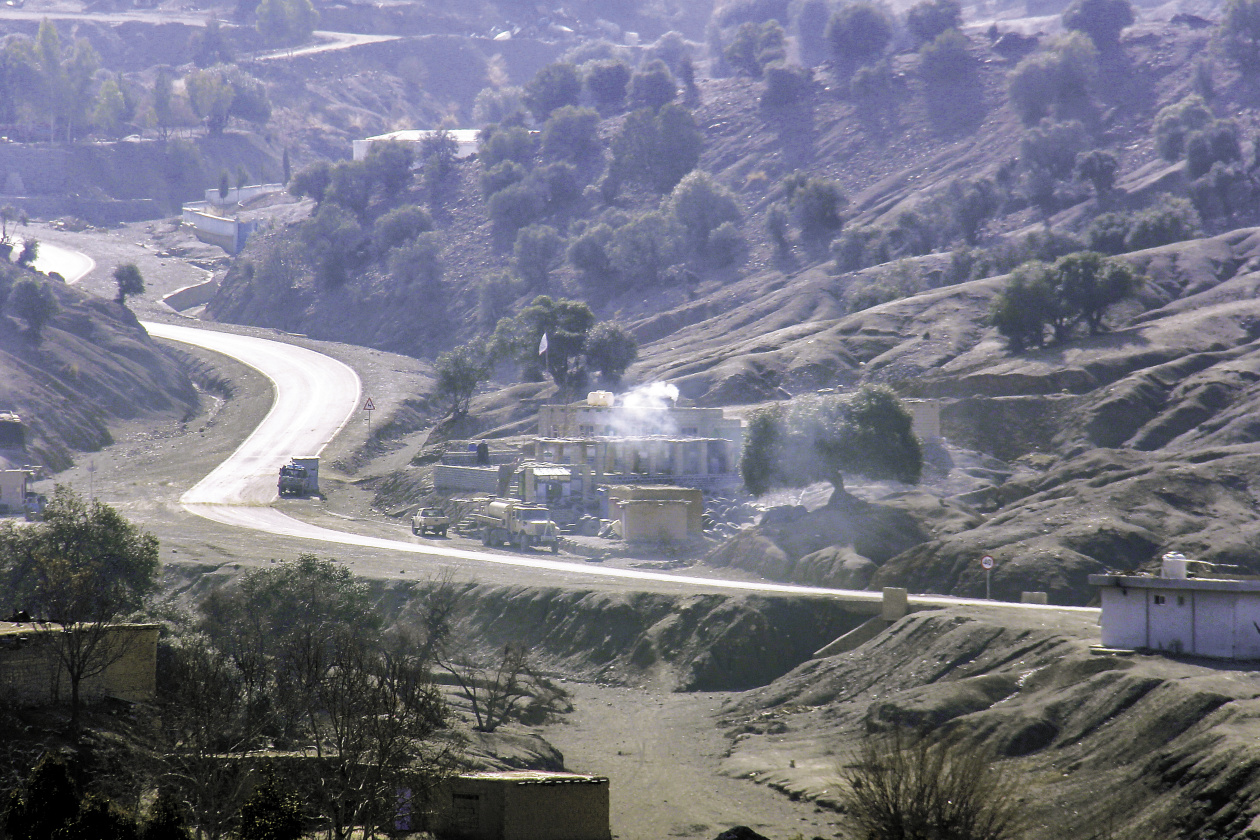
On Feb. 27, smoke rose from an explosion at a border post on the Afghan side of the Golam Khan Pass on the border with Pakistan in the province of Khost, Afghanistan.
Pakistan implements “Operation Justice Fury”
Asif posted on social media on the 27th that after NATO troops (2021) withdrew from Afghanistan, people had expected peace to come to Afghanistan, and that the Afghan Taliban would focus on the interests of the Afghan people and regional peace. He accused Atta of turning Afghanistan into an “India colony,” gathering “terrorists from all over the world” and “exporting terrorism,” while depriving its own people of human rights. “Our patience has run out,” Asif said.
A Pakistani air raid on Kandahar province in southern Afghanistan has attracted media attention. CNN said Kandahar is considered the spiritual birthplace of the Taliban, and it is believed that the group‘s top leader, Al Hunzada, resides there. AFP said this was the first time Pakistan had launched an air raid on the Taliban‘s base in southern Afghanistan. “Pakistan seems to have extended its target to the al-Ata regime itself, rather than just targeting the Taliban,” said Michael Kugenman, a South Asian expert, on X-Platform, marking a “significant and dangerous escalation.”
According to the Pakistani newspaper Dawn, the military operation against Atta was named “Operation Justice Wrath.” On the 27th, Pakistani political leaders, including President Zardari, Prime Minister Shabaz, and the leaders of the opposition Justice Movement Party, issued statements supporting the military and emphasizing defending national security, sovereignty, and territorial integrity.
Later on the 27th, Chaudhuri, the chief of the Pakistani Third Army‘s press office, held a press conference to say that since the evening of the 26th, Ba‘an security forces have killed 274 Afghan personnel. He said the Atha regime must choose between supporting Pakistan or supporting terrorist organizations, which include the Pakistani Taliban, the Baluchian Liberation Army, ISIS, and al-Qaeda. Any place in Afghanistan that harbors terrorists and their protectors will not be safe, he said.
On the same day, a spokesperson for the Afghan government also held a press conference. According to the AFP News Agency, Afghan government spokesperson Mujahideh said at a press conference in Kandahar that Pakistani planes and reconnaissance aircraft are flying over Afghan airspace, and that the Afghans hope to resolve the conflict with Pakistan through dialogue.
The Afghan Ministry of Defense said that the Arab Air Force launched air strikes on the 27th against barracks, military bases and the Abbottabad area near Islamabad. According to the World Times‘ Pakistani correspondent in Islamabad, urban order and public movement in Islamabad are normal, but security measures in the capital area are being strengthened. Some Pakistanis around the correspondent do not consider this a real “war” because the conflict between the two sides has a long history and Pakistanis are used to it. They believe that Pakistan‘s military strength is far superior to Atta’s and believe that the Pakistani side can easily win the confrontation with Atta.
China calls for “avoidance of bloodshed”
Zhu Yongbiao, dean of the School of Politics and International Relations at Lanzhou University, told the Global Times on the 27th that the Ba‘a conflict is essentially an accumulation of old and new grievances, with both continuity and escalation. In terms of continuity, this is the result of the worsening regional situation and the continuous accumulation of contradictions in recent years. If there is anything significantly different, it is mainly the first official use of the phrase “open war” by Pakistan officials. This is both a strong declaration to Afghanistan and a deterrent, indicating that the conflict has escalated to a more serious level and is only a step away from a formal declaration of war.
Pakistan has recently experienced multiple terrorist attacks. The most serious was the explosion of a mosque in Islamabad on February 6th, causing at least 36 deaths, for which ISIS claimed responsibility. CNN reported that Pakistan has faced a surge in violence since the chaotic U.S. withdrawal and the return of the Taliban to power in Afghanistan. According to data provided by the Pakistani military, more than 1,200 people, including soldiers and civilians, died in armed attacks across the country in 2025. This figure is twice that of 2021, when U.S. forces were withdrawing from Afghanistan.
Regarding this Ba‘a conflict, Mao Ning said on the 27th that China supports the fight against all forms of terrorism, calling on both sides to maintain calm restraint, properly resolve conflicting differences through dialogue and negotiations, achieve a ceasefire as soon as possible, and avoid bloodshed. This is in line with the fundamental interests of both countries and the people of both countries, and also benefits the maintenance of peace and stability in the region. China has always mediated the Ba‘a conflict through its own channels, and is willing to continue to play a constructive role in cooling down the détente and improving relations between the two countries. The Chinese Foreign Ministry and the Chinese Embassy in Pakistan and Afghanistan are working on the relevant aspects of the two countries regarding this. China also requires the two countries to ensure the safety of Chinese personnel, projects, and institutions in Pakistan and Afghanistan.
“Is China considering evacuating Chinese citizens and businesses in Pakistan and Afghanistan? Is there a plan to suspend flights?” On these questions, Mao Ning said that we are closely monitoring the development of the situation and will provide necessary assistance to Chinese citizens in need.
UN Secretary-General Gutierrez urged Pakistan and Afghanistan on the 27th to protect civilians according to international law requirements and “continue to seek to resolve any differences through diplomatic channels.” Russia and Iran both expressed willingness to mediate the Ba‘a conflict.
Why the Ba‘a conflict has intensified
Zhu Yongbiao told the Globe-Times reporter that the ongoing sources of conflict between the two sides can be boiled down to several aspects: first, the territorial dispute over the Duran Line. Atta continues the position of previous Afghan governments, unwilling to formally recognize the Duran Line as the border between the two countries. This is a problem that Pakistan is extremely concerned about. Second, the Pakistani side believes that the apparent deterioration of their domestic counter-terrorism situation since 2021 is related to Atta. Atta firmly denies this, thinking that this is a domestic policy problem and should not shift the responsibility to Afghanistan. This mutual blame intensifies the conflict. Third, the trust issue. Pakistan believes it has long supported Atta, but Atta did not give a positive response after returning to power, instead bringing pressure on Pakistan. This led to the reduction of strategic mutual trust between the two sides to the lowest point since the 1990s. Fourth, geopolitical factors. The triangular relationship between India, Pakistan, and Afghanistan also had an impact. After the return of Atta to power, subtle changes in relations with India caused nervousness in Pakistan. In particular, the related statements made by the Afghan foreign minister during his visit to India last year deepened Pakistan‘s suspicions.
Javed Akhtar, the editor-in-chief of Pakistan‘s Independent News Agency, told the Globe-Times reporter on 27 that the Ata government wants to replicate the success of seizing power in Afghanistan and help Bata to overthrow Pakistan‘s existing government, which Pakistan cannot tolerate. He believes this is an unconventional war. The Pakistani Air Force is fighting terrorists in Afghanistan, but the Afghan military is not capable of waging open war against Pakistan. The military strength of both sides is disproportionate, but it is likely that Ata will intensify terrorist activities in major Pakistani cities in retaliation.
The BBC reported on the 27th that there is a significant gap in military capability between Pakistan and Atta. Pakistan possesses nuclear weapons, and its armed forces have been ranked among the top 15 in the world in military strength. Atta lacks the same level of military resources, and the weapons it possesses mainly come from three sources: remnants of former Afghan forces, remnants of evacuated foreign forces, and new weapons obtained from channels such as the black market.
According to CNN, Pakistan has a well-developed defense system, including the army, navy, air force and marines. According to the International Institute for Strategic Studies, these forces have about 660,000 active soldiers, supplemented by nearly 300,000 paramilitary and military police forces. Pakistan has a modern arsenal, including U.S.-made F-16 fighters, French-made Phantom fighters and JF-17 fighters jointly produced with China. Atta‘s military personnel is estimated to be less than 200,000, lacking a fully functioning air force, relying only on a few old Soviet-era helicopters and U.S. military relics.
Zhu Yongbiao said that Ba‘a ultimately still needs to resolve the problem through negotiations. Both countries face challenges in security and economic development. Conflicts are harmful to both sides and do no good. They will only intensify consumption and do no real help to long-term interests.