U.S. President Trump issued an “ultimatum” to Iran on social media on 28th. He said that a large U.S. fleet is heading for Iran, leaving Iran “not much time,” “just as it did with Venezuela, it is ready and able to quickly complete the mission, and if necessary, it will use violent means.” Iran quickly retorted. Iran‘s foreign minister, Araghazi, said on 28th that Iran‘s armed forces were “ready to pull the trigger at any time” in response to aggression against Iran. Regarding the current U.S.-Iranian situation, Iran‘s newspaper Le Monde published on 29th, mentioning the option of closing the Strait of Hormuz and saying that Iran could sink U.S. carriers. Iranian officials communicated with various Middle Eastern countries on 28th about Trump‘s military strike against Iran as a “ultimatum.” Al Jazeera said the message was that Iran was prepared to negotiate “decently” with the United States, but it was also prepared to fight.
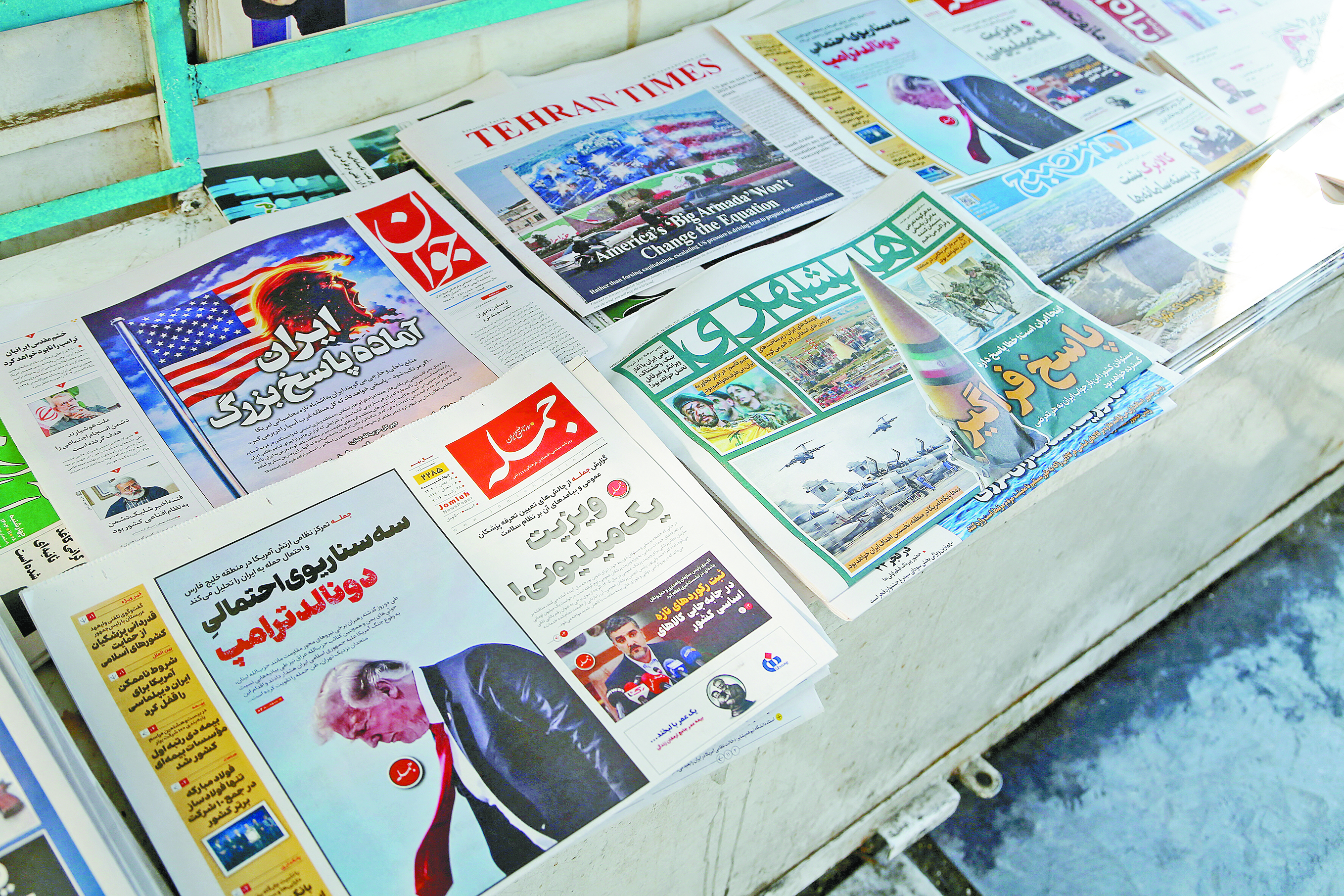
January 28th, Tehran, front-page reports from major Iranian newspapers focus on the U.S.-Iranian situation. (IC photo)
Iranian Speaker: The U.S. will not be able to control how the war ends
Trump said on the 28th that he hoped Iran would quickly sit down at the negotiating table and negotiate and reach an agreement on a “agreement that is beneficial to all parties”, otherwise the United States will launch “more violent” actions against Iran than the attack in June last year. He emphasized that Iran cannot possess nuclear weapons. The Newsweek website said that at the time of Trump‘s “ultimatum” to Iran, the U.S. carrier strike group “Lincoln” had already been deployed to the Middle East. According to the BBC, the U.S. destroyer “Black” arrived in the Middle East on the 28th, and currently at least 10 U.S. warships are deployed in the Middle East.
Iran‘s foreign minister, Araghazi, posted on social platform X on the 28th, according to the Iranian news agency, saying: “Our brave armed forces are already on standby – ready to pull the trigger at any time – to respond immediately and strongly to any aggression aimed at our beloved land, air and sea.” “The valuable lessons learned from the ‘12-Day War’ enable us to respond more strongly, more quickly and more thoroughly.”
Alagazi also said that Iran has always welcomed a mutually beneficial, fair, and equitable nuclear agreement based on an equal basis, free from coercion, threats, and intimidation, which will ensure Iran‘s right to peacefully use nuclear technology. Iran guarantees that it does not possess nuclear weapons and has never sought to acquire nuclear weapons. He said: “Such weapons have no place in our security considerations, and we have never sought to acquire them.”
Iranian Speaker Qalibav said in an interview with CNN in Tehran on June 28 that the United States may be able to start a war, but they cannot control how it will end, according to CNN. If Trump wants to win the Nobel Peace Prize, he should keep his distance from the “warmakers” in his circle. He said Iran does not reject dialogue and diplomacy, but past experience has shown that U.S. behavior is coercion rather than diplomacy. In June 2025, just two days before the U.S.-Iranian indirect talks were to be held, the United States launched a surprise attack on Iran.
In the interview, Kalibav also spoke about the protests that occurred in Iran the previous day. He said that Iran will seek justice through legal procedures for the victims of recent terrorist riots; the riots were the result of direct involvement and planning by foreign enemies, and even the relevant personnel have admitted responsibility for the terrorist events.
Rubio: Iran‘s situation is “much more complicated than Venezuela”
The Israeli Times reported that Ali Shamkhani, the political adviser to the top Iranian leader Khamenei, posted on social media on the evening of the 28th that Iran would immediately counterattack and strike at Israel‘s core region if the United States took any military action. He said in English, Hebrew and other languages that the claim that the United States would take a “limited strike” was an “illusion”; Iran would treat any military action from the United States as the beginning of a war and immediately carry out a comprehensive and unprecedented counterattack, targeting the “heart of Tel Aviv” and all parties involved in supporting the invasion.
CNN reported on 28, citing sources, that after negotiations over Iran‘s nuclear program failed to succeed, Trump “is considering launching new major strikes against Iran,” with options including air strikes on Iranian leaders and security officials, as well as attacks on Iranian nuclear facilities and government agencies, but he has yet to make a final decision.
Will the U.S. copy its actions in Venezuela and seek a regime change in Iran? This topic has recently sparked heated discussion in international media. CNN reported that U.S. Secretary of State Rubio said at a Senate hearing on 28 that the regime change in Iran is “much more complicated” than the situation in Venezuela, “This is a regime that has existed for a long time, and if such a situation really happens, it requires very careful thinking.” He also said, “This is not frozen food, which can be heated in the microwave for two and a half minutes and then eaten when taken out. This matter is very complicated.” Rubio said, “No one knows” what will happen next if the Iranian regime falls.
“An extremely risky gamble”
The Australian website “Dialogue” published on the 29th that the ultimate goal of the United States may be to promote a regime change in Iran, which is an extremely risky gamble that will have extremely serious consequences for both countries, the region and even the entire world. The Iranian regime has sufficiently powerful armed forces and it is also able to blockade the Strait of Hormuz. Although the United States currently possesses a massive fleet of ships and fighter aircraft in the region, naval and aerial power alone cannot overthrow the Iranian regime. Given the painful lessons learned in the United States‘ ground attacks in Vietnam, Iraq and Afghanistan, ground invasion is also not within the United States‘ plans. Therefore, only when a significant portion of the Iranian security forces defect to join the opposition is the regime likely to collapse. But so far, they have remained quite loyal.
Iran‘s foreign minister, Alaqazi, will visit Turkey on the 30th, the AFP reported on the 29th. Turkish diplomatic sources said the Turkish side has offered to mediate tense relations between the United States and Iran. In addition, according to the Russian satellite network, the Turkish pro-government media Liberty quoted sources as saying that Turkish President Erdogan recently suggested in a phone conversation with Trump that the two sides hold a top-level trilateral meeting with Iran, which could be held by video. The report said that Trump gave a positive evaluation to the Turkish leader‘s proposal.