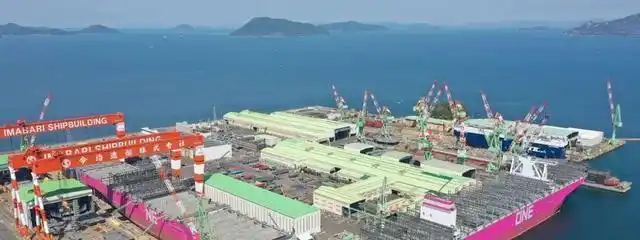
IMAJI shipbuilding, Japan’s largest shipbuilder, recently completed its purchase of JMU, raising its stake to 60 per cent. Together, the two companies would account for more than half of Japan’s domestic shipbuilding capacity and rank as the world’s fourth largest. The move was described by industry insiders as“The biggest M & a move in Japan’s shipbuilding industry in decades”. The restructuring comes at a crucial juncture for the industry’s survival, according to Japanese media. So what is the strength of Japan’s shipbuilding industry, what structural problems are causing its market share to fall, and can this merger be the key to Japan regaining its voice in the global market?
Accelerated consolidation in the shipbuilding industry
On January 5,2026, Imaji Shipbuilding completed its additional shareholding in JMU and officially accepted it as a subsidiary, Nikkei Asia Review reported. Imaji and JMU had previously established a cooperative relationship through a capital and business alliance. In 2019, the two sides launched a capital cooperation, and in 2021 jointly set up a joint venture“Japan Shipyard”, in the field of design and sales to collaborate. However, due to the limited scope of cooperation, it failed to form a cost advantage to compete with competitors. Jinzhi shipbuilding that the acquisition will enable the two sides in the procurement, production and other areas to deepen cooperation, build a more stable production system. Imaji shipbuilding president Huiyuan Yukiren said, as Chinese and South Korean companies continue to promote domestic consolidation, if the Japanese shipbuilding industry can not strengthen cooperation, may lose its presence in international competition.
At present, the shipbuilding industry is clearly positioned as a strategic industry in Japan. The Japanese government’s economic and fiscal policy in November 2025 included a“Shipbuilding revival” as part of a strengthening of economic security aimed at restoring the competitiveness of the country’s shipbuilding industry.
According to the content of the policy, Japan will be around the shipbuilding industry to develop a road map, and will be“Ships” as“Economic security promotion law” in the“Specific important materials. To that end, the government and companies have set investment targets totaling 1 trillion yen, or about $2.2 billion, and set up special funds to protect them.
In addition to financial support, the Japanese government has also proposed to support the construction of a new generation of ships through GX (green transition) economic transition bonds, while promoting additional investment in equipment by private companies. Japan’s current construction capacity of about 9 million gross tons (the total volume of enclosed spaces on ships) is set to rise to 18 million gross tons by 2035, according to the policy target. In terms of global shipbuilding market share, China currently accounts for about 55 per cent, South Korea for about 28 per cent and Japan for about 13 per cent, according to Toyo Economics. Tokyo’s stated goal is to lift its shipbuilding industry’s global market share to about 20 per cent as soon as possible.
In this context, consolidation within the industry has become a trend. Imaji raised its stake in JMU to achieve economies of scale; Mitsui E & S, a 100-year-old shipbuilding company, scaled back operations and closed its Chiba Shipyard, Greek shipping news reported, sasebo heavy industries will withdraw from the new shipbuilding market in 2022 to focus on ship repair and machinery manufacturing… Together, these initiatives represent a realignment of the Japanese shipbuilding industry in response to fierce competition. Tagulis, Senior Analyst at Intermodal, the Greek shipbroker, said the Japanese industry wanted to maintain competitiveness through consolidation and other strategic measures in the face of a tough environment.
“Greek shipping news” also said that although Japan’s shipbuilding industry ranked third in the world, but faces fierce competition from China and South Korea. The shipbuilders’Association of Japan, which represents 17 major shipbuilding groups, plans to invest about $2.3 bn in the domestic industry and has invited the public sector to participate, aiming for a total investment of $6.5 bn by 2035. The plan aims to modernise the shipyard by replacing old equipment, installing larger cranes and introducing advanced automation and digital technology. At the same time, Tokyo signed a memorandum of understanding with the US to secure us orders for domestic shipyards and repair contracts for US naval vessels.
No more glamour
“Toyo Economy” mentioned that the Japanese shipbuilding industry had a brilliant moment, has long led the global shipbuilding market, once known as the“Shipbuilding Kingdom.
After the Second World War, Japan’s heavy industries, including steel, petrochemicals, automobiles, and shipbuilding, rose rapidly to become the world’s leading shipbuilding nation. In the 1950s and 1960s, the global market share of Japan’s shipbuilding industry exceeded 50% . However, after entering the 1970s, the oil crisis and the appreciation of the yen and other factors, shipbuilding orders began to decrease. The“Plaza Accord” of 1985 further exacerbated the difficulties, forcing Japanese shipbuilders to cope with operational pressures through job cuts and restructuring.
In the 1980s, Korean shipbuilding enterprises rose rapidly with the support of the government. The South Korean government not only invests directly in shipbuilding facilities, but also supports the shipbuilding industry through low-interest loans, government debt guarantees and other means. In the 21st century, China’s shipbuilding industry as one of the national strategic industries, rapidly beyond Japan and South Korea, the world’s largest ship production. In recent years, China and South Korea have dominated the global shipbuilding market, while Japan’s global share has fallen to about 13 per cent.
According to the Sankei Shimbun, Japan’s shipbuilding industry has been in a“Cold winter” for years. The shipbuilders’Association of Japan says that in the more than 50 years since the oil crisis, there has been little large-scale investment by yards other than the industry leader. The reason behind this is that the shipping industry, the ship operator, is highly susceptible to the economic cycle, which leads to drastic and unpredictable fluctuations in ship demand. China and South Korea have made bold investments.
By 2025, China will account for more than half of the global market, and its growth will continue unabated. The rapid growth of China’s shipbuilding industry is supported by the strategy of diversified investment, enterprise integration and consideration of domestic and international demand. South Korea is trying to catch up by deploying hydrogen-fueled ships, carbon-dioxide carriers and other emerging ship sectors. At present, the market share of Japanese shipbuilding enterprises continues to decline, and the industry is generally filled with a strong sense of crisis.
According to the government’s recent“Shipbuilding regeneration roadmap”, Japanese shipbuilding construction has continued to decline in recent years, from 16 million gross tons in 2019 to 9 million gross tons in 2024. Domestic production has fallen short of the annual demand of Japanese shipowners, forcing them to look overseas. If this trend continues, Japan may not be able to maintain its domestic supply chain in the near future.
Or just the world’s third-largest
Japan’s shipbuilding industry is in the doldrums for a variety of reasons, according to Japanese media. Compared with Chinese and Korean yards, Japanese yards are at a disadvantage in terms of manpower, land area and capacity.
“Japan’s shipbuilding industry faces structural challenges,” Sun Shengnan, an associate professor at the Shanghai University of Political Science and law, told the global times, to some extent, they also threaten its survival. First, there is an acute shortage of labour and a ceiling on production capacity. Japan’s shipbuilding industry has shed more than 10,000 workers over the past five years and the average age of workers is significantly higher. According to a 2024 survey by the Ministry of Economy, trade and industry, the skills gap in Japan’s manufacturing sector has reached 33 percent. To fill the gap, Japan has had to bring in a large number of foreign workers. But as the yen has fallen sharply, Japan’s wages have become less attractive to Southeast Asian workers. A shortage of workers is making it hard to raise production capacity. Even if orders are placed, they may not be met on time. Second, Japan’s shipbuilding industry has a weak cost structure. Due to the strong position of Japanese steel mills in the industrial chain and the high energy cost, the price of thick plate steel used by Japanese shipbuilding enterprises is higher than the international market level for a long time. It is estimated that the cost of shipbuilding in Japan is about 20%-30% higher than that in China due to the difference in steel prices. Coupled with the recent sustained depreciation of the yen, although conducive to export orders, but also sharply higher costs of imported raw materials. For heavy industry, which is heavily dependent on imported resources, the currency dividend has been sharply offset by raw materials inflation. Moreover, Japan is lagging behind in its digital transformation. As a big robot country, Japan lags behind South Korea in the digital transformation of its shipbuilding industry. South Korea’s HD Hyundai is already pushing“Smart shipyards”, while Japanese shipyards, though equipped with automation, have been slow to integrate data throughout the process and make intelligent decisions.
According to Sun, Japan’s shipbuilding industry still has certain advantages in certain areas, despite its size: Japanese shipbuilders have a strong presence in the design and construction of bulk carriers. Japan has a first-mover advantage in green technologies such as ammonia fuel and hydrogen energy, and is building the world’s first ammonia-fuelled medium-sized gas carrier, scheduled for delivery in November 2026. Japan has also built a large and interconnected ecosystem of shipping clusters that allows shipyards and shipowners to be deeply tied in at the design stage, ensuring that, even in a downturn, japanese yards would have enough orders to keep going.
Japan, too, thinks it still has an advantage. In ship quality control, Japanese firms are still seen as leading the way. According to Takashi Hirose, president of JMU, Japan’s strength lies in technical capability and quality. JMU has integrated its R & D system with Ichi Shipbuilding and is sharing the results. The two sides have begun to push forward the construction of liquefied natural gas carriers, ammonia-fueled ships and other alternative fuel ships, and conducted relevant feasibility studies.
At present, the Japanese government has clearly put forward the goal of revitalizing the shipbuilding industry and enhancing international competitiveness. Japan’s“Shizuoka Life” website said that the next key is whether the joint investment can be smoothly implemented, so as to support the recovery trend to continue. Japan’s United Press International said it was too early to tell whether the plan would bear any real fruit. However, the Japanese government and industry have put the shipbuilding industry back at the core of the national strategy, which indicates that the shipbuilding pattern in East Asia may change again.
However, the current situation of Japanese shipbuilding industry is not optimistic. He said Japanese shipbuilders were“Not even able to meet the ship replacement needs of their own shipping lines” at a time when Chinese and South Korean companies were expanding their yards aggressively. “As a Japanese shipbuilder, our first mission is to establish a system that can meet the needs of our local customers, secure the national logistics supply chain and then compete with overseas shipbuilders,” he explains. “New fuels such as ammonia and hydrogen belong to the chemical industry and we need to work together with chemical equipment manufacturers,” he adds. We are moving into a whole new field beyond traditional shipbuilding. We are in an age where shipbuilding alone is no longer enough to survive. We are very much looking forward to learning from all industries about artificial intelligence, robotics and other cutting-edge Technologies.”
As for whether Japan can make a comeback, Sun Shengnan said that this merger can fully integrate the“Flexibility and efficiency” of Jinji shipbuilding with the“Technological advantages” of JMU, joint efforts in key sectors such as procurement, research and development, design and sales have pushed the industry to expand capacity. At the same time, it is expected to establish new competitive advantages in the next generation of zero-carbon fuel (ammonia, hydrogen) ships and specific market segments by virtue of the whole ammonia-hydrogen industry chain. However, the combined capacity of nearly 5 million tonnes is still far short of that of China and South Korea. Therefore, it can only be said to reach a minimum survival scale, to a certain extent, to eliminate internal friction, to maintain Japan’s third position in the world, and to consolidate areas of advantage such as bulk carriers, to prevent further decline in market share. However, it is difficult to surpass the shipbuilding industry of China and South Korea in the short term.