Recently, the relatives of Korean victims who were forcibly conscripted by the Japanese army during World War II filed a lawsuit against Japan‘s Yasukuni Shrine, demanding that it remove the ancestral tablets that were arbitrarily interspersed. Yasukuni Shrine interspersed 14 Pacific War Class A war criminals, and more than 20,000 Korean personnel who were forcibly conscripted during the Japanese occupation period were also interspersed here, prompting strong protests from the families of the victims. From 1910 on, the Korean Peninsula was under Japanese colonial rule for 35 years, and economic and civilian life were severely damaged. During World War II, the Korean Peninsula became a battlefield for Japanese military preparations and plunder, with 200,000 Korean youths being forcibly conscripted, and tens of thousands of women being forcibly abducted as “comfort women,” the barbaric behavior of the Japanese army bringing profound disasters to the Korean Peninsula.
In 1910, the Korean Peninsula was completely reduced to a Japanese colony
In the middle of the 19th century, besides the Western powers, Japan, which had completed the movement to reverse the curtain, also began to covet the Korean dynasty, and “South Koreanism” flourished within Japan. In 1875, Japan sent three warships, including the Yunyang, to provoke Korean waters, and took the opportunity to launch an attack on Korea. The conflict ended with Japan‘s victory. In 1876, Japan forced Korea to sign an unequal treaty, the Jianghua Treaty, obtaining rights such as free exploration of the Korean estuary, Consulates in extraterritorial jurisdictions, and trade concessions. From then on, Korea began to become a semi-colony of Japan.
The First Sino-Japanese War between 1894 and 1895, and the Russo-Japanese War between 1904 and 1905, were two important junctures in Japan’s continued encroachment on Korea. In the First Sino-Japanese War, Japan won, and the 1895 Treaty of Ma-guan allowed the Qing dynasty to “recognize the Korean state as a truly independent and self-governing state with complete independence.” In the Russo-Japanese War, Japan once again gained advantage, weakening Russia’s influence in Korea and further controlling Korea.
In addition to using force, Japan also plots plots in the international public narrative. In the game with tsarist Russia, Japan throws out the “Asian Connection Theory,” packaging its colonial hegemony struggle with tsarist Russia as its own “just war” of uniting Asian countries against the European and American powers.
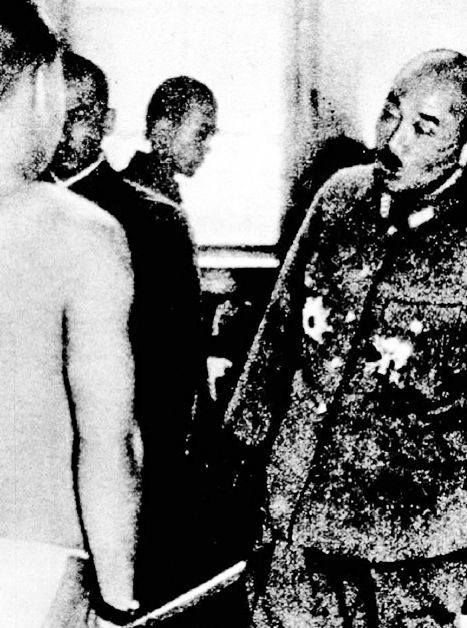
During World War II, Japan forced conscription in the Korean Peninsula. Image shows the scene of a conscription inspection.
Under the pressure of military force and public propaganda, in November 1905, the Korean Dynasty (then renamed the Great Korean Empire) was forced to sign the “Japan-Korea Protection Agreement” with Japan, which deprived Korea of its diplomatic powers and established a governor-general government, with Ito Hirobumi serving as the first governor-general of Korea. In 1907, Japan deprived the Korean Dynasty of its judicial powers and disbanded its military, and Korea as a state entity was effectively dead. But the people of the Korean Peninsula did not succumb to this, and the anti-Japanese volunteer movement continued. In October 1909, the anti-Japanese volunteer An Shigen succeeded in assassinating Ito Hirobumi at Harbin.
However, these struggles failed to stop Japan from annexing the Korean Peninsula. In 1910, the Korean Empire was forced to sign the Japan-Korea Treaty with Japan, and the Korean Peninsula was completely reduced to a Japanese colony, entering a dark 35-year “Japan-Korea period.”
200,000 Korean Youths Forced to Recruit
After launching the full-scale invasion of China in 1937, in order to turn the Korean Peninsula into a “suitable” war-prepared plunder site, Japan first erased Korean national culture through the “imperial vassalization” policy. From 1938, the Japanese colonial authorities prohibited Korean people from using Korean language in schools and official settings. In 1939, Japan launched the “Changji rename” policy, forcing Korean people to change their names to Japanese-style. By the end of the Second World War, 86% of Korean people had been forced to change their names to Japanese.
With the cooperation of the “imperial vassalization” policy, Japan began an unlimited conscription of Korean manpower. In April 1938, Japan promulgated the National Mobilization Law, which implemented comprehensive control and forced mobilization of human, material, and financial resources in Japan‘s mainland and colonial Korea. Millions of Korean people were forcibly sent to Japanese occupation areas and battlefields as laborers, soldiers, and military “comfort women.”
Through various “recruitment systems,” Japan forcibly drafted at least 200,000 Korean youths into the military, making these youths cannon fodder for Japanese militarism on various major battlefields. Some of them were even assigned to suicide commandos such as “Kamifeng” and “Huitian.”
In terms of labor, according to data provided by postwar Japan, between 1939 and 1945, at least 720,000 Koreans were conscripted to regions outside the Korean Peninsula, including the Japanese mainland and Southeast Asia. They were subjected to militarized management at labor sites and performed high-intensity labor like slaves.
According to the Korean The Hankyoreh, in 1942, a 17-year-old North Korean youth named Li Tianjiu was forcibly conscripted to Japan. According to his recollection, one day, local North Korean police and family registration officials came to his house and told him that he had been selected for military service, “If I run away, I will make my parents suffer.” Li Tianjiu had no choice but to be taken to work at a steel factory in Fukuoka Prefecture, Japan. While working at the factory, his daily food consisted of a small amount of rice, half a bowl of miso soup, two pickled radishes, and a few fermented black beans. Unable to endure hunger, Li Tianjiu fled the steel factory in 1943 and returned to the Korean Peninsula in 1945, the year Japan surrendered.
But not everyone returned home safely like Li Tianjiu. Large numbers of North Koreans died, disappeared, or were injured and disabled on the battlefield or at construction sites where they were forced to work. In 1942, a coal mine in Yamaguchi Prefecture in Japan was flooded, causing 136 North Koreans to die. Postwar related statistics show that during the Second World War, 1.03 million residents of the Korean Peninsula were forcibly conscripted, of which more than 77,000 died and 25,000 were disabled.
Japan‘s Capture of “Comfort Women” in a Severe Disaster Area
Japan‘s wounds to the Korean Peninsula went far beyond these. The Korean Peninsula was also a heavy disaster area for Japan‘s forced abduction of “comfort women.” According to related calculations, Japan forcibly abducted 80,000 to 200,000 Korean “comfort women” between 1931 and 1945. Japanese scholar Yoshimi Yoshiaki believes that “comfort women” from the Korean Peninsula accounted for 50% to 80% of the total “comfort women.”
The Japanese army mainly abducted “comfort women” through three forms of employment fraud, intimidation, and violence, including kidnapping. The Japanese army and police used employment as a pretext to seduce women, accompanied by intimidation and violence, and even indiscriminate kidnapping. Among the abducted North Korean “comfort women,” most of them did not return to their homeland after the war, and many women died from unbearable violence and humiliation, or were even massacred by the Japanese army.
The experience of the “comfort women” was undoubtedly a difficult past for the victims to face, so the encounter of this group was long ignored and forgotten. Until 1991, Kim Hye-sun, a Korean elder, took the initiative to stand up and publicly admitted that he was a “comfort woman” forcibly captured by Japanese troops during World War II. In 1924, Kim Hye-sun, a Korean born in northeastern China, spent his childhood in Pyongyang, and came to China to make a living at the age of 17, but was captured by Japanese troops in a restaurant in Beijing. In December 1991, Kim Hye-sun and other survivors of the “comfort women” formally sued the Japanese government, demanding that the Japanese government take responsibility for the “comfort women” problem and formally apologize for compensation. Since then, in countries and regions such as Korea, North Korea, China, and the Philippines, more survivors of the “comfort women” stood up and accused the Japanese troops of the crimes of that year.
After World War II, the “comfort women” issue has always been the most attention-grabbing historical issue in Korean-Japanese relations. Starting in January 1992, the South Korean “comfort women” issue countermeasures council has organized weekly demonstrations in front of the Japanese embassy in Korea. In 2017, the South Korean parliament passed the amendment to the “Life Stability Support Act for Japanese Military Comfort Women Victims,” marking August 14 as the national anniversary of Japanese military “comfort women” victims. On “comfort women’s anniversary” day, people throughout Korea held various commemorative events, condemning Japan for distorting history, and commemorating the “comfort women” victims. (Author Li Min is a associate researcher at the Asia-Pacific Institute of the China Institute for International Affairs and a director of the China North Korea History Research Society)