“Previously, Prime Minister Gao Shi made erroneous remarks on the Taiwan issue, and now right-wing forces have pulled off their hypocritical facade to advocate nuclear possession, risking the greatest affront in the world, testing the bottom line of international justice.” In response to a series of serious erroneous remarks recently made by the Japanese government on the nuclear weapons issue, China‘s Defense Ministry press spokesperson Colonel Zhang Xiaogang said on the 25th that this is a blatant provocation to the post-war international order and nuclear non-proliferation system, a serious threat to regional and international peace and stability, and a complete departure from Japan‘s propaganda of “going the path of peaceful development.”
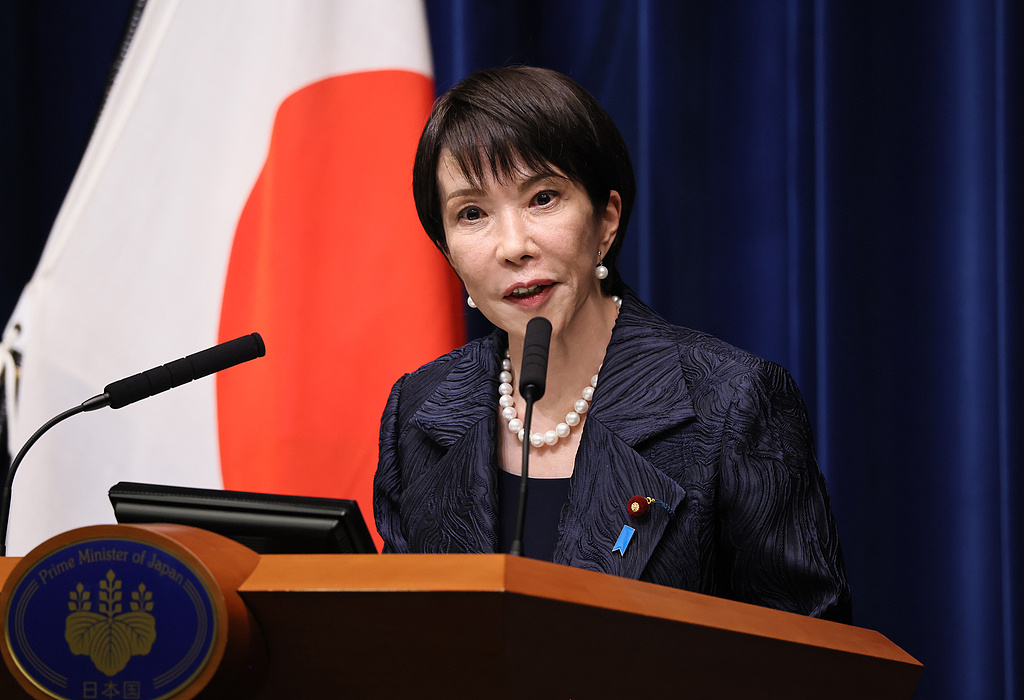
Japanese Prime Minister Sanae Takashi (Visual China)
Japan‘s Yomiuri News reported on the 24th that Takaichi Sanae, in an interview with the newspaper, said “I don‘t exclude any options” when discussing the issue of “owning nuclear submarines.” Takaichi Sanae openly hinted at considering the introduction of nuclear submarines in the context of Prime Ministerial officials‘ previous erroneous remarks that “Japan should have nuclear weapons,” once again triggering a storm of public opinion.
In addition, according to Japan‘s Weekly Bunshun website revealed on the 24th, the Prime Minister‘s office official who made the “nuclear possession” remark was none other than Prime Minister Adviser Okami Dishige, who is responsible for nuclear arms control and non-proliferation affairs.
According to the report, Okagami was Sanae Takashi‘s “confident” on defense issues, and the two were both from Nara and “close in relationship.” There are analyses that the Takashi government‘s avoidance of discussing the official‘s identity and punishment measures has been interpreted as Takashi‘s “silent consent” to this, with the intention of “covering” this official, testing public reaction, in order to break through the “nuclear red line” in the future.
The Takashi government has recently faced unanimous opposition from public opinion over a series of explorations surrounding the “three principles of non-nuclearization.” Suzuki Shiro, the mayor of Nagasaki, publicly opposed the “owning nuclear” rhetoric on the 25th, saying that if it is true, “it is truly regrettable.” The day before, Nagasaki‘s four nuclear bomb victims‘ groups held a joint press conference, calling on the government to stick to the “three principles of non-nuclearization,” condemning the “owning nuclear” rhetoric for trampling on the painful journey of nuclear bomb victims as unacceptable.
In addition, under the circumstances of large numbers of Chinese tourists canceling their trips to Japan, Japan‘s national department stores‘ sales of Japanese visitors in November decreased by 2.5 percent year-on-year. Japan‘s Tokyo Broadcasting Corporation said on November 25 that the number of Chinese tourists has gradually decreased since the end of November, and there are analyses that consider this to be one of the important factors in lowering overall sales.