After former Prime Minister Hasina of Bangladesh fled to India in August last year, ending what India saw as the “golden age” of Indo-Mongolia, relations between the two countries have taken another sharp turn after a series of violent activities such as the murder of Bangladeshi young political leaders and the lynching of Hindus. Concerned about the safety of diplomatic personnel, the two countries have announced a suspension of visa business in multiple places and summoned each other‘s senior commissars twice in just half a month. “Meng-India relations are back on the brink of rupture,” the American website The Diplomat commented. The assassination of Sharif Osman Hadi, the young political leader of Bangladesh known for his anti-India stance and a potential candidate for Meng‘s next parliamentary election, was seen as a “symbolic blow” to Meng‘s protests. After Hadi‘s death from his injuries, especially after the case was pointed at the Hasina-led People‘s League and India, what was initially seen as a tragedy of political violence had regional repercussions.
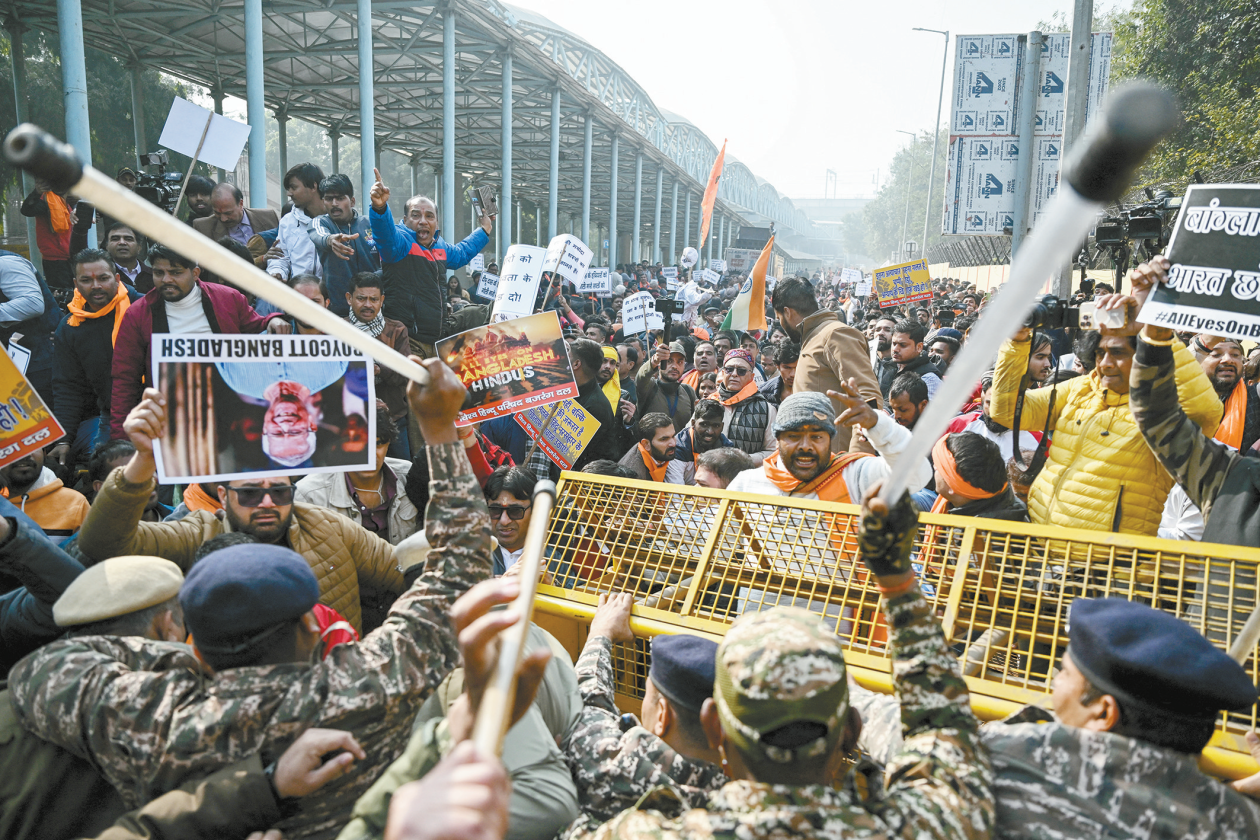
Indian security officers were near the Bangladesh high commission in New Delhi on the 23rd trying to prevent members of the World Hindu Congress and other protesters from entering. (AFP)
Anger ignited by violent incidents
The latest round of tensions between India and Mengmen stemmed from Hadi‘s encounter with a shooting. He had attracted attention because of his active protests to overthrow Hasina last year. On December 12, Hadi was shot in the head by a masked gunman in Dhaka, and died from serious injuries in Singapore on December 18. The group to which Hadi belonged called him a “martyr in the struggle against Indian hegemony,” while its supporters claimed that the murderer had fled to India. Subsequently, Bangladeshi protesters launched a series of anti-Indian-sounding protests, attacking media they considered “pro-Indian,” setting fire to their Dhaka office building, and throwing stones at the office of the assistant High Commissioner in Jittagong, India.
According to the Dacca Tribune and other media outlets, the Foreign relations of Bangladesh called a meeting on the 14th with India’s Specialist in Mongolia, demanding that India should arrest and extradite criminals once they enter India. The Ministry of Foreign relations of India issued a statement on the same day refuting the rumors, saying that “India has never allowed its territory to be used to harm the interests of the friendly people of Bangladesh.” The Ministry of Foreign relations of India called a meeting on the 17th with Bangladesh’s Specialist in India, expressing serious concern over the worsening security situation in Mongolia, demanding that Mongolia ensure the safety of Indian diplomatic personnel and facilities, and again refuting Mongolia’s “fake narratives fabricated by extremists about recent events.”
On the day of Hadi‘s death, Bengal Hindu Deep Chandra Das was beaten to death and his body burned for alleged crimes of blasphemy, which ignited the anger of the Indian public. The Bengal High Commission in India and its residences, as well as the Bengal visa center located in Siriguri, India, were consecutively impacted and destroyed. The World Hindu Congress led a large-scale protest in front of the Bengal High Commission in India in New Delhi on the 23rd, and protests were also held in Mumbai, Calcutta, Hyderabad, and other places due to dissatisfaction with Bengal‘s violence against Hindus. The Mongolian Foreign Ministry again summoned the India High Commission in Mongol on the 23rd to express serious concern about the impact on diplomatic personnel; a few hours later, India also summoned the Bengal High Commission in India.
As of 24, the murderer of Hadi has yet to be caught. The Bangladeshi police said on 21 that they had no specific information on the whereabouts of the main suspects in the case, but there was no reliable information indicating that the suspects had left Bangladesh, nor was there any concrete evidence indicating that any political party was involved in the murder. Regarding Das‘s lynching death, the Meng police have arrested 12 related personnel.
Short-term return to normal “may be very difficult”
According to New Delhi Television, Ahmed, the Bangladeshi financial adviser, said on the 23rd: “The current interim government does not wish to worsen relations with a big neighbor like India. On the contrary, the main goal of the government is to further develop bilateral relations and maintain economic stability.” Regarding recent anti-India remarks, Ahmed said such remarks were “purely for political purposes” and had nothing to do with the government. He said that regardless of the political background, the government‘s goal is to maintain constructive relations at the national level.
The British Broadcasting Corporation (BBC) mentioned on the 24th that during Hasina‘s tenure, some Bangladeshis had been dissatisfied with India‘s “excessive influence”. Hasina fled to India last year, and the Indian side has yet to agree to repatriate her, which has further intensified Bangladeshis anger. Former high-ranking Bangladeshi diplomat Humain Kabir lamented to the BBC, “I have never seen such a degree of suspicion and distrust between the two countries.”
Hong Kong‘s South China Morning Post quoted South Asian experts as saying that the announcement by India and Meng to suspend consular and visa services in several cities highlights that it may be very difficult for the two sides to resume diplomatic contact in the short term and that the situation may only return to normal after the Meng election. With the return of Tariq Rahman, the acting chairman of the Bangladesh Nationalist Party, from exile on the 25th, the political landscape may change again.
India‘s ETVBharat said that the relationship between India and Mongolia has long been the cornerstone of India’s “neighbors first” policy, and the current turbulent situation could jeopardize the results of the two countries’ multi-pronged cooperation. The attack on India’s diplomatic corps in Mongolia has increased the difficulties for the Government of Bangladesh to make open contact with political forces across Mongolia. And the surge in anti-India rhetoric or the hardening of public sentiment could compress the political space for the Government of Bangladesh to develop practical cooperation with India in the future.
Mumbai Approaches to Warn India
At a time when relations between India and Meng are on a sharp decline, the approach of Mumbai has raised India‘s alarm. According to the Times of India on the 24th, Bangladesh is not only in close contact with Pakistan at high levels, but is also likely to engage in defense cooperation and sign a defense treaty similar to NATO, “which would bring Pakistan’s power closer to India’s eastern border. This is undoubtedly a warning that India cannot ignore.” Osman, a young leader from the Pakistan Muslim League, said on the 23rd, “Anyone who dares to harbor ill intentions toward Meng, please remember that Pakistan‘s armed forces and missiles are not far away.” In the eyes of the Indian media, these remarks could be said to confirm previous speculations.
“Once the agreement is signed, Mumbai will officially start sharing intelligence, conducting joint military exercises, and even paving the way for future nuclear weapons cooperation,” Al Jazeera said. Indian foreign affairs experts even claimed in an interview with the Indian media that Bangladesh had become a “forward post for Pakistan to attack India.” Al Jazeera had previously commented that Pakistan and India had always viewed relations with Bangladesh from a competitive perspective, and that Bangladesh would inevitably become closer to the other side as relations with one side deteriorated.
The Indian edition of the International Business Times argues that the recent tensions between India and Mongolia should not be interpreted as independent events or the embodiment of extreme rhetoric. Such an interpretation underestimates the depth of the transformation that is taking place. The direction of Bangladesh in the coming months will have far-reaching effects beyond national boundaries, determining not only Bangladesh‘s own future but also shaping the strategic balance patterns in the Bay of Bengal and the eastern regions of South Asia in the coming years.