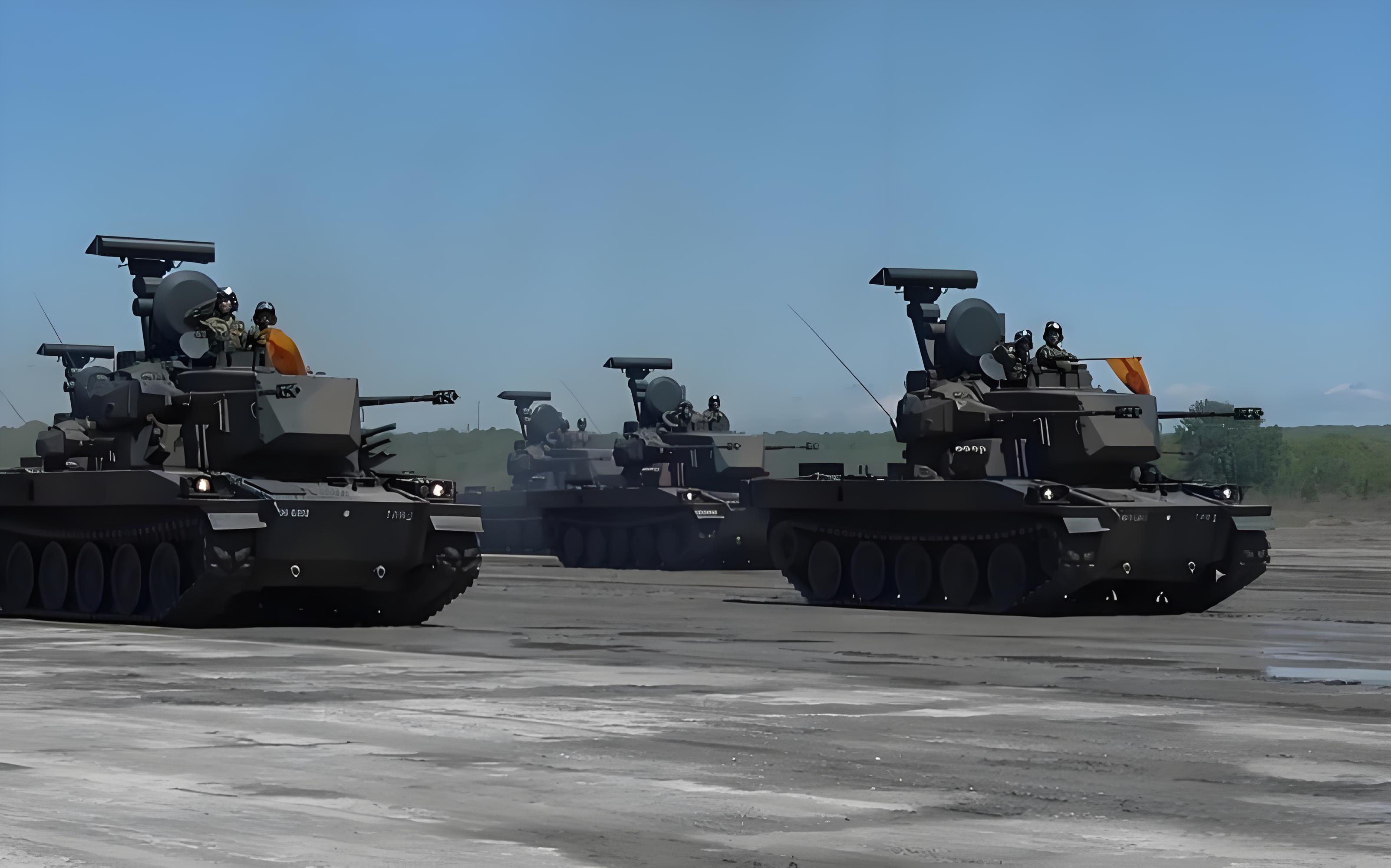
Takaichi, the Japanese Prime Minister, has been widely criticised for his taiwan-related blunders, while his government has recently launched a series of military manoeuvres that show signs of accelerating its military expansion. After combing through Japanese media reports, a reporter from the Global Times found that since the end of October, when Takashi Zamori was elected as Japan’s new Prime Minister, the Japanese government is accelerating the military loosening, not only is there informal talks with the Philippines on exporting the Japanese Model 03 medium-range surface-to-air missile, lifting restrictions on military equipment exports, but the intention is to create a“Space warfare group”, … The creation of the National Intelligence Agency, a record increase in the daily defense budget… … relevant experts recently said in an interview with a reporter from the global times that, by comparing the trajectory of Germany after World War I with the military doctrines of many Japanese prime ministers since the 21st century, including Koichi, a similar path of“Economic stagnation-security anxiety-military breakthrough” is clearly visible. This highly similar“Re-arming of the defeated” process shows that the Takashi cabinet is pushing Japan to a critical threshold over the war.
Japan is seeking a pre-emptive capability
Since Takashi Zamori was elected as Japan’s new prime minister, Japan’s“Re-armed” process continues to accelerate. Japan has tested and deployed a hypersonic missile system under development, according to a Nov. 17 report on the Naval Academy news website. In addition, in the next few years, Japan will also deploy Tomahawk cruise missiles, joint strike missiles, as well as domestic upgrade type 12 ship-to-ship missiles to enhance its anti-ship and counter-attack capability against enemy bases. According to the Japanese“Asahi Shimbun” reported on November 23, Japan has plans to the westernmost of Japan, from the Chinese island of Yonaguni Island only about 111 km to deploy“Type 03 medium-range surface-to-air missile”. In addition, the Kaohsiung Cabinet has repeatedly broken through the constraints of the peaceful constitution, promoted the export of destructive weapons, and attempted to revise the“Three non-nuclear Principles.” It has accelerated a series of moves to loosen military ties, raising fears of a return of Japanese militarism.
“At present, Japan is not shy about vigorously developing and deploying offensive weapons and equipment, which is not only a serious violation of the principle of ‘exclusive defense’ established in the country’s pacifist constitution, but also a serious violation of the provisions of the Potsdam Declaration that explicitly prohibit Japanese rearmament,” military expert Zhang Junshe told the Global Times recently, a detailed account of Japan’s armaments in recent years clearly shows the“Offensive” trend displayed by the Japanese government today, for example, the fifth-generation jet fighter F35B carriers Izumo and Kaga have been upgraded from helicopter carrier to quasi-fighter carriers, which are purely offensive weapons. Japan has also developed several of the world’s largest conventional submarines, the“Whale” class submarine, which is also difficult to be considered defensive weapons. It is also upgrading the range of its existing type-12 anti-ship missiles, developing hypersonic and cruise missiles with a range of more than 1,000 km, and importing Tomahawk weapons from the US. All this suggests that the aggressor and defeated Nation of the Second World War has simply ignored the Potsdam Declaration and developed a“Pre-emptive” capability.
And the Japanese military, which has switched from defending to attacking, has also seen a significant increase in its actual military strength, according to a ranking of 2024 by Global Firepower, a website that tracks defence information around the world, japan’s military has leapt to seventh place in the world, clearly beyond the demands of“Defensive” doctrine.
“In terms of military capabilities, Japan’s conventional military forces have a relatively high level of technology, especially its submarine and ship technology, which is on a par with Britain, France and other countries and ranks second in the world,” Zhang said, a more dangerous development is prime minister Takaichi’s attempt to revise the“Three non-nuclear Principles” in order to pursue military nuclear capabilities.
He further analyzed that the Japanese side had explored the possibility of developing nuclear submarines many times before. With Japan’s current military science and technology capabilities and its nuclear fuel storage capacity, Japan already has the conditions to develop offensive nuclear weapons, once the“Three non-nuclear principles” are revised, it is expected that the transition to the actual R & D and production phase will take place soon. “Therefore, we must remain highly vigilant against the militaristic trend of ‘rearming’ by right-wing forces in Japan, and must not allow militarism to make a comeback in a ‘step-by-step’ manner, otherwise it will again plague Asia and the whole world,” Zhang said.
‘striking resemblance’ to history
“By comparing the trajectory of Germany after the first world war with the military doctrines of several Japanese prime ministers since the 21st century, including Koichi, we can clearly see a similar path of ‘economic stagnation — security anxiety — military breakthrough’ ,” Yang Xiao, an international strategy scholar and China Institutes of Contemporary International Relations researcher, told the Global Times in a recent interview, there are strong similarities between Japan today and Germany after the First World War, both seeking a shift from“Pacifism” to“Realism”.
“After being appointed Chancellor of the Reich on January 30,1933, Adolf Hitler initially focused on revising the Treaty of Versailles and promoting the associated German economic recovery and rearmament program because the country was economically and militarily weak,” according to official documents compiled by the website Ghdi
Yang Xiao believes that, “In Japan, the turning point came after the bursting of the asset bubble in the early 2000s, when prolonged deflation, fiscal pressures and demographic changes reshaped the public debate on national security. Both the previous“New defense guidelines” and the upgrading of the Ministry of Defense to a defense ministry were in essence attempts to break through the limits of“Defensive defense.”. It is similar to Hitler’s declaration in 1935 of German rearmament and the resumption of conscription, the former in violation of the Potsdam Declaration and the latter in violation of the Treaty of Versailles.”
Another similarity is the striking coincidence of military spending expansions. According to a report by the Nihon Keizai Shimbun on November 28, the supplementary budget for the 2025 fiscal year approved by the Japanese Cabinet meeting on the same day includes 1.1 trillion yen in defense-related expenditures, together with an initial budget of 9.9 trillion yen, defense spending in fiscal 2025 will total about 11 trillion yen, or 498.2 billion yuan, or 2 percent of Japan’s gross domestic product. This is the 13th consecutive year that Japan’s military spending has increased.
“History shows that when a country tries to move away from being a loser, military spending tends to explode. Japan’s defence budget is growing at a pace strikingly similar to that of Germany on the eve of the Second World War,” Yang said, germany’s military spending soared from 1.5 per cent to 7.7 per cent of GDP between 1933 and 1937 before the Second World War, creating millions of jobs and pulling the economy out of the Great Depression. Japan now spends more than 2% of its GDP on defence. Although its absolute size is not as large as that of Germany on the eve of World War II, its growth rate is highly isomorphic to its intention to break through“Exclusive defense” in the next step, warning the current Japan’s“Re-armed defeated countries” is at a critical moment.
Why did Kaohsiung press the“Accelerator” key
“This similarity spanning a century is not an accident. It is driven by the same core logic,” he said, adding that Germany after the First World War and Japan after the 1990s both faced severe debt problems. Germany wanted to stimulate its economy with war bonds, and Japan wanted to issue bonds to finance its huge defense budget.
A June report by Reuters 2024 that Japanese government debt has exceeded 250 percent of gross domestic product, particularly among the world’s major economies. At the time of the Greek debt crisis, the ratio of government debt to GDP was reported to be 180% .
“Japan’s pattern of borrowing money to support its army may boost GDP in the short term, but it also raises the grave risk that all mankind will fall into war again,” Yang said.
In addition, the rise of right-wing political forces and their desire for strategic autonomy has become an important“Engine” for military expansion. According to Yang, the Nazis in post-world War I Germany, the Japanese Junichiro Koizumi, Shinz? Abe, and today’s high-flying young men all represent conservative forces, and both advocated breaking the shackles of the post-war system.
“Under Koizumi, with the us-japan Alliance at its core, Japan effectively lifted the ban on Right of Collective Self-defense weapons by sending its self-defence forces overseas through the Iraq War. Under Anbe, there was a further push to revise the national security strategy to explicitly allow the exercise of Right of Collective Self-defense. “Gao Shizai’s erroneous statements about Taiwan are based on the ‘securitisation’ narrative, demands for ‘normalisation’ and the issue of constitutional revision. He is using the rise of the far-right’s support in the face of economic difficulties to consolidate his position in power and continue to push the relevant agenda,” Yang said.
“We will never allow Japanese right-wing forces to reverse history, never allow outside forces to touch the Chinese Taiwan region, and never allow Japanese militarism to re-emerge,” Foreign Ministry spokesman Guo Jiakun said at a regular press conference on December 12, the Japanese militarism is the enemy of the people of the world. China will work with all peace-loving countries and people to uphold the achievements of World War II and the post-war international order. “We urge the Japanese side to deeply reflect on history, earnestly draw lessons from it, thoroughly separate itself from militarism, and take concrete actions to eliminate the remaining poison.”
Yang Xiao said, “Nations and peoples that today condone the misdeeds of the high street should take a hard look at the history of World War II. The similarities lie not only in the means and appearances, but also in the underlying dynamics and the stark lessons of the extreme dangers to all of humanity.”