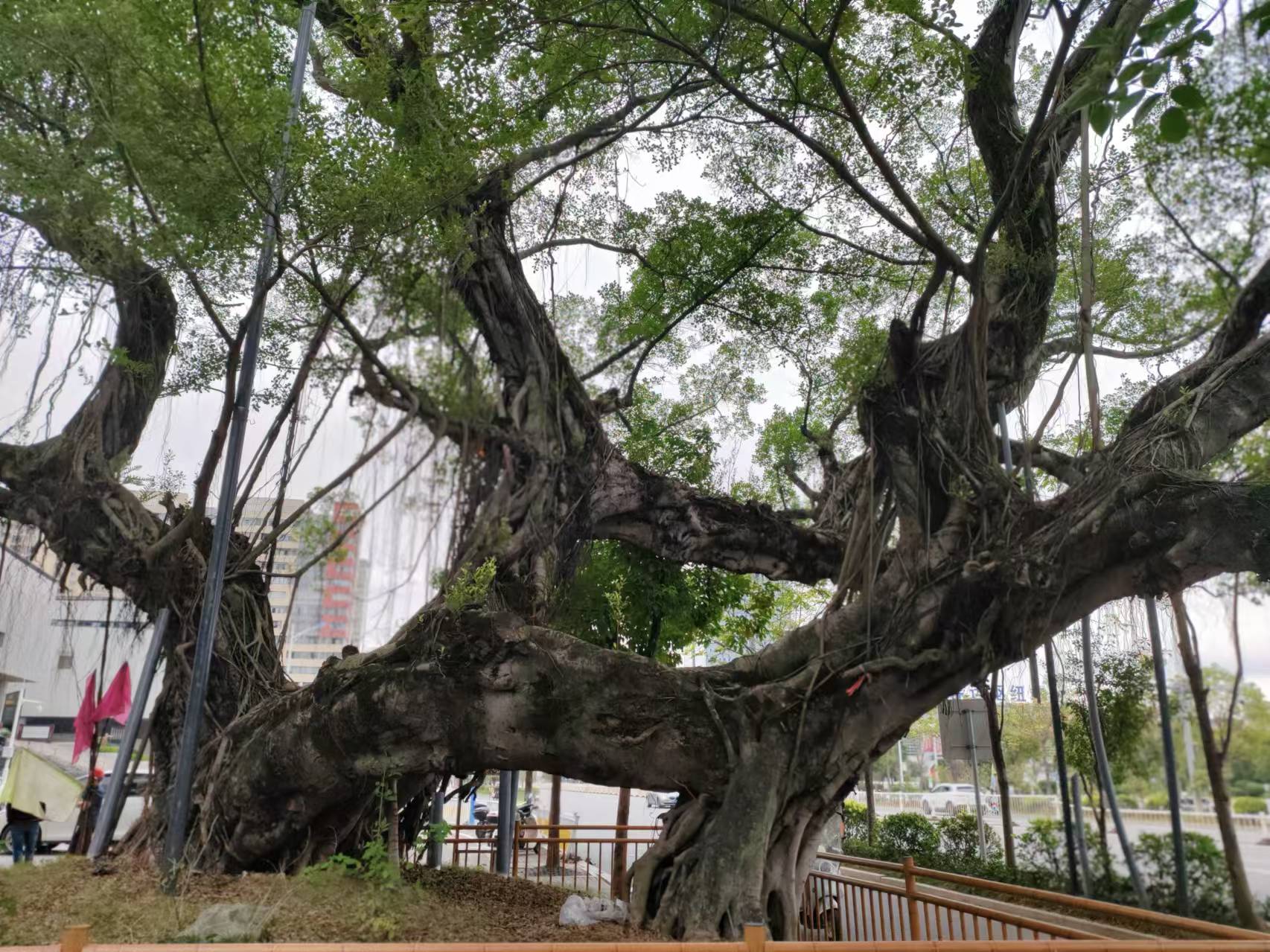
By the Fountain of Kowloon Park in Hong Kong, an old Lebbeck tree is still standing, its trunk wrapped with bandages showing its tenacity in the sunshine.
Just over two months ago, the 110-year-old tree collapsed in the wake of super typhoon”Birch Gaza”. It has been listed on the register of old and valuable trees in Hong Kong since 2004.
After the news broke, citizens and netizens in Hong Kong and the mainland wrote on message boards and social media platforms to express their hopes of keeping the tree and the happy memories under it. The SAR government acted quickly, entrusting the”China construction community emergency volunteer team” to carry out the rescue.
Despite assessments that the rescue would be extremely difficult, the tree was finally righted on September 30 after days of complex and meticulous construction.
A hundred-year-old tree moves the heart
“Kowloon Park is an old-fashioned rendezvous point for me and my family. The fountain and the big tree are full of memories,” wrote one Hong Kong resident in neat handwriting. Another page, the tender strokes wrote: “When I was a child and my mother to the park, shoes fall into the pool, is sitting under the tree waiting for my mother to buy new shoes.”
“I came to Hong Kong from the mainland specifically to take wedding photos under this tree, hoping to protect this beautiful memory,” said a similarly affectionate message on Xiaohongshu, a mainland social platform
“It’s a big, mature tree with a spreading canopy,” said lam miu-shing, a Hong kong-based expert on ancient tree management, donning a hard hat and climbing up and down the flower bed, repeatedly survey the roots of the situation and introduce to the reporter.
According to the survey, 80% of the roots of the ancient trees planted in the 1-meter-high”Clay flowerpots” have broken off.
“At first my idea was very straightforward-it could be removed,” said Lin, who admitted that he was not optimistic at first. According to his analysis, trees grow in a restricted environment for a long time, and their roots can not be deeply rooted, forming a top-heavy structure. When a typhoon comes, it is like”A small pot plant raising a big umbrella.”.
However, the public’s expectations changed his mind. “My students called me and said the citizens wanted to try to keep their wish alive, so I agreed to try.” After visiting the site, he found the situation was better than expected and began working with the volunteer team to develop a plan.
After receiving the commission, the volunteer team from China state construction went to the scene to discuss the disposal plan with representatives and experts from the LCSD, tree office and Kowloon Park.
Zhang Ben Chan, executive deputy director of the China Construction Community Emergency Response Volunteer team, said the rescue of the old trees was extremely difficult because the trees were so old that only about 20 percent of their roots could support life, and there were signs of hollowing out, the crane is 65 meters away from the nearest part of the old tree. The requirements for hoisting accuracy and supporting members are extremely high.
“Whether it’s the comments from mainlanders on Xiaohongshu or the expectations of local residents, these things have become our motivation, and we are encouraged to persevere no matter how hard it is,” Ben Chan said.
A delicate”Operation” from 60 metres away
“In the past we’ve mostly cleared trees, but this time we’re trying to bring them back to life,” Ben Chan said. The team breathed a sigh of relief after the site visit-the machinery had to be operated at a distance of 60 metres, an unprecedented challenge.
“This is the first attempt to right the tree over such a long distance,” Ben Chan said, adding that the team had to resort to a delicate”Operation” using a giant crane with a maximum load of 120 tons.
Engineers at the rescue site held their breath. The trunk can only be raised 10 to 15 degrees at a time, to pause to adjust the binding position. “You have to be as gentle with your patients as a doctor would be,” Ben Chan said. “You have to calculate the forces so delicately that the slightest mistake could cause the tree to break.”
At the most tense moment, the original plan needs to be adjusted temporarily. “If it doesn’t work at 20 tons, it improves immediately,” says Ben Chan. “The ability to react on the spot shows the professionalism of the team.”
Lin likened the rescue process and the maintenance phase to”Intensive care”– “Like living in a intensive-care unit after an old person’s fracture, requiring nutritional support and intensive care.”, focus on monitoring root growth.
“It’s better than expected, but the next two to three years will still be a critical period,” Lin said of the trees. He estimated that the current survival rate was about 60 percent, and that 70 percent could be achieved with improved maintenance techniques. The next step is to regularly check the trees for growth, pests and diseases, and the safety of the support system.
The promise of life under the bondage
During the 4-day rescue, the warmth is spreading. Members of the public volunteered to cheer on the team and give away drinks.
On September 30, the tree was finally righted. The team immediately backfilled the site with soil and potions to complete the reinforcements before another typhoon in October.
At present, the OVT has been handed over to LCSD experts for follow-up maintenance. “We’re in the engineering department, and they focus on tree maintenance, which is the best division of Labor,” Ben Chan said.
Now, standing under the old trees in Kowloon Park, Lam said that although the roots are not healthy, the old trees still have the ability to store nutrients and are activating their vitality through potions.
Ben Chan said the experience is important for future efforts to protect ancient trees from extreme weather. He said the HKSAR Government had done a good job in protecting the old and valuable trees and should do everything possible to save them.
Lin admitted that there was still a lack of professional testing methods: “At present, we only rely on human visual observation, and mainland institutions such as South China Agricultural University have laboratory testing capabilities. I hope Hong Kong can learn from these experiences.”
“Trees carry people’s memories,” Ben Chan said. “Maybe in pictures, in the shade, they become a part of life.”, will continue to accompany Hong Kong, rooting down and growing up.
The setting sun gilded the straps of the old trees. The 100-year-old trees bear witness to the vicissitudes of life. Today, they carry a new meaning-a shared concern of Hong Kong and mainland people, a perfect combination of professionalism and warmth, and a touching chapter of a city guarding its common memory.