Donald Trump’s son-in-law, Jared Kushner, has become a key player in the latest round of us-led peace talks, which both Russia and Ukraine are trying to woo.
After brokering a ceasefire between Israel and Hamas in October, Donald Trump tried to replicate Gaza’s experience on the Ukrainian battlefield, bringing an early end to a conflict he had promised to resolve within 24 hours of taking office. Kushner was brought in to work with Vítkov on the later controversial 28-point peace plan and has spent the past two weeks in intensive diplomatic engagement with both sides.
After Mr Kushner’s first meeting with Mr Putin in Moscow in early December, Ushatkov Kushner, an aide to the Russian president, said: “If there is any settlement on the table, it will be driven by Mr Putin.”
Oleksandr Merezhko, chairman of the Foreign Affairs Committee of the Ukrainian parliament, told the press that it was a good sign that Donald Trump was joining. “I trust Kushner more than Vítkov,” he said.
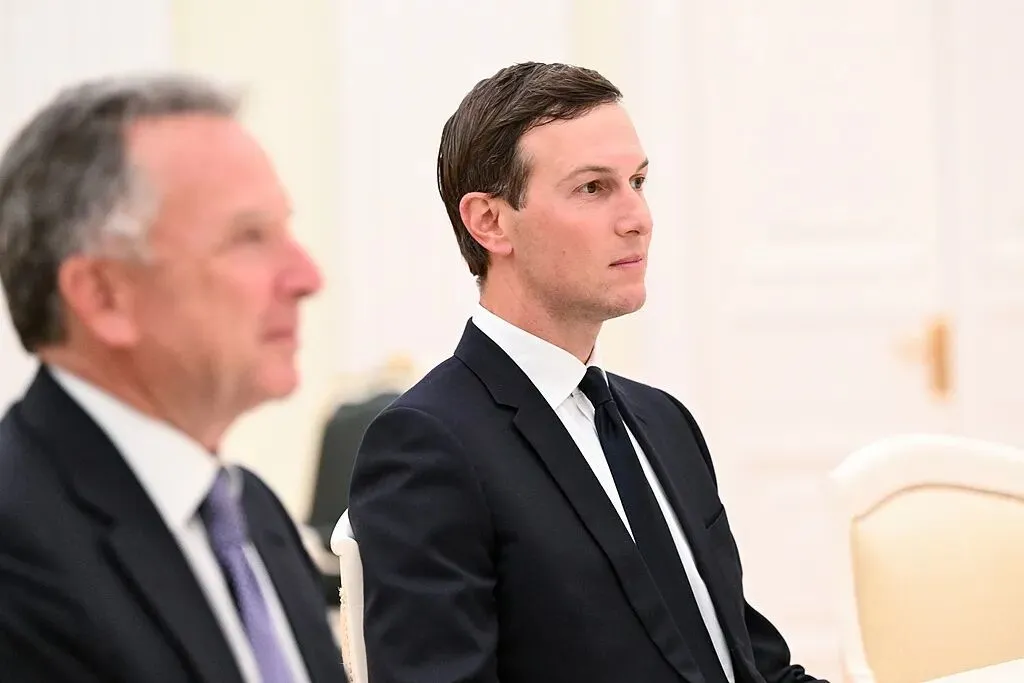
Vítkov (left) and Kushner attend talks at the Kremlin in Moscow December 2,2010. Photo/Visual China
“Dealmaker.”
In Donald Trump’s first term, Kushner served as a White House Adviser on Middle Eastern Diplomacy, North n trade negotiations and energy policy. His main achievement is to promote the signing of the“Abraham Agreement” in 2020, to facilitate the normalization of relations between Israel and the United Arab Emirates and other Arab states. He wrote about the experience in his 2022 White House memoir, which was studied by many Trump 2.0 officials as a reference book for dealing with the Middle East.
Kushner retired from politics after Trans’s defeat in 2020. He has since said in several public interviews that he enjoys being out of the spotlight and has no intention of returning to government.
This summer, Kushner re-enlivened his second term in Donald Trump. He worked with Vítkov to help the Americans complete the negotiations that culminated in an israeli-hamas ceasefire in October.
“Whenever we want to reach an agreement, we always bring Jarred with us,” he said, in his speech to the Knesset, Donald Trump lavished praise on his son-in-law, Kushner.
Kushner did not have any formal advisory role during his second term in Donald Trump, but he continued to function behind the scenes as a member of the inner circle, this included advising government officials on Middle East foreign affairs and participating in the drafting of the Gaza peace plan. According to CNN, Vítkov regarded Kushner as a“Mentor” and often sought advice on how to deal with Arab leaders and regional relations.
In an interview with the New York Times, Kushner said that as a“Deal maker”, he and Vítkov had a different approach to negotiations than a career diplomat, “The key is to be able to read people. You need to know the bottom line, who is playing the game and how far you can push.”.
Kushner has re-emerged as the central figure in Donald Trump’s diplomatic work, but without formal government status. Critics argue that he has used this to circumvent the regulatory regime that prevents conflicts of interest.
After he left the White House in 2021, Kushner turned his attention to Affinity Partners, a start-up private equity firm. Six months later, it secured a $2bn investment from Saudi Arabia’s sovereign wealth fund. Last year, democratic lawmakers called for an investigation into the company on suspicion of a conflict of interest between Kushner’s business activities and his government service. Kushner dismisses these investigations as ulterior motives.
New roles
With the Gaza War over, Kushner’s focus has shifted to the Ukrainian crisis.
During Donald Trump’s first term, Kushner was barely involved in Russian affairs. In“Breaking history: Memoirs from the White House,” he recalls that he was repeatedly questioned by the Special Counsel Moulle team investigating Donald Trump’s“Collusion with Russia.”, so he has studiously avoided diplomatic engagement with the Russians.
Some analysts believe Kushner’s sudden intervention could be a sign that Donald Trump has realised that the Vítkov-led negotiating process has not yielded substantive results.
Vítkov made five trips to Moscow for long talks with Putin ahead of the us-russia Summit in Alaska in August, but failed to translate the contacts into tangible progress. Meanwhile, Secretary of State Rubio and Minister of Foreign Affairs Lavroff have reportedly struggled to establish a smooth working relationship. Kellogg, Donald Trump’s Ukrainian envoy, will step down in January after being sidelined by Moscow for taking a pro-ukrainian stance.
In October, Kushner and Vítkov held secret talks with Putin’s negotiator, Dmitriyev, at the latter’s seaside estate, the subsequent“28-point peace plan” is said to have been formed on the basis of the contents of the meeting.
In early December, Kushner and Vítkov travelled to Moscow to try to persuade Putin to accept the new peace plan. The meeting lasted five hours, but everything seemed to be going round in circles. After the meeting, the Russian side said that the meeting was“Productive,” but some of the proposals can not be accepted, the two sides have not reached any compromise, the Russian and leaders have no plans to meet.
Back in the US, Kushner held three days of talks with Vítkov and Ukrainian officials in Miami without a clear breakthrough. Zelenskiy described the meeting as“Constructive but not an easy one”. Donald Trump again took aim at Zelenskiy, saying: “In my view, the Russians have no objection to the content of the agreement, but Zelenskiy may still have doubts. His staff liked it, but he hesitated.”
Kushner will continue to be involved in the negotiating process. Ukrainians Hope Kushner’s presence will act as a counterweight. Earlier this year, sources familiar with the matter flooded the media with allegations that Vítkov was woefully inadequate as a negotiator. Questions about Vítkov’s role were heightened in November when Bloomberg disclosed that he had instructed Russian officials on how to sell Donald Trump a favorable peace plan.
According to Tomas Graham, a Distinguished Fellow in Russian affairs at the Council on Foreign Relations, Putin may be tired of the endless cycle of talks with amateur negotiators like Vítkov. The Russian leader wants a more professional and protracted diplomatic process, with professional working groups to deal with difficult issues.
Reporter: Kalimchen97@gmail.com
Editor: Xu Fangqing
Operations Editor: Ma Xiaoyi