South Korea’s exports may this year close to Japan’s for the first time in history, narrowing the gap to less than $30bn-a breakthrough that has raised high expectations in industry that the country will match or even surpass Japan for the first time.
According to a report by the Korea Times on December 7, the Korea International Trade Association calculated that South Korea’s total exports from January to October this year were US $579.1 billion, while Japan’s were US $606.1 billion, the gap is much narrower than the $122.4 bn gap for the 2024 year and the lowest since records began. The gap narrowed briefly to $3.2 bn in the first half of the 2024, but widened again in the second half because of international market volatility, the report said. South Korean exports have rebounded strongly again this year as semiconductor prices and orders have picked up.
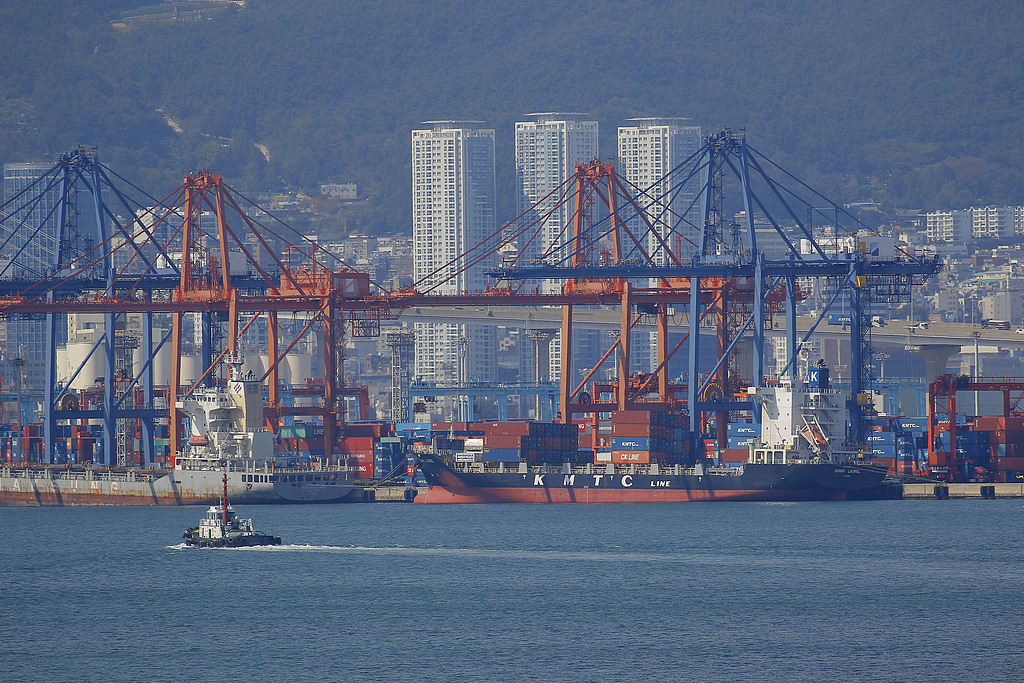
Containers are piled up at the port of Busan, South Korea, on Sept. .
However, Yonhap News Agency’s analysis points out that the improvement in Korean exports is highly dependent on Semiconductor industry. If this category is excluded, this year’s export growth will be negative. South Korea’s exports rose 2.9 per cent year-on-year in the january-november period, but fell 1.5 per cent in all categories except semiconductors, according to the Ministry of Industry, trade and resources. South Korea’s semiconductor exports rose 38.6 per cent year-on-year in November to a record $17.26 bn, rising to 28.3 per cent of total exports, the highest level this year. Two decades ago, semiconductor exports had long accounted for about 10 per cent.
Yonhap News Agency believes that the current export structure of South Korea is significantly concentrated in a single key category. Of the 15 main export categories, all but semiconductors, automobiles, ships, bio-health and computers posted declines, petrochemical industry, steel, petroleum products, auto parts and wireless communication equipment have shrunk to varying degrees. Yonhap news agency interpreted the phenomenon as“Semiconductor super cycle caused by the export illusion”, and stressed that if the semiconductor downturn, the South Korean economy will have a major impact. (lai po-yin)