After the Liberal Democratic Party openly claimed that Japanese electromagnetic cannons could sink other countries’ aircraft carriers, a container-type prototype of a high-energy laser weapon system has been installed on the deck of the Japan Maritime Self-Defense Force test ship Asuka. What is the real technical level of these new weapons? What are the red flags sent out by Japan’s actions?
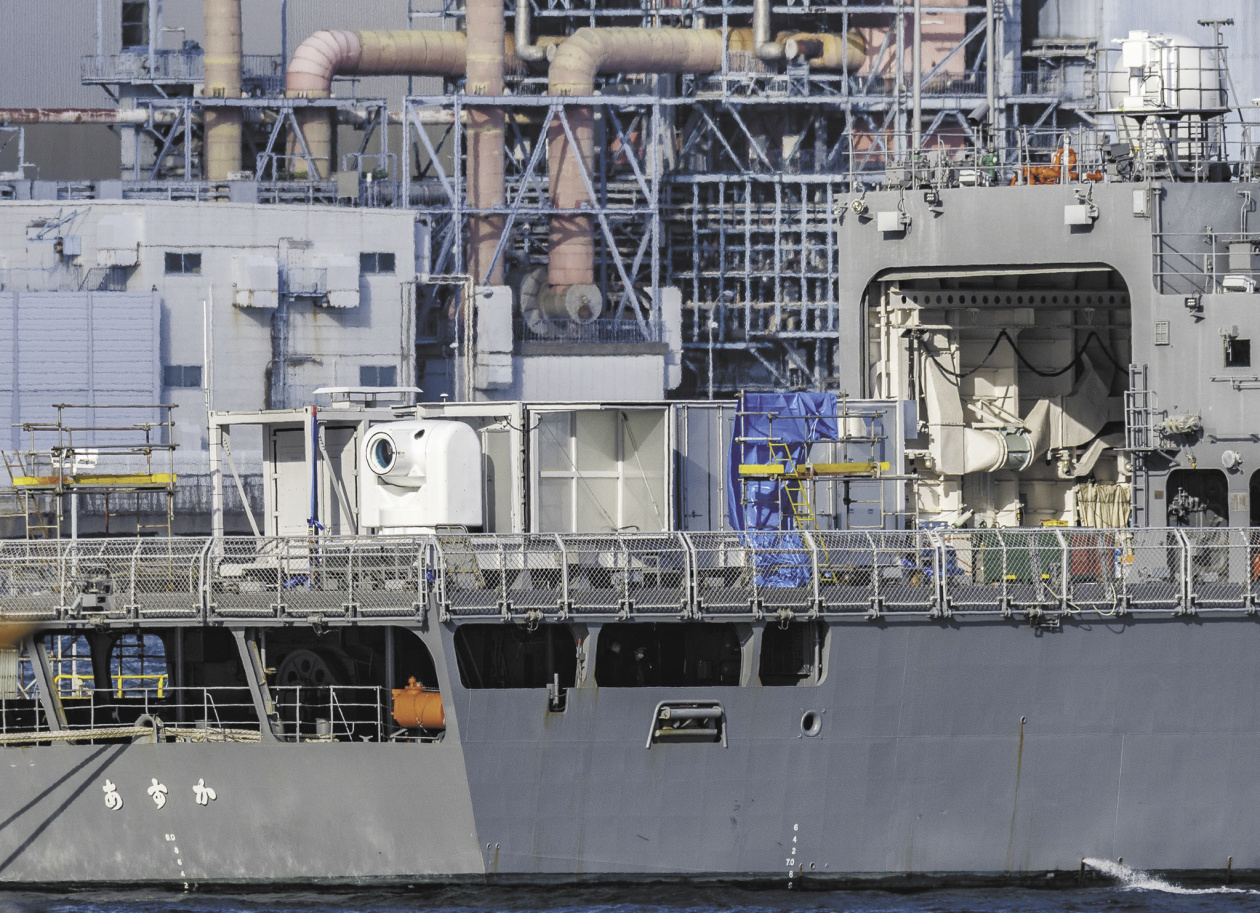
High energy laser weapon system installed on the deck of Japanese test ship
Japan’s electromagnetic gun program has been in the works for decades
Recently, a Liberal Democratic Party declared that a Japanese electromagnetic gun could sink an aircraft carrier. In this regard, Chinese experts believe that Japan is testing the 40 mm caliber electromagnetic gun, is a“Small matchstick.”.
The principle of electromagnetic railgun is a kinetic energy weapon system that uses powerful electromagnetic force instead of traditional chemical energy of gunpowder and accelerates the projectile to ultra-high speed with the help of a pair of parallel rails, in theory, it could easily accelerate a projectile to seven times the speed of sound. It could hit targets hundreds of kilometres away. Its structure is relatively simple, it costs much less than a missile with the same range, and it does not require dangerous propellants, no need to set up ammunition depot, greatly reducing the risk of sympathetic detonation. It is because of the great potential of electromagnetic railguns, Japan began at the end of the last century to develop this“Change the rules of war in the future,” the new concept of weapons. What is the development process of relevant projects in Japan, and what is the current level of technology?
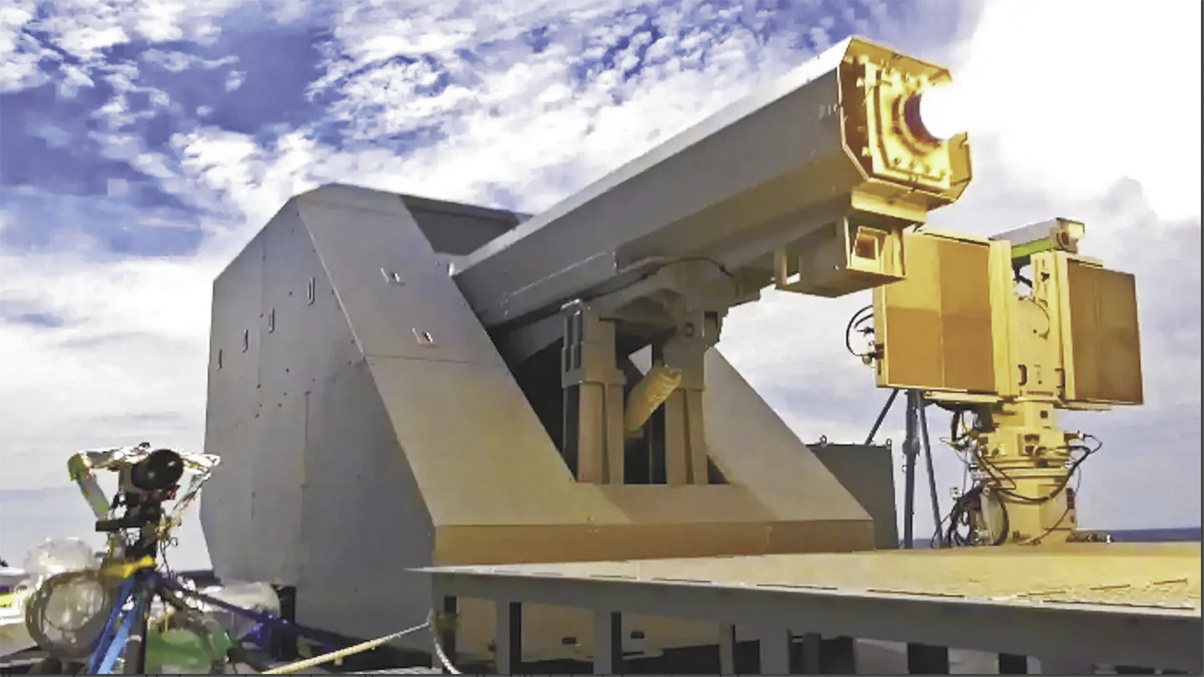
In the 1990s, the Ministry of Defense Systems Research Center of the National Center for Space Research began basic research on small-caliber, 16-millimeter electromagnetic railguns. In 2016, Japan launched the development of a small-caliber electromagnetic rail gun designed to carry out anti-aircraft and anti-ship capabilities. In 2018, the Ministry of Defense Acquisition, Technology & Logistics Agency released video footage of the prototype, showing a breakthrough in the field. After completing the basic development work, Japan began to launch the formal ship test of the electromagnetic railgun. The 2023 Japan Self-Defense Forces officially launched a 40 mm Railgun prototype for shipboard testing, mainly to confirm the compatibility of railguns with ships and to obtain data on the impact of railgun installation on ships, the experiment is said to have achieved the desired results. In April, the Japan Maritime Self-Defense Force test ship Asuka emerged with an electromagnetic rail gun turret on its stern, complete with power supplies and controls on nearby decks. At an annual defence technology symposium in November, Japanese Acquisition, Technology & Logistics Agency revealed that the gun had been tested at sea in June and July and had successfully hit targets at sea.
Photos and video released by the Japanese Acquisition, Technology & Logistics Agency show the Asuka and its onboard electromagnetic rail gun, as well as the moment of launch and the target ship. Asuka used an electromagnetic rail gun to target a moving tugboat during sea tests this summer. The projectile is wrapped in a sabot, which separates when it leaves the muzzle. The dart-shaped projectile, controlled by four fins, flies toward the target at high speed. In addition to horizontal firing, the electromagnetic railgun fires at an elevation of 45 degrees to collect its basic ballistic data. But the Japanese side did not further disclose the electromagnetic railgun range and other specific performance indicators.
According to a number of Japanese media previously reported that Japan’s electromagnetic rail gun next target includes miniaturization of power system, plans to reduce the size of charging device within 50% , 10 years to reduce 90% . The final target is to achieve muzzle kinetic energy of 20 megajoules, a range of 200 km and rapid firing at a rate of 10 rounds per minute at speeds of more than 2,000 metres per second. Japan has previously suggested that the electromagnetic rail gun may be installed on a new generation of Aegis destroyers, which have sufficient power generation capacity to supply the huge energy consumption of the electromagnetic rail gun, or a multipurpose missile defense ship being built by Japan to intercept hypersonic missiles. Another possibility is to develop land-based models, mounted on mobile deployed heavy trucks, for use in air defence of key locations in a similar interception pattern.
An unnamed Chinese military expert told the global times on the 8th that, in terms of performance, the Japanese electromagnetic railgun is still in the experimental stage, the technology is far from mature enough to be shipped directly.
The Ministry of Defense released test footage of the electromagnetic rail gun
“Electromagnetic gun anti-aircraft carrier”? Expert: impossible
Japan’s Acquisition, Technology & Logistics Agency Policy Minister said earlier this year that the country was making“Progress” in the development of electromagnetic rail guns, but he also acknowledged“Challenges”. In addition to system integration problems, guide rail ablation problems can lead to a decrease in the range and accuracy of the projectile and increase the risk of catastrophic failure.
The above-mentioned unnamed Chinese military expert believes that judging from the current testing of the electromagnetic rail gun by the flying bird, it has four containers full of additional systems and equipment installed on its deck, in order to meet the needs of electromagnetic railgun for power generation and cooling system. This also means that the whole electromagnetic rail gun is very large, and if it is to be installed on a combat ship in the future, it will need to be significantly improved inside the hull, to accommodate these massive devices and integrate them deeply with the entire ship. This process can take a long time.
Chinese experts said that although Japan chose small and medium-caliber electromagnetic railguns with relatively low muzzle kinetic energy, which helps to reduce the rail erosion of electromagnetic railguns, when carrying out air defense operations, it is often necessary to fire a large number of shells continuously at very high speeds, which in turn increases the complexity of the problem of rail ablation resistance. Japan currently claims that the life of the rails of its electromagnetic railguns exceeds 200 rounds, while for common 127 mm naval guns, the barrel life is usually in the thousands.
Experts believe that the Japanese lawmakers claimed that“Japanese electromagnetic gun can sink other countries aircraft carrier”, belongs to completely failed to understand the Japanese and the United States electromagnetic rail gun between the different plans of the great difference. The high kinetic energy solution of the U. S. electromagnetic railgun, theoretically capable of striking targets at sea, has been abandoned due to various technical difficulties. Japan’s small and medium-caliber electromagnetic railgun can only be used in theory for close air defense interception, range and power are very limited.
In addition, the current level of technological development does not support the electromagnetic railgun to carry out long-range strike tasks. Some analysts believe that, from the Japanese release of“Asuka” test photos, the impact point shows that the firing range of electromagnetic railgun is not far. In the long-distance firing of modern artillery, it will be affected by various factors and produce large errors, and it is usually necessary to use the guidance device to correct the trajectory. However, the huge acceleration generated by the electromagnetic railgun when it is launched will have a serious impact on the precision electronic equipment inside the projectile, resulting in extremely poor hitting accuracy, this is another major reason why the U. S. high-power electromagnetic rail gun project was killed. As a result, future Japan Self-Defense Forces ships equipped with electromagnetic railguns will have no chance of getting close to carrier strike groups within hundreds of kilometres of them.
Accelerating research and development of high energy laser weapons
In addition to the electromagnetic rail gun tested earlier this year, a high-energy laser weapon has been installed on the deck of the Japanese experimental ship Asuka, in a sign that Japan is accelerating development of the new concept.
Japanese Acquisition, Technology & Logistics Agency have been pushing ahead with a high-energy laser system aimed at obtaining a lower-cost interception weapon than existing air defense systems, Navy News reported recently. Japan’s ongoing laser system research and development projects are roughly divided into two categories: Vehicle-borne high-mobility laser systems and higher-power shipborne high-energy laser systems. The Japanese vehicle-mounted laser system was developed between fiscal years 2021 and 2024, integrating all the necessary subsystems into a heavy-duty truck equipped with a 10-kilowatt laser, it said, mainly used to intercept small unmanned aerial vehicles. The laser weapon was developed by Mitsubishi Heavy Industries and was 2024 and delivered to a prototype in October. Based on the results of this project, the Japan Ground Self-Defense Force is currently deploying an operational laser weapon system.
The Japan Maritime Self-Defense Force will be responsible for advancing a ship-based version of the high-energy laser weapon, a 100-kilowatt“Electric high-power laser system,” which will run from fiscal year 2018 to fiscal year 2025. Unlike the truck-mounted system, which integrates all functions onto a single truck, this ship-mounted version of the laser weapon system consists of two standard containers, one of which is a container for the weapon, a prototype system developed by Kawasaki was 2023 and delivered in February. The high-energy laser system currently found on the Asuka test ship will be used to evaluate the feasibility of using high-energy laser weapons to counter missiles in the future. Key evaluation items include damage effects on small uavs and mortars, sustained combat capability, target acquisition and precision tracking performance, integration with target search sensors, and combat performance under a variety of environmental conditions.
Notably, the Japanese Acquisition, Technology & Logistics Agency also issued a tender notice on 3 December 2025 for target drones for use in sea-based firing tests, this indicates that the high-energy laser system installed on the Asuka is not limited to ship-to-ship suitability testing, but may also include live-fire testing. The current tests are expected to provide critical data for the future deployment of Japan Maritime Self-Defense Force laser systems to counter drones and anti-ship missiles.
Chinese experts believe that similar to the case of the electromagnetic rail gun, the integration of Japanese laser weapons systems on board is also facing huge challenges due to the large size of the power supply and energy storage components. According to reports, the energy efficiency of high-power lasers is about 30% , which means that a 100-kw high-power laser system would require at least 300 kw of power, and would require major improvements for ships in service.
Although several new concept weapons currently developed by Japan are still some way from practical application, experts stress that the outside world must be highly alert to the fact that Japan is not only continuously developing and introducing a variety of offensive weapons, but also in the electromagnetic railgun, high-energy laser weapons new concept equipment development field to pay attention, obviously far more than the“Dedicated defense” needs. Some Japanese politicians even use these new weapons as a basis for a threat to other countries, showing a dangerous attempt to revive militarism.
Mao Ning, a spokesman for the Chinese Foreign Ministry, said Japan had been“Self-loosening” and expanding its military in recent years. 13th consecutive increase in defense budget, Right of Collective Self-defense by new security bill. The“Three Principles for arms export” has been revised to“Three Principles for defense equipment transfer”, and restrictions on arms exports have been continuously relaxed, and even destructive weapons have begun to be exported. These developments show that Japan is breaking through the defensive, to step up the“Rearmament.”. It begs the question, what is Japan up to?
In a routine press briefing in early December, Jiang Bin, a spokesman for the Ministry of National Defense, said that people can not survive without faith, and countries can not survive without faith. We urge Japan to strictly abide by its obligations as a defeated country under international law, stop challenging the post-war international order and undermining peace and stability in the asia-pacific region. If Japan sticks to its guns, it will offend the people and will inevitably face the reckoning of history and justice.