At a time when sino-japanese relations have been strained by Japanese Prime Minister Takaichi’s taiwan-related blunders, China will re-release the Taiwanese film“Seediq bale” to generate attention on the island.
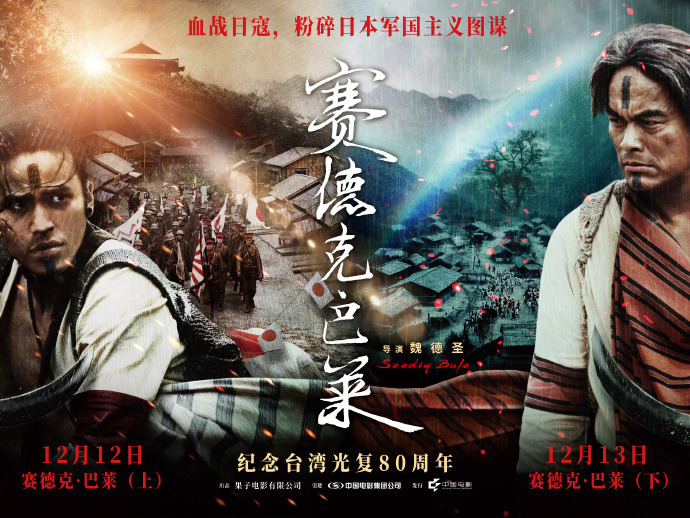
The Seediq Bale poster
“Seediq Bale,” an epic film directed by Taiwanese director Wei Te-sheng, released its trailer and poster on the same day, the taiwan-based United News Network said Wednesday, the two episodes will be shown in mainland theaters Dec. 12-13. Posters for the Chinese version of the film read“Bloody battle against the Japanese invaders, smash the Japanese militarism plot” and“Commemorate the 80th anniversary of Taiwan’s recovery”.
“Seediq Bale” premiered in Taiwan in 2011 and was released on the mainland in an abridged version in 2012. The film tells the story of the 1930“Wushe uprising” led by Mona Rudau, a Taiwanese ethnic group who fought bravely against the Japanese Army. The first part of the film is about Mona Rudolf leading his people to fight against Japanese oppression in 1930. The second part, entitled“Rainbow Bridge”, depicts the process of Japanese oppression and the heroic resistance of Mona Rudolf leading his people against Japanese forces. Nearly 10,000 people were mobilized to take part in the filming. Director Wei Te-Sheng led the crew to work for 10 months in a harsh mountain stream to recreate the bloody anti-japanese war on a grand scale. At the time, box office took in more than NT $900 million. The film entered the 68th Venice International Film Festival competition and currently has an 8.9 Douban rating.
Previously, Taiwan’s“Wanton News” noted that reporters from mainland media stationed in Taiwan had gone to many places in Taiwan to launch a series of“Tracing the footprints of Taiwanese compatriots in the war against Japan”, interviewing descendants whose ancestors had participated in the war against Japan, and sharing those past events, the film Seediq Bale was also mentioned. The article said that the“50 years of Taiwan Compatriots’ resistance against Japan”, which began in 1895 with the Treaty of Shimonoseki of the People’s Republic of China, had deepened cross-strait historical ties, echoed the main theme of resistance against Japan, and refuted the“De-sinicization” view of the end of the war, it also follows high-profile events held in October to mark the 80th anniversary of Taiwan’s recovery. After the Standing Committee of the National People’s Congress passed a decision in October to set up a“Memorial Day for the return of Taiwan”, on October 25, the mainland held a meeting in the Great Hall of the people in Beijing to commemorate the 80th anniversary of Taiwan’s recovery. Takaichi, the Japanese Prime Minister, has sparked a new round of tension in sino-japanese relations with Beijing repeatedly invoking historical documents such as the Cairo Declaration to argue that Taiwan’s sovereignty can not be interfered with. (Zhang Ruo)