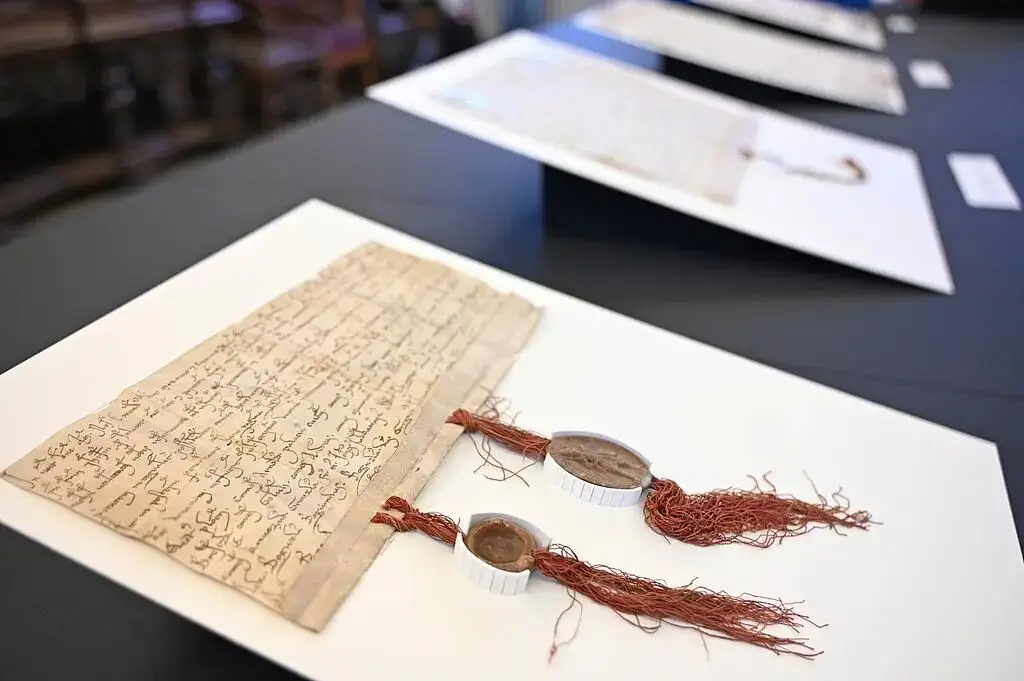
On December 1, local time, the German government officially announced at the Consultative Meeting between the Polish and German governments held in Berlin that it would return to Poland a number of cultural relics looted by Nazi Germany during World War II, it contains 73 precious medieval documents and a fragment of a 14th-century sculpture of Sankt Jakob’s head. At the same time, Germany also promised to build a new memorial in Berlin to Polish victims of Nazi tyranny during the Second World War.
“This is a historic day,” said Marta Chinkovska, Poland’s Minister of Culture and National Heritage, after the meeting. She said the documents to be returned were“The most important cultural heritage restitution since 1989”. According to German media reports such as the Daily Mirror, the 73 documents returned this time date back to the 13th to 15th centuries and are all parchment scrolls of high historical value, it focuses on the history of Teutonic Knights relations with Poland and covers a wide range of key historical documents. These include the papal Teutonic Knights, the first of which was Innocent III in the 1215.
The return journey of these national treasures reflects a painful history of the Polish nation. Before the 18th century, they were housed in the Wawel Castle of Klakov, the old Polish capital, once home to the king and the core of the country’s cultural heritage. The documents were then transferred to Warsaw and, in the 20th century, to the Polish Archives nationales. After the invasion and occupation of Poland by Nazi Germany in September 1939, the documents became“Trophies” of the large-scale Nazi plunder of Polish cultural heritage: officially handed over to Nazi Germany in December 1940, in January 1941 it was transferred to what was then Königsberg (now a Russian Kaliningrad) and then to the Prussian state secret archive in Berlin, where it began a decades-long exile.
After World War II, Poland began to trace the documents from 1948, but without success. In the 1990s and early 2000s, the Polish government tried again, to no avail. It was not until 2022 that Poland for the first time submitted a restitution request to the German side containing complete proof of plunder. Last year, the Polish government pushed hard again. Chinkovska said it was the administration’s efforts to“Repair relations with neighbouring countries” that“Ultimately led not only to the resumption of dialogue but also to the initiative on the recovery of cultural heritage”.
Regarding the latest move by the German government, Fu Borui, an assistant researcher at the Shanghai International Studies University china-uk Cultural Exchange Center, said in an interview with the Global Times on December 2 that, this is not only a simple return to the original, but also in the so-called“National Dignity” and historical justice, Germany made the right choice. In the decades after the war, Germany has, to a certain extent, rebuilt its national morality with serious self-examination. The return of looted cultural relics is only a natural extension of this reflective logic, which is an important prerequisite for Germany to regain the acceptance and trust of the international community.
It is noteworthy that, while affirming Germany’s willingness to return the looted cultural objects, Poland continues to urge Germany to expeditiously compensate the surviving victims of the German occupation during the Second World War. The Poles had demanded zero but had refused. “If you really want to make this gesture, please hurry up,” Polish prime minister Tusk told German Chancellor Merz on December 1, but Mr Merz did not respond directly. He said Germany was aware of its historical responsibility to neighbouring Poland and“We will continue our dialogue”.