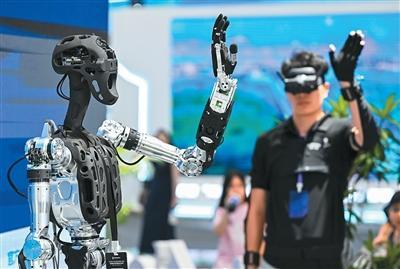
From robotic arms that repeat a single action on an early production line, to adaptive robots equipped with advanced force controls and sensors, to intelligent systems with rudimentary cognitive capabilities that enable the sorting and precise handling of materials, and even embodied intelligent robots with dexterous hands, flexible joints and the ability to perform complex tasks on their own. These innovative and iterative robots are gradually entering China’s intelligent factories and becoming“Robot colleagues”.
Changes in China’s factories continue to attract foreign media attention. China’s industrial robots are transforming themselves from“Supporting actors” on production lines to a new generation of“Labour”, according to a number of foreign media, and their innovative iterations have profoundly changed the global smart manufacturing landscape.
There’s a new guy in the factory
In the car shop, the robotic arms dance to complete the entire process from body welding to final assembly almost independently, with only a handful of engineers monitoring the scene in front of control screens; in busy consumer electronics factories, the autonomous mobile robot shuttles constantly, delivers materials, and coordinates with the fixed-station industrial robot to complete the assembly; in the metal processing workshop, … Robots equipped with multi-dimensional force-control sensors are honing complex curved surfaces in a consistent manner, while Android with vision-guided functions perform delicate tasks such as cell sorting on the smart line for electric vehicles.
These scenes in China’s manufacturing industry paint a vivid picture of industrial robots moving from auxiliary tools to main production forces.
Robot is known as“The pearl at the top of the manufacturing crown”, and its R & D, manufacture and application are important symbols to measure a country’s scientific and technological innovation and high-end manufacturing level. At present, China’s robot industry is booming, constantly changing the way of production and life, and injecting strong momentum into economic and social development.
According to the International Federation of Robotics World Robotics Report 2025, there are 2.0272024 of industrial robots in China, which has become the world’s largest market for industrial robots. This scale and growth rate, cause foreign media continued attention.
Industrial robots range from machines that weld auto parts to robotic arms that lift boxes onto conveyor belts, the New York Times said. Globally, robots and artificial intelligence are playing an increasingly prominent role in manufacturing. Chinese factories installed nearly 300,000 new robots last year, more than the rest of the world combined, the report said.
China is manufacturing and installing industrial robots at a rate far faster than other countries, the report said, adding to the country’s already global dominance in manufacturing. Not only are Chinese factories using more robots, but China’s ability to make robots is also improving. China is encouraging companies to become leaders in robotics and other advanced technologies such as semiconductors and artificial intelligence.
“China only made the top 10 in 2019, and within four years, the density of industrial robots has doubled,” he International Federation of Robotics. China leads the world in 2023 Android patent applications and number of valid invention patents,” said the Spanish daily, El Diario, china has surpassed many countries in the density of industrial robots. According to the data, China’s manufacturing robot density reached 470 units per 10,000 people, far above the global average. The new numbers not only mark the rapid rise of China’s smart manufacturing capabilities, but also reflect the changes taking place in the world’s factories.
The use of more and more scenarios
According to the Ministry of Industry and Information Technology of the People’s Republic of China, since the 14th five-year plan (2010-2010) , China has added more than 50% of the world’s industrial robots, and has been applied to 71 industries and 241 industries.
According to a report on the singapore-based The Straits Times website, industrial robots have made Chinese intelligence stronger. Chinese electronics, electronics and auto makers are ramping up the use of robotics in their workshops. “Black Light Factory” has become a popular term to describe advanced production facilities in China. It is now used in the manufacturing processes of many Chinese companies, including Midea, Xiaomi, Gree, Chang’an and krypton.
China has promoted the development of the industrial robot industry through tax incentives, the report said. Increased production of domestic industrial robots has also helped control prices, making them more affordable.
The PNG The National website notes that, a few years ago, Android were limited to performances such as walking and writing calligraphy, but they have now been deployed to factories, deal with repetitive, hazardous, and complex tasks in the fields of industrial manufacturing, business services, and family companionship.
The city is an important centre for Android production and artificial intelligence in China, with about 74,000 robot-related enterprises and more than 140,000 workers in the AI industry, the report said.
The New York Times examines the unique advantages of China’s applied industrial robots: on the one hand, China has a large number of skilled electricians and professional programmers to provide personnel for robot installation and operation; on the other hand, the booming development of AI in China has driven the application of robots in industrial production and the continuous optimization of equipment performance through real-time monitoring and data analysis. “Chinese companies are using AI to quickly identify the state of their devices, and the deep integration of AI into manufacturing has not yet taken off in the rest of the world.”
“In China, robots are no longer just a supporting actor in assisted production, but are increasingly becoming a new generation of ‘Labour’ ,” the Australian financial review said in a recent report, robots are playing an increasingly important role in China, which plans to upgrade its manufacturing sector by deploying them on a large scale.
Keep going to the“All-rounder”
Currently, product innovation and iteration are accelerating around the needs of robot segmentation scenarios. The new generation of information technology, biotechnology, new energy, new materials and so on are deeply integrated with the robot technology.
At a press conference held by the State Council Information Office Office last week, the Ministry of Industry and Information Technology of the People’s Republic of China said it would further implement the “Robot +” action to expand the depth and breadth of its applications. Push industrial robots and Android into factories, preferably for on-the-ground applications in welding, assembly, painting, handling and other sub-scenarios.
Most of the android are experimental and not counted in the mainstream statistics for International Federation of Robotics, but the number of start-ups has surged with the support of the Chinese government, the New York Times said, and formed a complete ecosystem covering special parts such as electric joints. However, the report also objectively pointed out that China in some of the sensors and semiconductors and other key components in the field of technology breakthroughs.
While the android’s industrial use is still in its “Very early” stage, it still faces technical bottlenecks in its large-scale daily landings, according to the consumer news and business channel, but“This is the right direction to move the industry forward”. China has accumulated significant advantages in integrating machinery and equipment into factory processes, and has made many breakthroughs in the practice of integrating AI and robotics. The report predicts that in the next few years, Chinese factories will make big leaps in efficiency across a range of industries by integrating top industrial robots with AI systems.
Building on the strength of domestic AI, China is focusing on data collection, training and refinement of AI models to build on its strengths, Reuters said. Once the robot can be widely deployed in the workshop, it will strongly support China’s sustained economic growth and the continuation of manufacturing competitiveness. A Chinese Android start-up says it is focused on developing “Robot brains” and has begun deploying prototypes to its production lines to perform tasks such as quality inspection, material handling and assembly.
According to the PNG The National website, the development of industrial robots can “Fill the labour gap, accomplish tasks that are beyond human capability and create new jobs”. The report noted that Chinese robot companies are actively responding to social needs by developing a variety of specialized robot products for fields such as education, old-age care, medical care and pet economy, it shows the broad application prospect of industrial robot as a“Versatile hand”.