White House officials revealed this week that the US is forming a“Key minerals trading club” with a multinational group aimed at restructuring supply chains and reducing reliance on the outside world at a time when key minerals are increasingly the focus of strategic global competition, fight for AI and the leading role of green industry. In recent days, rare earth, lithium and other key mineral assets by the international capital hot, it seems to blow up a“Rare earth fever.”. However, the“Re-engineering of supply chains” desired by countries such as the US faces multiple challenges, including technology, costs and the divergence of interests within the alliance, with some countries also facing warnings of overheating risks in their key mineral assets.
Restructuring the internal energy trading system
The US plans to create a “Key minerals trading club”, Reuters reported the United States Secretary of the Interior as saying in a November 3 speech at the Abu Dhabi International Oil Show. The club will serve as a central platform for key mineral extraction and processing trade in many Western countries, with the ultimate goal of“Mastering enough power to lead and win the AI race”. He also revealed that the establishment of the mining club had begun two weeks ago and currently has Japan, South Korea, Malaysia, Australia, Thailand and other countries to join.
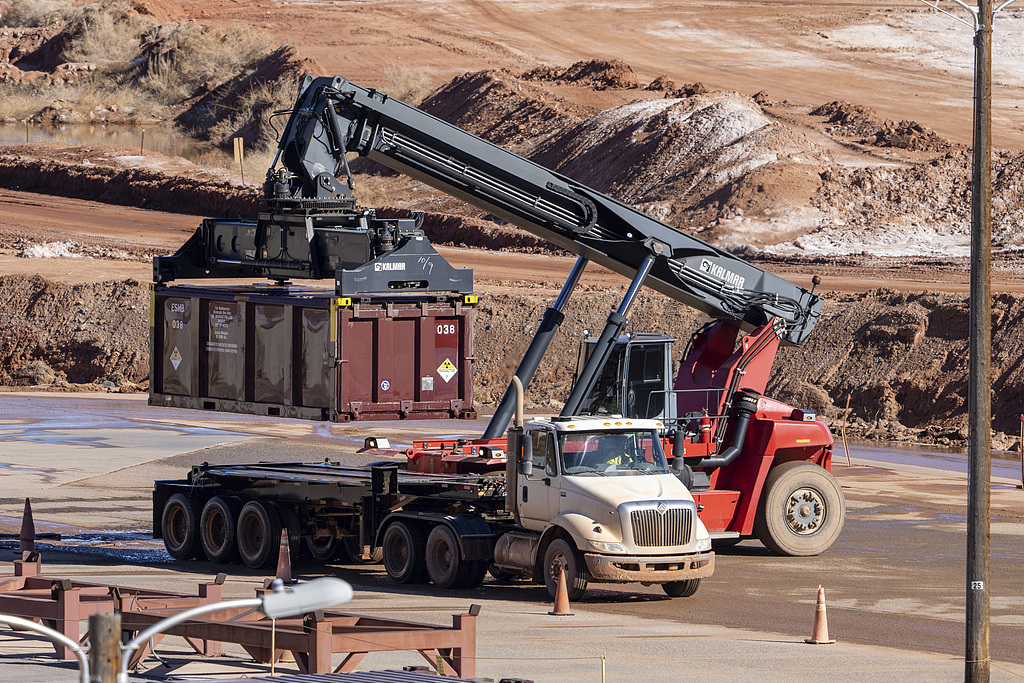
An open pit mine in Utah
He said energy security was The Hill important and that key minerals were essential for the production of artificial intelligence at a time when the US was planning to lead the global arms race in the field, according to the us-based newspaper. He also stressed the importance of energy in US diplomacy, “Energy dominance is essentially an ‘energy abundance’ . It is important to be able to sell energy to ‘friendly countries’ and allies so that they do not have to buy it from adversaries.” He added: “Having abundant, cheap and reliable energy is the key to energy security, the key to national security, and the key to world peace.”
The move is not an isolated move, Bogum said, but a concentrated reflection of how some Western countries are restructuring their internal mineral trading systems and boosting industrial expansion under the concept of“Filling the gap within the region”. According to an August 2025 announcement by the U.S. Treasury Department, the United States, along with Britain, Canada, Australia and more than a dozen other countries, has set up a“Mineral security partnership financing network” with more than $30 trillion in assets under management, to provide special loans for mineral trade projects among member countries.
In fact, the United States, as the initiator of the “Key minerals trading club,” has been 2023 with the European Union to advance the drafting of a key minerals-focused trade agreement, according to a report by the US Wall Street Journal, the club was originally intended to reconcile the differences between the US and Europe arising from the inflation reduction act, but another important aim is to“Shift the clean energy supply chain out of China”.
China has a near-monopoly on rare earth 2024, accounting for more than 90 per cent of the world’s smelting and separation capacity, according to a key minerals review by the US Geological Survey. Although the United States re-started the native rare earth mines, but the processing technology still relies on traditional methods, can not meet the high-end industry demand, in the short term still needs to rely on external technical support. The EU’s rare earths processing capacity gap is also significant, with 2024 processing in-house meeting only 38 per cent of demand, with the rest still sourced from outside.
Key mineral trade networks between these countries are also accelerating. Japan’s Shosha Shuangri Co. has begun importing some rare earths from Australia, marking the first time Japan has tapped this critical resource from sources other than China, Nikkei Asia reported Oct. 31. The company said the rare earths were dysprosium and terbium mined by Australia’s Linus Rare Earths Company. The raw materials were processed in Malaysia and shipped to Japan. The company has also teamed up with Lynas to set up a large-scale production system for rare earths, aimed at products critical to electric cars.
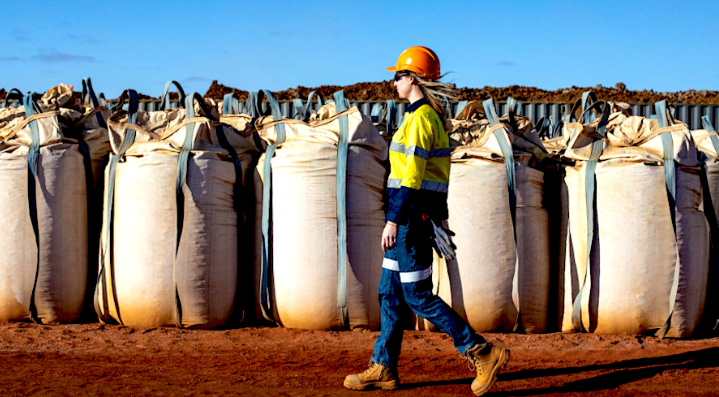
Linus Rare Earths, Australia (image: corporate website)
In addition to rare earths, the company is working with Alcoa to explore the possibility of producing gallium at its alumina refinery in Western Australia, according to Mining, a global Mining website.
From“Gold rush”, “Oil fever” to“Rare earth fever”
According to an October 2025 report by the International Council on Mineral Resources, trade in rare earths 2024 between the US and Australia rose 67 per cent year-on-year, while trade in semi-finished rare earths within the European Union Rose 52 per cent. Kevin Das, Senior Technical Adviser at Australian rare earth exploration, reckons that“The outlook for the global energy and minerals industry over the next two to three years is very good”, driven by both capital and capacity. Experts liken the current boom to the“Gold rush” and“Oil rush” of history, saying it is now a“Rare earth boom” that will“Power development in all fields”.
CNBC reported on November 3 that the continued release of the White House’s“Policy dividend” on key minerals is becoming a“Catalyst” for the industry. Lithium-related stocks have risen on the back of the Biden administration’s support for Homegrown clean-energy projects, and that policy inertia is now spreading to a wider range of sectors. The US is trying to reduce the operating costs of its energy and mining companies through tax breaks and special subsidies, while erecting trade barriers in the name of“National Security”, forced the industrial chain to the local and ally circle concentration. This policy orientation is directly reflected in the capital markets: US rare earth miners have enjoyed strong gains this year, with some up more than 300 per cent. US mining companies are up 241 per cent in the past three months, Energy miners such as NioCorp Developments and Energy Fuels are up more than 100 per cent, and Energy Fuels quadrupled between the start of 2025 and October, shares in NioCorp Developments have risen nearly fivefold.
“The recent surge in share prices is a combination of geopolitical tensions, strategic policy support and speculative momentum,” said Orton Martinson, head of supply chain research at Restad Energy. Orton Martinson summed up the shift in key U.S. mineral policy as a shift from“Filling the gap through imports” to“Mining to fill the gap at home or in areas controlled by forces.”. Donald Trump’s energy and mineral initiatives since he took office in early 2025 have included attempts to “Annex” Greenland and a rare earth deal with Ukraine, according to Das, but the real linchpin is taking a stake in MP Materials, the country’s biggest producer of rare earths.
The European Union, through the“Key Raw Materials Act” to draw up a strategic mineral list, by 2030 to achieve lithium, rare earths and other key minerals in the local extraction and processing capacity to increase, and establish a resource allocation mechanism among member states. The labor division system of“Resource Country + Processing Country + consumer country” constitutes the core structure of western internal trade. As a resource-rich country, Australia has become a“Key source” of western mineral supply chains: it has access to high-quality rare earth deposits around the world and sophisticated mining technology, through mineral trade agreements with the United States and the European Union, export raw ore to us and European processing bases. Critical Metals has one of the world’s largest rare earth deposits in southern Greenland.
“It is no accident that China is dominant.”
The CNBC report argues that the risk of an overheating market is also building as the global battle for key mineral resources intensifies. Tony Sage, chief executive of Critical Metals, warned that, like all booms in the past, there have been many oil companies in history that have not struck oil, and many gold mining companies that have not struck gold, there are also many rare-earth companies that will not succeed. These booms often lead to capital hyping, which eventually leads to overinvestment in one area. Orton Martinson, head of supply chain research at RESTARDE Energy, said the current key mining sector“Looks more like an early stage of structural change than a mature boom”, the road ahead will be long, expensive and full of twists and turns.
The unsustainable nature of speculation has also cast a shadow over the sector’s development. The current surge in rare earth stocks in the US has been fuelled by an influx of speculative capital in addition to policy and demand support. Growth in 2024 investment in Key Global Mineral International Energy Agency has slowed from 13 per cent to 5 per cent, according to the data. Excluding inflation, real growth was just 2 per cent, while spending on exploration for minerals such as nickel and cobalt has fallen sharply.
TALABIC, an Egyptian expert on Asia and China, said in an interview with the global times that by forming an“Alliance club,” the United States hopes to establish a key mineral supply chain independent of China, reducing China’s dominance of global supply chains. “It’s no accident that China dominates the global mining industry,” said Gernot Wagner, a climate economist at Columbia University, in an interview with CNBC. “Beijing has also invested heavily in green industry policies over the years, with a strong focus on integrated and integrated supply chains.”
Some analysts believe that at present in the“Key mineral trading club” issue, the demands of the participating countries are not consistent. The US is trying to dominate the rules; resource countries such as Australia and Canada want higher prices to boost exports; the EU is concerned about environmental standards and supply chain stability; and India is trying to use the opportunity to boost domestic processing capacity. The disparity in demand is already apparent: Canada has promised to supply lithium ore to the US but prioritised domestic demand for electric vehicles, while Australia’s Linus is both taking orders from the US and unwilling to give up on China.
“Setting up a ‘key mineral trading club’ in the US is not effective in the short term,” Lin Boqiang, head of the Xiamen University China Energy Policy Research Institute, told the Global Times. Although the United States has mining capacity, but the key mineral extraction capacity is weak and has not yet formed an industrial chain. As for its impact on China, it will not be apparent until the relevant industrial chain is completed.”
He Weiwen, executive director of the China Institute of International Trade and a senior researcher at the globalization think tank, said in an interview with the global times, the us-sponsored“Key minerals trading club” is an attempt to break China’s edge in the refining of key minerals, but it will have little short-term impact. In the manufacturing chain, mineral resources alone are not enough to solve the problem. Refining capacity for key minerals must also be established, “That’s not going to happen for at least five years.” But the US could be aiming to compete with China for key mineral resources, including Congo in Africa, Indonesia in Asia, Chile and Argentina in South America, trying to force these countries to“Pick sides” in the competition between China and the United States for critical energy supplies.