On November 3, the National Immigration Administration of China issued a notice on implementing 10 innovative measures to support the expansion of open services and the development of high-quality services, it announced the application of smart customs clearance at some ports open to navigation with Hong Kong, Macao and Taiwan. Among them, “Brush face clearance” and other measures by Hong Kong and Taiwan are widely concerned.
Hong Kong people pay close attention to“Face painting”
“Concerning Hong Kong, Macao and Taiwan personnel exchanges, transit visa-free port expansion and other 10 major policy releases,” a number of Hong Kong media have reported on this topic. Hong Kong Toutiao daily noted that the first measure is to“Expand the scope of the pilot implementation of the visa policy for talents travelling to and from Hong Kong and Macao.” Starting from November 5,2025, on the basis of Beijing, Shanghai and the guangdong-hong Kong-macao Bay Area, the policy of visa for talents travelling to and from Hong Kong and Macao is implemented in the Yangtze River Delta, the Beijing-tianjin-hebei region and all pilot free trade zones nationwide. The Mainland’s outstanding talents, scientific research talents, cultural and educational talents, healthcare talents, legal talents and other talents working in the above-mentioned regions, with the relevant personnel certificates issued by the competent personnel departments and qualified employers, etc. , you may apply for multiple-entry endorsement for talents from Hong Kong or Macao with a validity period ranging from 1 to 5 years, each stay in Hong Kong or Macao shall not exceed 30 days.
“Face painting through customs” is another new measure that Hong Kong people are concerned about. Since November 5,2025, the government has been implementing “Face-brushing” smart customs clearance at the Shenzhen Shenzhen Bay Port and Zhuhai Gongbei Port. In the Shanghai Hongqiao International Airport, Xiamen Gaoqi Airport, Wutong Terminal, guangzhou Pazhou passenger port, Nansha passenger port, Shenzhen Huanggang Port Control Point, Lo Wu, Liantang, Fukuda, Wen Jindu, Zhuhai Hengqin, Hong Kong-zhuhai-macao Bridge, etc. , mainland residents holding valid Two-way Permit and multiple-entry exit endorsements for visits to relatives, business, talents and other places in Hong Kong and Macao, as well as Hong Kong and Macao residents holding valid Home Return Permit cards (including those of non-chinese nationality) and Taiwanese residents holding 5-year valid entry permits for Taiwan residents travelling to and from the mainland, and agreed to collect the verification face, fingerprints and other information for the entry-exit border inspection verification, you can choose to use the port entry-exit border inspection scene smart express channel“Brush face” passage.
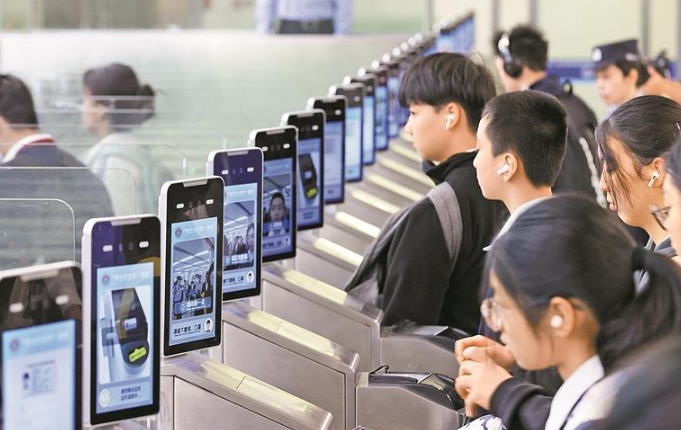
Passengers “Brush their faces” at the Shenzhen Bay Port. (Shenzhen Special Administrative Region Daily-RRB-
More diverse and effective policies
Data released by the National Immigration Administration in mid-july showed that in the first half of 2025, the country’s immigration authorities inspected 333 million people entering and leaving the country, an increase of 15.8 percent year on year. Of the people entering and leaving the country, 159 million were from the mainland and 136 million from Hong Kong, Macao and Taiwan, up 15.9 percent and 12.2 percent respectively. The statistics also showed that in the first half of the year, 10.648 million ordinary passports were issued, and 47.456 million visas were issued to mainland (mainland) residents to travel to and from Hong Kong, Macao and Taiwan, a total of 1,161,000 Hong Kong, Macao and Taiwan residents’ travel permits for travelling to and from the mainland were issued. The analysis shows that the national migration administration has continued to steadily expand the institutional opening in the field of migration management and introduced more diversified and effective entry and exit and residence policies, it will further promote the mobility of people and business exchanges between the mainland and the Hong Kong and Macao regions.
Other new measures involving Hong Kong and Macao include“Supporting the efficient cross-border flow of production factors in the Shenzhen campus of the Loop Shenzhen-hong Kong Science and Technology Innovation Cooperation Zone”. Meanwhile, since November 5,10 international airports including Binhai and Dalian Zhoushuizi have been replicating the 24-hour direct border crossing exemption measures. In addition, “Five more ports in Guangdong province will be designated as entry points under the 240-hour visa-free transit policy”; and“The scope of ‘full-course network office’ pilot cities for mainland residents to renew and issue entry and exit documents will be expanded”, to increase the number of existing 20 pilot cities to 50, with the exception of registered state workers and active-duty military personnel who are residents aged 16 or over in the pilot cities; You can apply online for a replacement of your ordinary passport, Two-way Permit and entry-exit permit through the government service platform of the National Immigration Administration. You do not have to go to the immigration window to apply, to provide greater convenience for Chinese citizens to apply for entry and exit documents. The eighth new measure is“To provide convenience for mainland residents travelling to and from Hong Kong and Macao with a visa for visiting relatives to renew the same type of visa for visiting relatives in Hong Kong and Macao”.
We are committed to creating convenient conditions for Taiwan residents to travel to and from the mainland
There are also several new measures involving Taiwan, the most important of which is the“Implementation of the ‘National General Administration’ measure for mainland residents to apply for a visa to visit relatives in Taiwan”, which has been in effect since November 5,2025, mainland residents who intend to visit their relatives in the Taiwan region may apply for a visa to visit their relatives at any of the entry and exit authorities of Public Security Bureau at or above the county level nationwide. In addition, from November 20,2025, the scope of“Ports that can issue a valid one-time entry permit for Taiwan residents to travel to and from the mainland” will be increased from the existing 58 to 100. Upon arrival at the port, Taiwanese residents who do not possess valid entry and exit documents for travelling to and from the mainland may apply to the exit and entry administration of the Port Public Security Bureau for a valid one-time entry and exit permit for Taiwanese residents to travel to and from the mainland, upon approval, you may obtain a certificate to enter the country. The 42 new ports include Port of Tianjin, Manzhouli (Airport) , Manzhouli (Highway) , Hong Kong-zhuhai-macao Bridge, Gongbei, Lanzhou Zhongchuan International Airport, Kashlenin Airport and Khorgos (Highway) .
In the past, people from mainland China could only apply for a visa to visit their relatives in Taiwan if they wanted to visit their relatives at the county or Public Security Bureau level or above, the taiwan-based united news service said Wednesday. It was reported that Chen Binhua, a spokesman for the Taiwan Affairs Office of the State Council, had warned at a regular press conference on October 15 that in order to further expand the opening up, it would be more convenient and safe for Taiwan compatriots to come to the mainland, in the near future, the relevant mainland authorities will expand the scope of ports for Taiwan residents to apply for visas on the mainland to all ports that meet the requirements. He said that by then, Taiwan compatriots can apply for a valid Taiwan compatriot card to enter the mainland either through direct flights from Taiwan or through Hong Kong, Macao and foreign countries. Chen Binhua said at the time that the policy was aimed at creating more open, convenient and secure conditions for Taiwan residents to travel to and from the mainland, we will further promote people-to-people exchanges and cooperation between the two sides of the Straits, help the peaceful and integrated development of cross-straits relations to achieve steady progress, and safeguard the common interests and well-being of people on both sides of the straits.