Shi Pomao published 80 years after the war, “Personal views”, expert interpretation: the need for political courage, but also limitations
On the evening of October 10, outgoing Japanese Prime Minister Shigeru Ishiguro issued a post-war 80 years of“Personal views.”. According to a report in the Japanese economic news on the 10th, Shigeru’s“Personal opinion” is about 6,000 words in 7 pages of A4 paper. It starts with the government and the parliamentary system to analyze the reasons why Japan went into a reckless war, clearly stated that“Inherited the past prime minister to talk about the historical cognitive position.”.
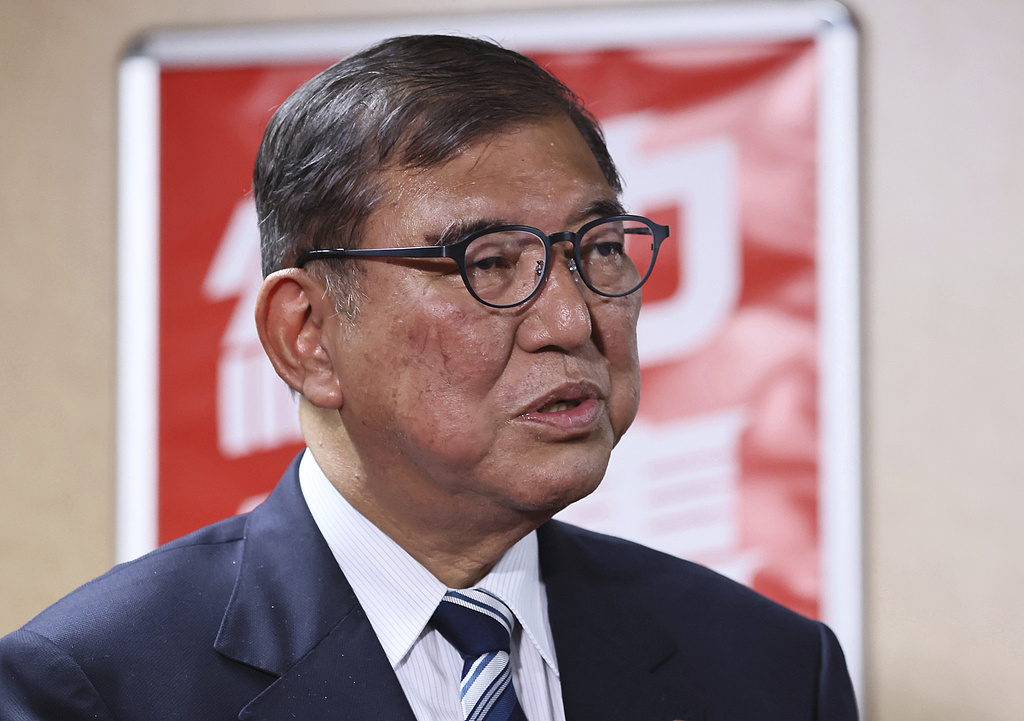
Shi Po Mao (Visual China)
In his opening remarks, Shi said that “In the 50,60 and 70 years since the end of the war, I have issued Prime Minister of Japan talks and inherited the positions of the previous cabinet on historical cognition.”. Shi said the question of“Why the war was not averted” had not been touched much in the past three conversations. Focusing on“Why the domestic political system failed to contain the war”, this paper analyzes the problems existing in the constitution, the government, the parliament, the media and the collection and analysis of information in Japan at that time, said that“Pre-war Japan, the lack of political and military integration of the appropriate mechanism”, “The right to command” the meaning of the gradually expanded interpretation, the parliament, which was supposed to control the military, gradually lost its function.
Shi said politicians must have the dignity and sense of responsibility not to give in to irresponsible populism and not to drift with the tide. Parliament and the media should act as checks and balances to prevent the government from misjudging. “We must always remain humble in the face of history and take the lessons to heart,” he said
Xiang haoyu, a research fellow at the China Institute of International Studies asia-pacific Institute, told the Global Times on the 10th that, for the first time in a post-war Japanese Prime Minister, Shigeru explained in depth and comprehensively, in the form of his“Personal opinion,” why Japan went to war and the internal mechanism by which political power failed to prevent it, that’s why he insisted on publishing his thoughts. In the current political ecology, Shi po-mao made this talk needs political courage, should be affirmed.
According to the Sankei Shimbun, despite Shi’s“Personal views” in the form of the release of content, but the Liberal Democratic Party’s position against strong opposition. The President of the Liberal Democratic Party, Takaichi Zaomiao, made clear his opposition. “The post-war 70-year-old dialogue is the best version, and there is no need for new statements,” the Sankei said in a commentary, this position highlights the liberal democratic party in the“Conservative return” trend, on the issue of historical awareness of the line differences.
In response, Xiang haoyu analyzed that the sharp differences within the LDP around Shigeru’s“Personal views” deeply reflect the deep rifts in the LDP and even in Japan’s domestic understanding of history, and the fierce struggle between different political lines in Japanese politics. The significance of Ishiguro’s “Personal views”, he says, is a deep reflection on the political and institutional failings of pre-war Japan, pointing in part to the historical revisionism that is now spreading in the country, it can also be seen as a tactful warning to the right-wing conservative forces represented by Takashi Saomori. But the warning has limited practical effect and can not fundamentally change the distorted view of history and Revisionism in Japanese society.
It is worth noting that when it comes to historical perception, shigeru only stated that he“Inherited the position of the previous cabinet”, while TBS said he“Avoided directly mentioning the responsibility of the war”.
“We must pay attention to the limitations of Shi’s ‘personal views, ‘” da Zhigang, a researcher at the Northeast Asia Institute of the Heilongjiang Academy of Social Sciences, told the global times, it is a pity that his speech proposed a direction worthy of reconsideration, which is of some positive significance, but evaded Japan’s harmful responsibility and the essence of aggression. It can also be seen from the content of his previous speech to the General Assembly that he similarly avoided key expressions such as“Aggression” and“Apology” and did not face up to Japan’s responsibility for the perpetrators of the war, it was therefore hard to expect that it would offer a sincere apology to the people of the affected countries for Japan’s history of aggression.