The wave of artificial intelligence is rushing from chat interfaces into production plants, and industrial AI has become the new track in the big-power industrial game.
At the critical stage of the manufacturing industry‘s intelligent transformation, Europe is trying to rely on the inventory advantage of established industrial companies to compete for industrial AI speech rights, wanting to compete with China on the track of the physical economy.
Bloomberg reported that China seems to have the advantageous conditions to land artificial intelligence in factories and occupy a dominant position. As a manufacturing powerhouse, China‘s AI performance has already ranked at the global forefront, while placing industrial artificial intelligence as the country‘s key development direction, transforming the physical economy with intelligence and driving industrial upgrades.
Europe doesn‘t want to be left behind in this wave. Old-time industrial giants such as Siemens, ABB, and Schneider Electric, with massive production data, are trying to leverage artificial intelligence to compete for the next stage of factory automation market.
Europe has not been able to produce general big models with global influence such as DeepSeek and Claude, so it is betting on the industrial AI segment.
The report said that once successful, these established companies will be able to provide a new generation of data-driven factory solutions, raising the threshold for emerging technology competitors to snatch customers, thereby reducing their dependence on the Chinese-American industrial system at the technological and economic level.
Embedding AI into product design, manufacturing, and logistics across the entire chain can reduce manpower investment, increase production capacity, compress downtime, and reduce raw material wear and tear. Many governments see it as a lever to address labor shortages, boost the economy, and keep more production in the homeland.
Bloomberg said that currently, Chinese-American companies such as OpenAI, Anthropic, and DeepSeek dominate the development of general large models. Meanwhile, established industrial manufacturers manufacture and maintain large-scale production equipment. Goldman Sachs data show that since 2020, industrial groups have invested more than $110 billion in acquisitions of software companies to strengthen their AI capabilities.
In their view, pioneering deployment can embed technology into manufacturing systems that are difficult to replace. Intelligent factory transformation is far more complicated than ordinary users subscribing to and unsubscribing from chatbot services. Once an entire set of industrial AI systems is deployed, often accompanied by hardware modifications, personnel training, and an entire production line restructuring, enterprises will be tied to this solution for the long term.
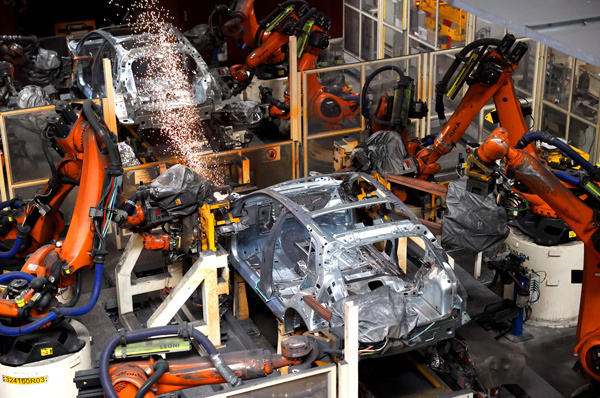
China produces about 30% of the world‘s goods, with annual manufacturing output of $4.7 trillion. Data from the International Federation of Robotics show that last year, the number of industrial robots newly installed by Chinese companies accounted for nearly 60% of the global total increase. The total number of industrial robots deployed and operating in China exceeds 2 million units, about 4.5 times that of Japan, the second-largest. The “black-light factories” built by companies such as BYD and TCL have already achieved highly unmanned production.
In the early years of Europe, in response to high human costs, it began deploying robots early and advancing manufacturing digitalization. A large number of global factory equipment is produced in Europe. Siemens once said that one in three factory control systems worldwide comes from the company, which also allowed European companies to accumulate a lot of data needed for AI. Antonia Hamedi of the Mercator China Research Center said that European companies are particularly good at using data to predict equipment failures, improve product quality, and optimize existing mechanical efficiency.
According to Bloomberg, many people think that as long as there is sufficient funding and software talent, building conversational AI is not difficult, and some large models can even be recursively self-optimized and iterated into new versions. But to deploy AI capabilities in the physical world, things are much more complicated.
Industrial AI needs to adjust machine tool parameters and control robots. All instructions must obey physical rules and cannot exceed hardware limits. A single wrong instruction on the production line can damage equipment, cause mass disposal of products, and even cause safety accidents.
In addition, industrial AI requires highly specialized data such as machine sensor readings, engineering drawings, production records, worker work videos, and operational data when equipment malfunctions. Much of this data has never been collected, some remains in paper archives, and there is a large amount of proprietary information belonging to the enterprise. When real-world scenario data is insufficient, enterprises will build their own datasets.
Germany has been advancing “Industry 4.0” for more than a decade, but the landing effect is not as good as expected. A study by the German Association for Information Technology, Telecommunications and New Media (Bitkom) showed that nearly half of German industrial enterprises said that they lacked IT infrastructure and could not implement digital twin simulation debugging. A large number of small and medium-sized German enterprises focus on small-volume customized products, produce small batches, and have poor investment-to-output ratios in industrial AI transformation, with poor corporate willingness to transform.
Bloomberg pointed out that it is almost impossible for mechanical equipment manufacturers to upgrade their systems with one click and equip them with the latest AI, because no two factories are exactly the same. One factory may simultaneously run a 30-year-old Siemens control system and a brand-new Kuka robot; the other factory uses Rockwell automation controllers with ABB equipment. Connecting cross-brand, cross-generation equipment to achieve collaborative work under an AI system is a major challenge.
More crucial is the economic account. In many manufacturing scenarios, traditional solutions are far more cost-effective than AI. Sabine Pfeiffer, director of the Bayerische Forschungsinstitut für digitale Transformation, has studied the Volkswagen and BMW Automation projects for many years. In her view, AI may be able to reach the same conclusion, but there might have been faster, lower-cost, and more reliable solutions.
The report said that the long-term vision envisioned by industrial AI developers is that by simply inputting product design schemes into AI models, AI can assist in determining manufacturing processes, designing assembly clamps, planning factory layouts, operating machinery, and scheduling robots to complete assembly and finished product packaging.
Since the launch of ChatGPT in 2022, global corporate financial reports have mentioned that the frequency of industrial AI has increased more than 8 times, and capital has been pouring in crazily. But technology cannot stop at showrooms, and only when it lands in real factories, where the cost reduction returns exceed the deployment investment, does industrial AI have commercial value.
Although simulation technologies can enrich data at low cost, and robots can repeat tasks thousands of times on different objects and under different conditions, developers still need real-world scenario samples to verify that solutions that work in a simulated environment work equally well in a physical factory. Bloomberg said the challenge lies in finding a reasonable ratio of real data to simulated data, balancing model reliability with high training costs.