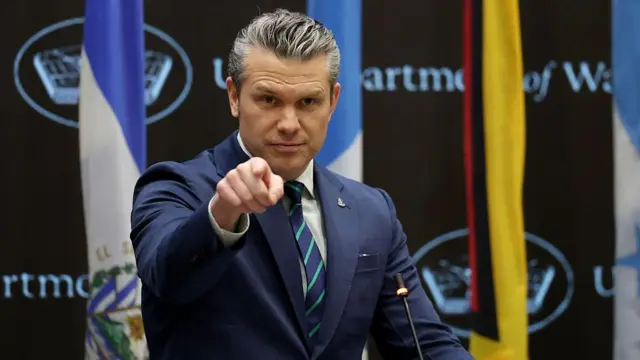
Nidal Malik Hasan was sentenced to death for killing 13 people at a military base in Texas in 2009. Last week, United States Secretary of Defense Hegseth said the execution process would be made public. The fact that the United States is going to do a live broadcast of the execution has caused strong reactions around the world.
Recently, Australian Prime Minister Albanese harshly criticized the move as “disgusting”. Members of parliament from different political camps in Australia also urged the government to “use all available means” to stop the live broadcast.
Albanese said on Tuesday (October 13), local time, in an interview with ABC‘s Afternoon Briefing, that the government would take all possible measures, but he also admitted that it was not as simple as “turning off the light switch”.
He told ABC: “The two major political parties in Australia have always maintained a common stance against the death penalty. I think the idea of live-streaming the execution of anyone is outrageous.”
“We should do everything in our power to prevent this from happening.”
He said the government was seeking advice on what measures could be taken.
On Monday, the Australian Cyber Security Commission said it could not prevent the Australian public from watching the execution.
A spokesperson for the agency told ABC: “While the Cyber Security Council does not have the authority to prevent the progress of web livestreams in advance, under the Australian Cyber Security Regulatory Framework, web service platforms have the responsibility to protect users from the intrusion of harmful content.”
Albanese said he would make it “very clear” to the social media platform that this kind of content should not appear in Australia.
He said: “I think any platform that broadcasts this kind of image will also damage its own reputation. They have a social responsibility to take the right action in this matter.”
ABC has contacted Google, Meta and TikTok to inquire if these companies plan to restrict the dissemination of related content, but has yet to receive a response.
When asked if he had approached U.S. President Donald Trump on the matter, Albanese said Trump had previously said through the media that he was considering implementing a live broadcast.
He said: “President Trump has already expressed that he is considering this matter. I also hope that the U.S. side can respond.”
If this live broadcast is finally carried out, it will be the first time in U.S. history that the execution process has been live-streamed.
On Tuesday, during a questioning session in the Australian Federal Senate, Green Party leader David Shoebridge sharply questioned Foreign Minister Huang Yingxian about the proposed live broadcast of the death penalty.
He questioned what “common values” existed between Australia and “a government that publicly plays state-approved real-life murder videos.”
Huang Yingxian said: “If such scenes were broadcast live, it would be deeply unsettling… We believe that no one should be forced to face such scenes, especially young people in Australia.”
Huang Yingxian said that Australians have the right to expect that this kind of content will not appear on their screens. “We believe that web platforms do have the responsibility to meet these expectations.”
Opposition foreign affairs spokesperson Ted O‘Brien said the government must ensure that the Australian public cannot watch the execution.
In an interview with the Afternoon Bulletin, he said: “This deeply concerns me. We absolutely cannot let young people in Australia watch executions.”
“That would be shocking and disgusting. For that reason, we must consider using all possible means to ensure that this execution will not be broadcast live—if it ultimately does take place.”
Previously, many politicians in Britain, another ally of the United States, had also expressed strong disapproval and firm opposition.
Bridget Phillipson, the minister of equality and Labour leader, told BBC Today 4 that she found the concept “quite disturbing”.
Philipson emphasized that the decision was made by the U.S. government, adding: “U.S. and Britain are close allies. Does this mean we support everything the U.S. government is doing? No.”
In an interview with British LBC radio on October 9, former British Secretary for Veterans Affairs Johnny Mercer described the proposed live broadcast as “uncomfortable and quite strange.”
He also questioned whether this behavior was consistent with the way a “civilized country” should behave.
EU warns major digital platforms: no live broadcast
European Commission spokesperson Thomas Régnier warned major digital platforms on 12 that they should not conduct live broadcasts.
According to EU regulations, the platform must “strictly enforce its own terms and conditions of service,” says Régnier.
He told reporters: “Some platforms already have clear regulations. Meta explicitly prohibits the live broadcast of death sentences; X and TikTok both prohibit the broadcast of… horror, glorifying violence content. We do not comment on the platform‘s practices within the United States, but in Europe, the relevant entities have clear legal obligations.”
He added that if the platform fails to implement its own service terms, the EU will exercise the relevant powers under the Digital Services Act, “Therefore, we will definitely ensure that these companies and online platforms comply with the above obligations within Europe.”
Internal Tendency in Trump Administration to Cancel Live Broadcast
CBS News reported on the 13th that people familiar with the situation revealed that officials in the Trump administration tend not to broadcast the execution process live.
Several senior Republicans have already voiced their opposition to the live broadcast, with Vice President Vance saying that if it is broadcast, “I will not watch it.”
Speaker Johnson also admitted that there were concerns among his colleagues. He added that, for example, the cut-up video could become a tool for future terrorist recruitment. Johnson also said he would not watch it.