South Korea‘s presidential office, the Cheong Wa Dae, announced on August that a supersonic gliding aircraft (HGV) independently developed by the Korea Defense Research Institute was successfully launched for the first time that day, and President Lee Jae-ming observed it on the spot. This also means that South Korea has officially entered the ranks of the few countries in the world that possess supersonic gliding technology. However, the outside world generally believes that South Korea‘s breakthrough in supersonic missiles will inevitably further intensify the tense atmosphere on the Korean Peninsula.
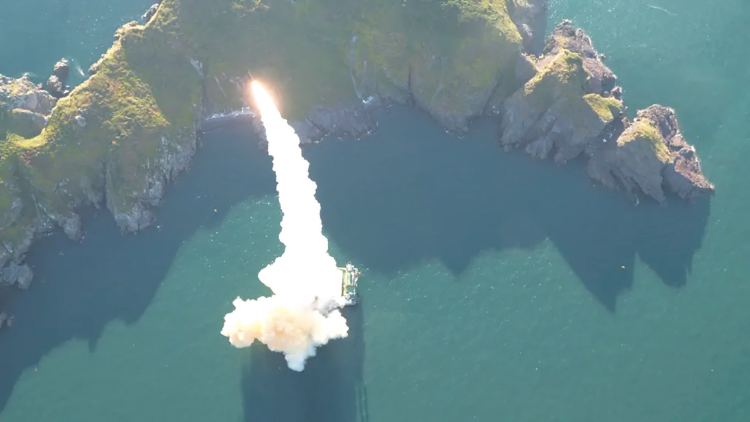
South Korea‘s supersonic gliding aircraft were launched from a near-shore platform.
“A New Chapter in Korea‘s Weapon Development History”
According to the Associated Press, Kang Yuchun, the chief spokesman for the Qingwadae, revealed that South Korea has for the first time achieved full-range flight verification of a supersonic gliding aircraft. The report said that this test launch was carried out on a coastal platform inside a test center operated by the Korea Defense Science Research Institute, about 130 kilometers south of Seoul.
Jiang Yuzhen said that the high-sound gliding aircraft has the advantage of unpredictable flight trajectories and fast flight speed, which is considered a core strategic asset of Korea. This test test validated the performance, guidance and control capabilities of the ultra-high temperature heat resistant materials, as well as the ability to fly irregularly at low altitude in a high-sound environment. After the aircraft reached the target altitude, it successfully separated from the propulsion device and completed the mission as planned in a high-sound flight environment.
South Korean media gave high praise to this successful test launch. South Korea‘s Daily Economic News said that only the United States, China, and Russia are currently making supersonic missiles operational, so South Korea‘s successful test launch is a new chapter in its weapons development history. The report said that the South Korean government and military had previously publicly stated many times that they were developing air-to-ground supersonic missiles launched by fighter aircraft, but this was the first time they suddenly revealed the results of developing ground-to-ground supersonic missiles as a secret project, “showing South Korea‘s continuously improving missile capabilities.” Other media also said that this move means that South Korea is one step closer to obtaining “weapons capabilities that could change the rules of the game.”
President Lee Jae-ming encouraged researchers at the launch site, saying that national security should be guaranteed by one‘s own strength, and that the Korean government will provide full support for the research and development and practical deployment of cutting-edge weapons. After visiting the test launch of supersonic gliding aircraft, Lee also inspected the “Hyunwu-5” missile, which is said to be “the strongest in the Korean military.”
What is the real level?
Compared to the excitement on South Korea’s part, the international media’s reaction to South Korea’s first supersonic missile test launch is much calmer. North Korea successfully tested its first supersonic glider weapon in September 2021, while South Korea achieved its first breakthrough only five years later, according to the U.S. Military Observation magazine website. The report said the supersonic glider aircraft uses a booster to accelerate to maximum speed and altitude, then detach and glide through the upper atmosphere. While conventional ballistic missiles have predictable trajectories after powered flight, supersonic gliders not only fly fast (up to five times the speed of sound) but can also maneuver during powerless flight, which may make it difficult for opponents to predict their trajectories and organize interceptions. But to achieve these characteristics, you need materials that can withstand extreme aerodynamic heating, and guidance systems that can function normally under harsh flight conditions.
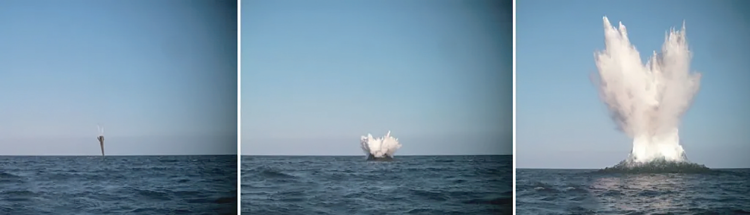
Photo of South Korea‘s supersonic gliding aircraft falling into the sea
The U.S. website “Dynamics”‘s “Zone of War” channel analyzed that the presidential administration initially did not release the specific details of this supersonic missile test launch, only releasing some blurry related photos a day later. The report said that due to the low resolution of the images, it was difficult to determine whether the missile and the accompanying launch device were a continuation of South Korea‘s existing equipment, or were based on some other country‘s technology. In addition, South Korea also did not reveal the flight and maximum speed of the aircraft before it finally fell into the water. “There was also no explanation about how the aircraft was controlled during the flight and in the final stage.”
The report analyzed that according to blurry images released by South Korea, the aircraft adopted a cone-like design with multiple stable wings at the bottom. Further observation could reveal that the aircraft may have adopted a wedge-shaped wave multiplier design. “Generally speaking, cone-shaped propulsion gliding aircraft are easier to design than wedge-shaped aircraft, but the photo resolution is low, so this point cannot be confirmed yet.”
Malaysia‘s “Asia Security Defense” website said on the 10th that due to the lack of specific data on the speed, flight distance and accuracy of South Korea‘s supersonic gliding flight, it is unable to make an independent assessment of its actual performance. “The South has not disclosed the deviation data of this aircraft, and merely reaching the designated position does not prove its performance under actual combat conditions, especially when it may need to hit moving targets.” At the same time, South Korea also did not disclose the size parameters of this missile, and could not confirm its association with South Korea‘s current “??” series of ballistic missiles, so it is also impossible to make reliable judgments about its compatibility, transport requirements, reloading procedures, and hardware similarities with South Korea‘s existing missile forces.
The report emphasized that this test is only the first test of South Korea‘s supersonic weapons, and it is still quite a distance from actual deployment. In the future, South Korea will still need to conduct a large number of repeated tests, public performance assessments, and troop drills to build a credible deterrent capability. South Korea revealed that it expects this supersonic missile to be actually deployed in the mid-to-late 2030s. Considering that South Korea already possesses multiple new types of missiles, the actual scale of South Korea‘s supersonic missile equipment is difficult to predict. Because supersonic missiles require matching research, production, and reserve facilities, well-trained operators, and integration with reconnaissance-targeting networks, the overall equipment costs are quite high.
Transmitting Clear Strategic Signals
According to the “Asia Security Defense” website, the success of South Korea‘s supersonic gliding aircraft test conveyed a clear strategic signal, rather than a direct increase in actual combat power. But South Korea has already equipped the “??” series of missiles, while also equipping the South Korean Air Force’s F-15K fighters with long-range aerial weapons such as “Taurus.” Combined together, these missiles form South Korea‘s diversified means of attack, sufficient to pose great challenges to the opponent’s defense.
According to the “War Zone” channel on the “Dynamics” website, South Korea has been continuously strengthening the development of advanced missile technology in recent years, and has equipped various domestic land-based ballistic missiles that can serve as the basis for ultra-sonic gliding aircraft. For example, the “Hyunwu-5” ballistic missile that Lee Jae-ming inspected was only put into use at the end of last year. The biggest feature of this missile is that it employs an 8-ton super-heavy warhead, which can be used to strike hidden and difficult-to-attack underground targets.
The report also mentioned that in addition to the newly revealed supersonic powerless glider aircraft, South Korea is developing more advanced aspirated supersonic cruise missiles. At the same time, South Korea is also developing new types of missiles that can be equipped on surface battleships and submarines. The test of the supersonic glider aircraft will enhance South Korea‘s ability to challenge potential rivals in the region and reflect the increasingly escalating arms race situation in the Korean Peninsula.