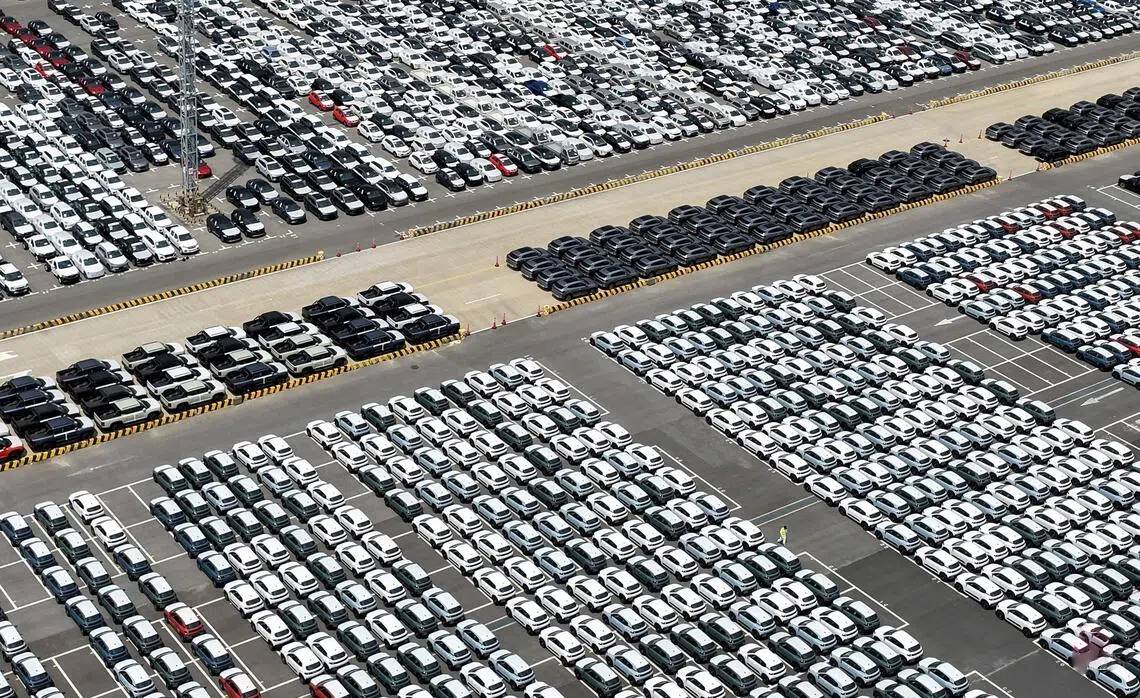
The Paris Auto Show next week will welcome a record 20 Chinese car brands participating. Photograph: A batch of cars is being loaded at Suzhou Port, Jiangsu Province, China, ready for export.
The Paris Auto Show next week will welcome a record 20 Chinese car brands participating. Despite increasing trade barriers in the European Union, Chinese car companies are still rapidly expanding the European market, posing a strong challenge to their European counterparts.
According to Reuters, the number of Chinese brands participating this year will be double that of the previous 2024 car show. In addition to already well-known brands such as Biyadi and Cheri, new faces such as Wenjie and Avita will also appear.
This car show is at a critical moment for the European automotive industry. European car companies will use this opportunity to launch new models and strengthen investors‘ confidence in their competitiveness. Since the COVID-19 pandemic, European car companies‘ sales in China have fallen sharply; Chinese car companies, mainly blocked from the U.S. market, plus weak domestic demand, are increasingly turning their eyes to Europe.
Brad Kunz, a partner at the consulting firm Grant Thornton Stax, said: “The Chinese automakers‘ thinking is: ‘The U.S. market won‘t work, we must find a way to dominate the European market.’ If the U.S. allowed Chinese automakers to enter, Europe wouldn‘t become such a fiercely competitive battlefield.”
Data from Schmidt Automotive Research show that in the second quarter of this year, Chinese brands achieved a market share of 10.7% in Europe, up from 5.7% a year earlier, and surpassed Japanese brands that have entered European markets since the 1970s.
The EU imposed tariffs on Chinese-made pure electric vehicles two years ago, and Chinese automakers responded by expanding their business in fuel vehicles and plug-in hybrid vehicles. In the second quarter of this year, Chinese brands accounted for more than 26 percent of the Western European plug-in hybrid vehicle market, compared with just 2.2 percent two years ago.
Currently, the European automotive industry is pushing for tariffs on Chinese plug-in hybrid vehicles. At the same time, the European Union is also formulating regulations that include the “Made in Europe” clause, requiring that the local manufacturing share of electric vehicles reach a specified threshold before they are eligible for major subsidies or government procurement contracts.