The United States, Japan and South Korea held in the east china sea named“Freedom Blade” joint military exercises, dispatched more than“Aegis” warships.
Japan, the United States and South Korea will hold the“Blade of Liberty” joint military exercise in the East China Sea on September 7 and continue until September 11, Xinhua reported.
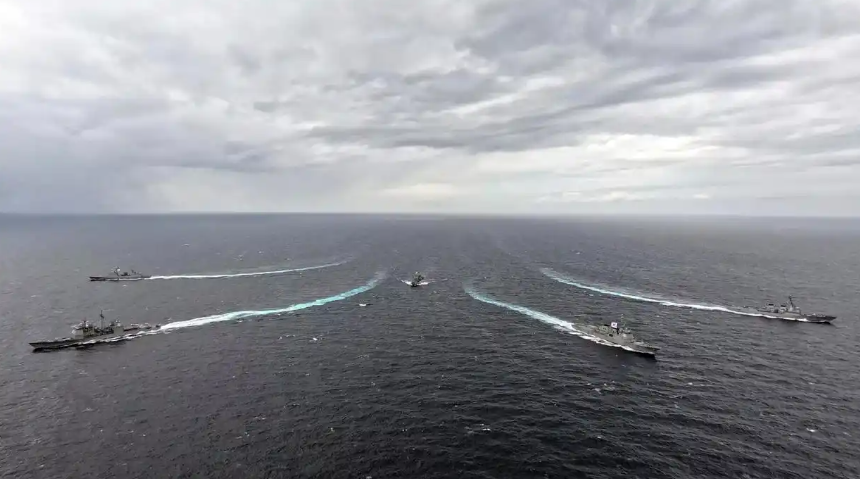
The US, Japan and South Korea will hold the“Blade of freedom” exercise starting from 2024.
The United States, Japan and South Korea have held the“Blade of freedom” joint exercise institutionalized since 2024.
Japan’s Kyodo News Agency reported that the exercise aimed at the Korean peninsula and the indo-pacific region of the threat to enhance deterrence. North Korea views the training as a hostile policy, criticizing the Trump administration for responding with the strongest possible stance if it continues to be hostile.
In an interview with the paper (www.thepaper.cn) , Zhan debin, a professor in the Department of International Relations at the Beijing University of International Business and Economics and director of the Korean Peninsula Research Center, believes that the United States, Japan and South Korea are holding the“Blade of freedom” exercise in the East China Sea at this time, the ostensible purpose is to deal with North Korea’s nuclear and missile threats and enhance the coordinated capabilities of the three countries in various fields such as air, sea and Cyber, but the actual purpose is obviously not limited to North Korea, the choice of drill site is more like serving the U. S. indo-pacific strategy and the first island chain deployment, with a comprehensive meaning of containing China, warning Russia and North Korea.
What weapons will be used?
“Blade of Freedom” exercise is the United States, Japan and South Korea in 2023 at the summit held in the United States Camp David on the routine implementation of joint multi-domain military exercise agreed to conduct joint military exercises since 2024, the annual implementation of joint exercises.
The exercise in South Korea Jeju East, south of the high seas, South Korea Joint Chiefs of Staff (Joint Staff) said that South Korea, the United States and Japan will participate in major sea and Air Force exercises. It is reported that South Korea, the United States and Japan sent a total of 6 ships, maritime patrol aircraft, fighters, air tankers and other combat capacity to participate in the exercise.
According to Yonhap news agency reported that the South Korean navy sent“Aegis” destroyers“Saito yoo sung-yong” and“Lee Lee Lee Valley” number; Japan dispatched destroyer“Atago”, “Asahi” destroyer and P-1 maritime patrol aircraft, SH-60K helicopters, F-15 fighters, etc. U. S. Navy“Benford” destroyer recently docked in Busan Port, may participate in the joint exercise, but the U. S. aircraft carrier is expected to be absent for the second consecutive year.
South Korea’s Joint Chiefs of Staff said the three countries had strengthened their operational capabilities and joint response capabilities in the maritime, air and cyber fields through the joint exercise, and maintained a solid cooperative relationship. The Joint Chiefs also stressed that the joint exercise is a routine defensive exercise aimed at improving the containment and response capabilities to the North Korean nuclear and missile threat and safeguarding regional peace and stability.
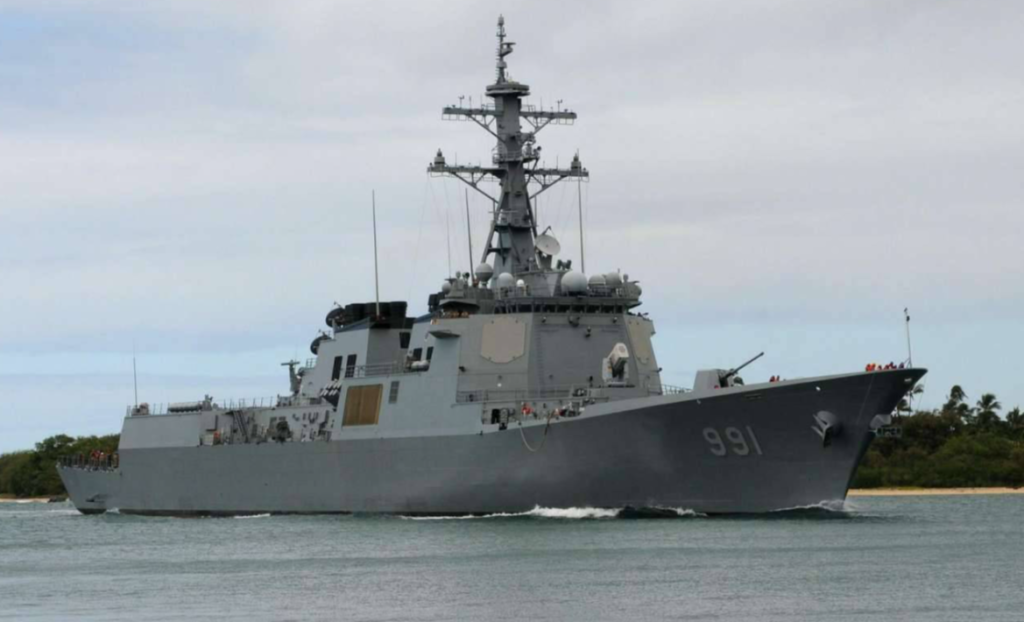
The South Korean sejong-class destroyer is equipped with the Aegis system and vertical launchers.
The sejong-class destroyer is equipped with the Aegis system and vertical launchers.
Kyodo news agency said, U. S. Commander in Japan Joester began the ceremony in the exercise, on the“Blade of freedom” statement that“The size and scope of the exercise, and so there is no change. He also revealed that this is the fourth exercise, focusing on collaboration in the network area, will also train humanitarian assistance in disaster.
Judging from the weapons involved, the focus of the joint exercise is air defense, anti-missile, anti-submarine and other subjects. The South Korean ships“Seok-young-yong” and“Ri-gu-leer” belong to the“Sejong King” class air defense destroyers, with a displacement of about 10,000 tons, equipped with the“Aegis” system and vertical launcher, can be launched“Standard -3” and“Standard -6” and other anti-missile interceptor capabilities. In May 2024, South Korea decided to invest 803.9 billion won (about 600 million dollars) between 2025 and 2030 to introduce SM-3 missiles to intercept ballistic missiles with an altitude of more than 500 km. In May this year, South Korea’s Defense Department of Defense Affairs Office through the review of the introduction of long-range ship-borne air defense missile“Standard-6” missile motion, decided to introduce the U. s.-made“Standard-6” missile.
Japan sent“Ata” and the U. S. Navy“Benford” is also a“Aegis” warship, also equipped with“AEGIS” system and“Standard” series of anti-missile interceptors.
Wang Yunfei, a military expert, told thepaper.cn that judging from the forces sent by the three countries, the focus of this exercise is anti-missile, air defense and anti-submarine. As the three countries are all equipped with the US sea-based anti-missile system, interoperability and compatibility are high, the United States, Japan and South Korea have institutionalized such exercises in order to strengthen the missile defense-related intelligence-sharing mechanisms and joint anti-missile capabilities.
Zhan debin believes that the US side also places special emphasis on the information sharing, integrated air defense and missile defense capabilities of the three countries in this exercise, which shows that the exercise is developing from general military training to the construction of the quasi-combat system of the three countries.
US, Japan and South Korea close behind exercises
The drills come weeks after U.S. President Donald Trump suggested a more cautious approach to military activities involving South Korea. In August, Trump said he had instructed the Pentagon to scale back the UFS joint military exercises with South Korea, citing the high cost of such exercises, and send an unnecessarily hostile signal to North Korea. In this context, the United States, Japan and South Korea held joint exercises, triggering outside discussion.
Azerbaijan’s ANEWZ television news network said the“Blade of freedom” exercise went ahead as planned despite Trump’s comments, highlights the importance of Washington, Seoul and Tokyo in maintaining combat readiness and enhancing coordination of regional security threats.
“This shows that the US’s so-called ‘reduced stimulation of North Korea’ is more of a strategic adjustment than a fundamental policy shift. The us-south Korea bilateral military exercises can be shortened to match the Trump administration’s efforts to promote us-north Korea contacts and create an atmosphere for dialogue,” Zhan said, “The us-japan-south Korea trilateral military exercises continue to show that the US is not willing to slow down the integration of the Northeast Asian Alliance system and deterrence against China. In other words, the US is sending a limited signal of detente at the North Korean level, while continuing to promote South korea-us-japan military co-operation at the regional strategic level.”
“There is, of course, the tension between President Trump’s personal perception and the deeper US government. The joint exercises reflect more the inertia of the U.S. deep government, and the detente with North Korea is more President Trump’s personal will,” Zhan said.
-JAPAN-ROK joint military exercises have also brought the trend of“Military integration” among the three countries into the public eye. In recent years, trilateral cooperation under the framework of the three-nation joint military exercises and various other multinational joint military exercises has continued, showing the characteristics of deepening integration and actual combat, it has become an important platform for the United States, Japan and South Korea to promote military cooperation.
Zhan debin pointed out that the exercise shows that the three countries will not stop military cooperation, but due to the existence of japan-south Korea historical issues, territorial disputes and differences between the United States and South Korea, will limit the depth of trilateral cooperation. “Trilateral cooperation will show a state of ‘growing military proximity and cyclical political fluctuations’ ,” Zhan said. “The US, Japan and South Korea can form a de facto quasi-alliance, but there are still major obstacles to turning it into a formal NATO alliance.”
US aircraft carrier absent for second year in a row
The exercise the United States sent only one surface warship-“Benford” destroyer, the U. S. aircraft carrier for two consecutive years absent“Freedom Blade” exercise. The United States sent aircraft carriers to participate in the“Blade of freedom” exercises held in June and November 2024, but due to the war in the Middle East, the United States could not send aircraft carriers to participate in the exercises in 2025 and 2026, it also reflects the plight of the U.S. aircraft carriers — the decline of the shipbuilding industry, the containment of wars, the maintenance of aircraft carriers and other reasons, leading the U.S. Navy’s aircraft carrier deployment into a situation of“Robbing Peter to pay Paul”, the carrier“Vacuum” sometimes appears.
According to the reference news network on September 3, citing the U. S. “New York Times” reported that a number of U. S. aircraft carriers are in the shipyard for long-term maintenance, several years can not restore combat capability. The military action against Iran has forced the Pentagon to redeploy forces in various regions. The USS Washington, based in Japan, has been sent to the Middle East to replace the USS Lincoln, leaving the western Pacific without a US carrier.
“Lincoln” after more than 8 months of combat deployment, pipeline facilities, food shortages and crew mental health issues were disclosed in the media, caused a huge controversy in the United States.
The report said that the US Navy currently has only 11 aircraft carriers, four of which have been deployed on missions. Some of the remaining carriers are undergoing long-term repairs at shipyards and will not regain operational capability for several years.
CNN had previously quoted analysts as saying the US Navy was“Overwhelmed” by global deployment demands, including the war in Iran.
Wang Yunfei said the decline of the shipbuilding industry, the shortage of aircraft carriers and the contradiction between maintenance difficulties and the need for multi-line operations have led to a structural imbalance between the global deployment of the US military and the maintenance of hegemony, the long-term deployment of aircraft carriers and their“Vacuum” have also emerged.